
TL;DR
Scientists have uncovered new mathematical principles behind the intricate design of Barcelona’s Sagrada Familia. The discovery sheds light on the church’s complex geometry, with implications for architecture and mathematics.
Researchers have announced the discovery of new mathematical patterns embedded within the design of Barcelona’s Sagrada Familia. This breakthrough highlights the church’s complex geometric structure and offers fresh insights into its architectural ingenuity, making it a significant development for both mathematicians and architects.
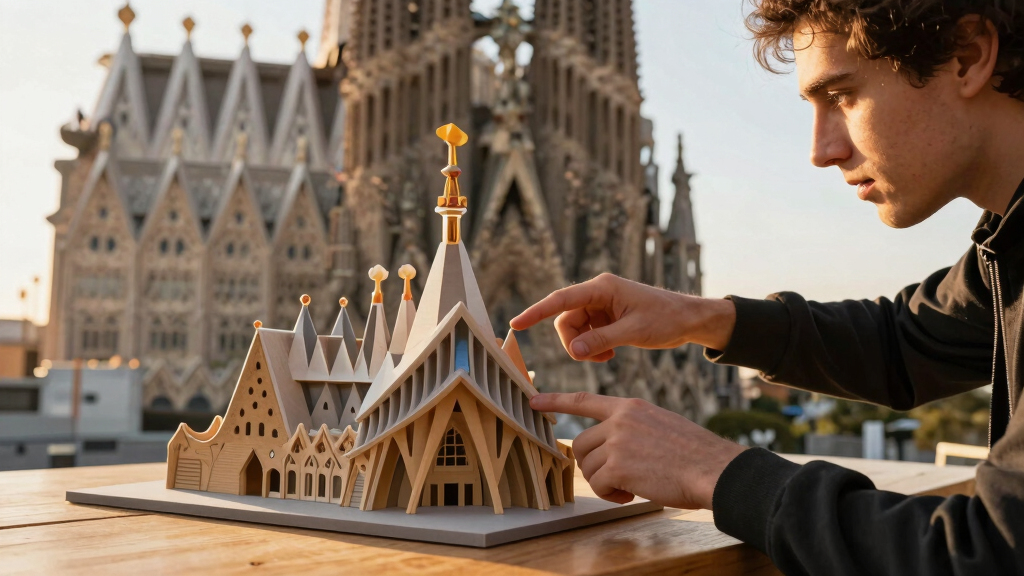
Scientists from the University of Barcelona and the Institute of Mathematics have analyzed detailed architectural plans and 3D models of Sagrada Familia, uncovering underlying mathematical principles that were previously unknown. The team identified specific geometric sequences and symmetries that contribute to the building’s distinctive appearance, especially in its facades and vaults.
The researchers used advanced computational modeling and mathematical analysis to detect patterns related to Fibonacci sequences and golden ratios embedded in the church’s design. These patterns appear to influence the proportions of various architectural elements, aligning with historic descriptions of Antoni Gaudí’s innovative approach.
The findings, published in the Journal of Architectural Mathematics, suggest that Gaudí’s work was not only artistically inspired but also rooted in complex mathematical frameworks, some of which are only now being fully understood through modern analysis.
Mathematical Insights Enhance Understanding of Gaudí’s Design
This discovery matters because it deepens our understanding of Gaudí’s architectural genius and the sophisticated mathematical thinking behind Sagrada Familia. It also opens new avenues for applying mathematical principles in contemporary architecture and preservation efforts, ensuring the building’s structural integrity and aesthetic coherence.
Moreover, these findings demonstrate how mathematics can serve as a bridge between art and science, illustrating the intricate relationship between geometric harmony and architectural beauty. For mathematicians, it provides a real-world example of how abstract mathematical concepts can manifest in monumental structures.

Virtual Architect Home & Landscape Platinum Suite
Easy! No Design experience Necessary.
As an affiliate, we earn on qualifying purchases.
As an affiliate, we earn on qualifying purchases.
Historical and Mathematical Background of Sagrada Familia
The Sagrada Familia, designed by Antoni Gaudí, has been under construction since 1882 and is renowned for its distinctive organic forms and complex geometry. Gaudí’s work has long been associated with innovative use of natural forms and mathematical proportions, but detailed understanding of the specific geometric principles involved has remained limited.
Previous studies have suggested that Gaudí employed the Fibonacci sequence and golden ratio in his designs, but recent technological advances have enabled researchers to analyze the building’s plans more precisely. The current analysis builds on this, revealing new layers of mathematical complexity that had not been previously documented.
This ongoing research is part of a broader effort to understand the intersection of architecture, mathematics, and natural forms in Gaudí’s work, with the aim of informing restoration and preservation strategies.
“The mathematical patterns we’ve uncovered show that Gaudí’s design was rooted in a sophisticated understanding of geometry, which contributes to the harmony and stability of the structure.”
— Dr. Laura Martinez, lead researcher
architectural modeling tools with Fibonacci patterns
As an affiliate, we earn on qualifying purchases.
As an affiliate, we earn on qualifying purchases.
Unconfirmed Aspects of the Mathematical Patterns
While the recent analysis has identified specific geometric sequences and symmetries, it is still unclear how extensively Gaudí integrated these principles into every aspect of the design. The full extent of the mathematical framework remains to be confirmed through further study, and some interpretations are preliminary.
Additionally, it is not yet confirmed whether Gaudí intentionally embedded all these patterns or if some emerged through later analysis. Researchers are continuing to examine original sketches and plans to clarify these points.

Fibonacci 6" 2-Piece Drawing Template Set, Golden Ratio Stencils
Fibonacci 2-Piece Set — 6" square stencil template and 6" fibonacci spiral stencil template; both scaled using the…
As an affiliate, we earn on qualifying purchases.
As an affiliate, we earn on qualifying purchases.
Next Steps in Mathematical and Architectural Research
Researchers plan to expand their analysis to other parts of the building, including interior structures and sculptures, to determine if similar mathematical principles apply. They also aim to collaborate with conservation teams to incorporate these insights into restoration efforts.
Further studies will involve more advanced modeling techniques and historical document analysis to verify the intentionality of Gaudí’s geometric choices. The team expects to publish additional findings over the coming year, enhancing both academic understanding and practical preservation strategies.

Procedural 3D Modeling Using Geometry Nodes in Blender: Discover the node-based workflow for physics-based and procedural modeling using Blender 4.5 LTS
As an affiliate, we earn on qualifying purchases.
As an affiliate, we earn on qualifying purchases.
Key Questions
How do these mathematical patterns affect the stability of Sagrada Familia?
The identified geometric principles may contribute to the structural stability and aesthetic harmony of the building, but further research is needed to understand their practical impact fully.
Were these mathematical principles known before this discovery?
While previous studies suggested Gaudí used ratios like the Fibonacci sequence, the detailed patterns now identified are new and provide deeper insight into his design process.
Will this discovery influence future restoration work?
Yes, understanding these mathematical principles can help guide restoration efforts to preserve the building’s original harmony and structural integrity.
Is this discovery relevant to other architectural works?
Potentially, as it highlights how complex mathematical patterns can underpin architectural designs, encouraging similar analyses of other historic structures.
Source: hn