
TL;DR

Get art and craft supplies delivered free with Prime
- Fast, free delivery on millions of items
- Prime Video, Amazon Music and more included
- Member-only deals all year
Radiant Geometries: Vectors of Knowledge from the Indigenous Americas is on view at Rice University’s Moody Center for the Arts in Houston through Dec. 19, 2026. Curated by Noor Alé, the exhibition brings together work by Indigenous artists across the Americas, including textiles, sculpture, painting, video and sound. The show explores connections between inherited knowledge, contemporary technologies and relationships with land and water.
Radiant Geometries: Vectors of Knowledge from the Indigenous Americas is on view at Rice University’s Moody Center for the Arts in Houston through Dec. 19, 2026, bringing together contemporary Indigenous artists whose work engages with mathematics, technology, cultural knowledge and the natural world. Curated by Noor Alé, the exhibition spans North, Central and South America and includes textiles, paintings, sculpture, video and sound.
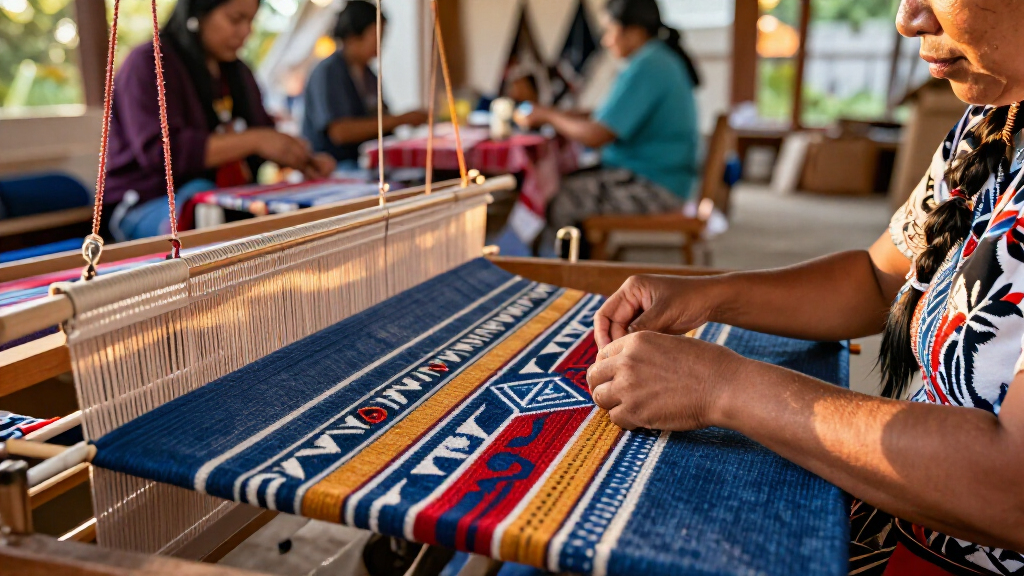
The exhibition places artistic practices and inherited knowledge in conversation with modern materials and technologies. Diné artist Melissa Cody, for example, draws on teachings passed down through three generations of makers. She works both on a vertical Navajo loom and with a mechanized Jacquard machine, combining traditional motifs with contemporary designs and messages. Her 2025 work Sunrise Rainbows is a Jacquard weaving with aniline-dyed wool fringe.
Large-scale geometric paintings by Eamon Ore-Giron are another prominent feature. His work references Indigenous motifs and symbols, including Native American medicine wheels and textiles from the Amazon Basin, while also drawing on the visual language of 20th-century geometric abstraction. The exhibition pairs his paintings with Natalia Montoya Lecaros’ four-part sculpture series Tótems de emergencia. The Aymara artist’s mixed-media forms draw on the figurative aesthetics of Andean garments and stand in a circle, evoking a ceremonial arrangement.
Other artists named in the exhibition include Patricia Domínguez, Jordan Ann Craig, Nanibah Chacon, Patrick Martinez and Caroline Monnet. The works use varied forms and materials to address mathematical, metaphysical, social and environmental themes. The exhibition’s geographic scope and range of media make it a presentation of multiple artists’ perspectives, rather than a single account of Indigenous art or knowledge.
How the Exhibition Connects Knowledge and Art
The exhibition presents Indigenous knowledge as an active influence on contemporary art and practice, not simply as historical subject matter. Cody’s use of both a traditional loom and a mechanized Jacquard machine offers a direct example of how inherited techniques can inform work made with contemporary equipment. Ore-Giron’s paintings, meanwhile, place Indigenous references alongside a modern abstraction tradition.
That mix matters because the exhibition links artistic form to relationships with territory, waterways and other species. The works approach mathematics, architecture and technology through the artists’ distinct cultural backgrounds, rather than treating those subjects as separate from community and environment. Alé describes the show as centering ways of knowing that continue to shape those relationships.
Popular right now

Breville BES870XL Barista Express Espresso Machine

De'Longhi Stilosa Compact Manual Espresso Machine with Milk Frother

Breville Bambino Espresso Machine, Brushed Stainless Steel
As an affiliate, we earn on qualifying purchases.
Diné Weaving and Andean Forms
The source report describes Diné weaving as a centuries-long practice in which artisans create geometric blankets and rugs on upright looms powered by the weavers’ bodies. It also notes that Diné herders have raised Navajo-Churro sheep since the breed was introduced by the Spanish in the 16th century. Cody’s work draws on that weaving heritage while incorporating a mechanized loom.
The exhibition also includes references to older artistic practices elsewhere in the Americas. The report cites Maya ceramics made more than a millennium ago and decorated with natural motifs, including birds. Montoya Lecaros’ sculptures draw on Aymara clothing traditions shaped by Indigenous practice and elements introduced by Spanish colonizers. These examples provide specific points of reference for the show’s broader exploration of continuity and change.
“At its core, Radiant Geometries centers Indigenous ways of knowing that continue to shape relationships to territories, waterways, and interspecies care.”
— Noor Alé, curator of Radiant Geometries
Details Not Given in the Report
The source report does not provide a full list of participating artists, the number of works on display, admission details or visitor attendance. It also does not say whether the Moody Center plans related events before the exhibition closes. The exhibition description identifies themes and selected artists, but does not establish that all Indigenous communities or traditions across the Americas are represented.
Exhibition Runs Through December
Radiant Geometries remains on view at the Moody Center for the Arts through Dec. 19, 2026. The center is also scheduled to open a large-scale vinyl installation by Sharmistha Ray on Oct. 22, with that work listed as remaining on view through Jan. 29. The source report does not give further details about programming connected to either exhibition.
Key Questions
Where is Radiant Geometries on view?
The exhibition is at Rice University’s Moody Center for the Arts in Houston.
When does the exhibition close?
The source report says Radiant Geometries is on view through Dec. 19, 2026.
Who curated Radiant Geometries?
Noor Alé curated the exhibition.
Which artists are featured?
The report names Melissa Cody, Eamon Ore-Giron, Natalia Montoya Lecaros, Patricia Domínguez, Jordan Ann Craig, Nanibah Chacon, Patrick Martinez and Caroline Monnet, among others.
What kinds of work are included?
The exhibition includes paintings, sculpture, textiles, video and sound, with works exploring cultural knowledge, technology, mathematics and environmental relationships.
Source: rss