TL;DR

Get art and craft supplies delivered free with Prime
- Fast, free delivery on millions of items
- Prime Video, Amazon Music and more included
- Member-only deals all year
A Hyperallergic report describes how Rohingya artist Enayet Khan and other refugees use art to document violence and process what they experienced. Legal advocates say artwork can help convey testimony and corroborate accounts, including in a case at the International Court of Justice, but the report does not establish that art alone proves crimes or secures convictions.
A Hyperallergic report describes how Rohingya refugees are using art to record violence and how legal advocates have collected artwork to help convey survivor testimony in accountability efforts. The report centers on artist Enayet Khan, who fled Myanmar in 2017 and later founded the Rohingya Art Club in Bangladesh; it presents art as a possible complement to other evidence, not a substitute for legal proof.
Khan told Hyperallergic that he and his family fled through forests and fields as fires spread between villages. He said he saw people shot and that three of the 10 family members who escaped with him were injured. They eventually crossed into Bangladesh. “I lost everything,” Khan told the publication, referring to his home, documents, property and sense of security.
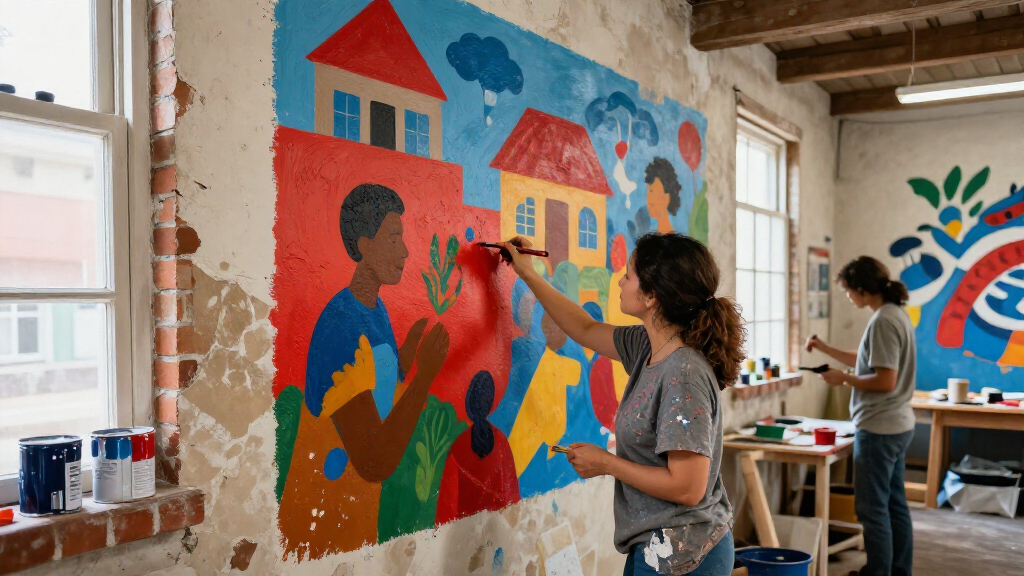
After settling in Cox’s Bazar, Khan began painting and drawing scenes connected to the violence he had witnessed, including burning homes, fleeing families and executions. He later established the Rohingya Art Club and trained other refugees in visual storytelling. The report describes this work both as a way to process traumatic experiences and as a means of preserving accounts that might otherwise be difficult to communicate.
Antonia Mulvey, executive director of Legal Action Worldwide and a former United Nations investigator, told Hyperallergic that she collected artwork for evidence in a case before the International Court of Justice concerning allegations of genocide against Rohingya communities. She said drawings can help convey testimony where high illiteracy, including among women and children, makes written statements difficult. The source does not specify which artworks were submitted, how the court treated them, or whether they affected any ruling.
Art as a Record in Legal Cases
Artwork can communicate experiences that a conventional written statement may fail to capture, particularly when a witness has limited literacy or finds it difficult to describe violence in words. In the account reported by Hyperallergic, drawings offered a way for Rohingya survivors to share testimony and for advocates to preserve visual records alongside other material.
The distinction matters: art may support an investigation by helping document events or corroborate survivor accounts, but its legal weight depends on how it is collected, authenticated and assessed with other evidence. The report does not say that any particular artwork independently established criminal responsibility. Its significance lies in showing a possible route for testimony to reach investigators and courts, while also giving refugees a means of expression outside formal proceedings.
The issue has relevance beyond one community. The source cites a global total of 117.8 million forcibly displaced people, describing the figure as a record, and says EU investigations and prosecutions involving genocide, crimes against humanity and war crimes increased by 44% from 2016 to 2021. Those figures describe the context given by the report; they do not establish that art is used in every case or that its use has increased.
As an affiliate, we earn on qualifying purchases.
From Flight to the Rohingya Art Club
The Rohingya have faced decades of discrimination and repression in Myanmar. The source says a 1982 law stripped them of citizenship, leaving the community among the world’s largest stateless populations. In 2017, large numbers fled military violence and crossed into Bangladesh. Khan’s account describes one family’s escape; his experience is not presented as a complete record of the persecution or of every refugee’s experience.
In Cox’s Bazar, which the report says is home to nearly one million Rohingya refugees, Khan turned to visual art and then helped establish the Rohingya Art Club. His paintings depict scenes he says he witnessed. The club’s work links personal expression with efforts to preserve community accounts, though the source provides no detailed information about its membership, funding, or current activities.
The report places these efforts alongside growing demand for accountability. It says the International Criminal Court has described the increase in demand from displaced people seeking justice as “unprecedented.” That reference concerns the ICC; it is separate from the International Court of Justice case in which Mulvey said she collected artwork. The two institutions are distinct, and the source does not say the ICC case involved Khan’s paintings.
“Drawings became a vital way to convey their testimonies.”
— Antonia Mulvey, executive director of Legal Action Worldwide, as quoted by Hyperallergic
textile and fiber art books for inspiration
As an affiliate, we earn on qualifying purchases.
As an affiliate, we earn on qualifying purchases.
How Courts Assess Refugee Artwork
The supplied report does not identify the specific artwork collected for the International Court of Justice case, explain how it was authenticated, or state whether it was formally admitted as evidence. It also does not report a court finding based on the work. Its precise legal role remains unclear from the material provided.
The report also leaves open how investigators verify the circumstances behind a drawing, distinguish firsthand observation from later interpretation, and protect artists and witnesses from possible risks. These are questions about evidentiary process and safety, not reasons to dismiss the testimony. No further detail is supplied on protections for Khan, other artists, or people whose accounts the artwork may represent.
visual storytelling art books about refugees and migration
As an affiliate, we earn on qualifying purchases.
As an affiliate, we earn on qualifying purchases.
Further Evidence and Legal Review
The next steps depend on investigators and courts: they may assess artwork alongside witness accounts and other records, with attention to how each item was made and preserved. The source gives no upcoming hearing date, ruling or new submission concerning the artwork or the case mentioned by Mulvey.
For now, Khan and the Rohingya Art Club’s work stands as a form of visual documentation and expression, while its effect in legal proceedings remains a matter for case-specific review. Further reporting would be needed to establish whether any of the artwork has been formally considered by a court and what weight judges assigned to it.
drawing and painting supplies for community art workshops
As an affiliate, we earn on qualifying purchases.
As an affiliate, we earn on qualifying purchases.
Key Questions
What is the news development?
A Hyperallergic report describes how Rohingya refugees use art to record experiences of violence and how a legal advocate collected artwork for an International Court of Justice case concerning allegations of genocide.
Who is Enayet Khan?
Khan is a Rohingya artist who fled Myanmar in 2017, settled in Bangladesh and founded the Rohingya Art Club to encourage visual storytelling among refugees.
Can refugee artwork be used as evidence?
The report says artwork can help convey testimony and corroborate survivor accounts. It does not establish that any particular work was admitted by a court or independently proved a crime.
What remains unknown about the court case?
The supplied material does not identify the artworks collected, explain their formal status in the proceedings, or report a ruling on their evidentiary value.
Source: rss
Evergreen bestsellers Picks
bestsellers
As an affiliate, we earn on qualifying purchases.