TL;DR

Get art and craft supplies delivered free — and shop member deals
- Fast, free delivery on millions of items
- Access to Prime Big Deal Days deals on October 6–7
- Prime Video, Amazon Music and more included
New Mexico-based artist Max Lehman’s exhibition Ancestral Androids is on view at Hecho a Mano in Santa Fe through Nov. 1, 2026. Its ceramic figures combine references to Pre-Columbian visual culture with science-fiction ideas about artificial beings, future archaeology and the stories that survive. Lehman says he leaves their origins open rather than supplying definitive explanations.
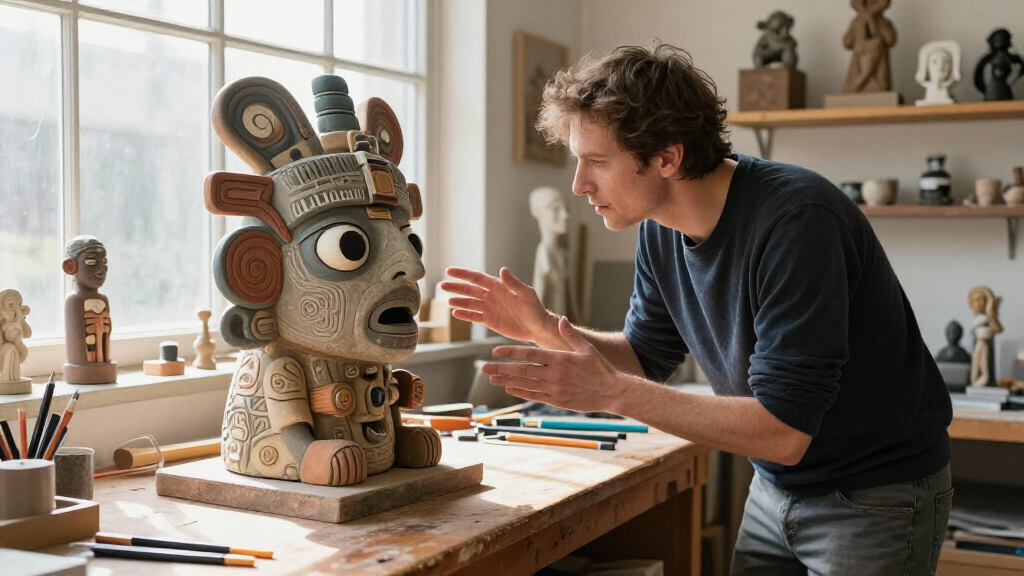
New Mexico-based artist Max Lehman’s Ancestral Androids, an exhibition of ceramic sculptures imagining a future in which artificial beings have their own ancient history, is on view at Hecho a Mano in Santa Fe through Nov. 1. The works combine science-fiction references to robots and digital technology with visual cues associated with Pre-Columbian art, inviting viewers to consider how later generations might interpret objects after their makers and original purposes have been forgotten.
The sculptures are brightly colored figures with titles including “The Malachite Mage,” “The Sapphire Sage” and “The Duchess of Digital Data.” Colossal’s report describes their expressions as cartoonish and sometimes unsettling. Some figures have additional faces on their foreheads or stomachs, a recurring feature Lehman uses to suggest collective identity or shared consciousness. The works are made from ceramic, with acrylic and metallic paint on several pieces; others are glazed ceramic.
Lehman frames the exhibition around a speculative archaeological future. He imagines the sculptures being excavated long after their creation, when their exact origins and uses are no longer known. The objects do not come with definitive explanations of who their figures represent or what they were made to do. Instead, their forms bring together references to ancient visual traditions and contemporary technologies such as artificial intelligence, robotics and digital devices.
Among the listed works are “Petro who is Predicting the Unpredictable” (2026), made with ceramic, acrylic and metallic paint, and “Mayan Max and His Pre-Colo iPad” (2026), made from glazed ceramic. The exhibition also includes “The Hope for Environmental Renewal” and “Fiery Phineas and His Tablet of Doom.” Colossal identifies the show’s end date as Nov. 1; the source report does not give opening hours or other visitor details.
Imagining Archaeology After AI
The exhibition links two questions that can feel remote from one another: how archaeologists interpret incomplete evidence from past societies, and how present-day technologies may shape what future societies remember. Lehman’s imagined future makes contemporary objects and ideas look as though they could become archaeological evidence, detached from their original setting and open to competing interpretations.
That approach matters in a period when digital records are plentiful but their long-term survival and meaning are not guaranteed. The sculptures do not predict what future people will believe, or establish what AI will preserve. Rather, as described in Colossal’s report, they use physical artworks to raise questions about how information becomes history and how gaps in evidence invite projection. Their handmade ceramic surfaces also place emphasis on an individual maker’s gestures, in contrast with the digital systems invoked by the exhibition’s subject matter.
As an affiliate, we earn on qualifying purchases.
Ancient Forms, Future Inventions
Lehman studies Pre-Columbian art history, and the report connects the exhibition’s visual references to ancient monuments and sculpture, including carved stone imagery associated with Maya temples and the Mexica Sun Stone, often called the Aztec calendar stone. The source does not say that Lehman’s figures reproduce specific archaeological objects. It presents the historical material as part of the work’s wider visual and intellectual grounding.
The exhibition’s central premise reverses the usual direction of archaeological looking. Instead of treating the past as a complete story waiting to be recovered, Lehman imagines his own era becoming a distant past known through fragments. The “androids” in the show are not presented as evidence of actual ancient machines; they are contemporary ceramic characters that use science-fiction imagery to ask what it might mean for artificial beings to acquire ancestors, ruins and myths.
“I resist providing complete explanations because archaeology rarely offers certainty.”
— Max Lehman, in a statement quoted by Colossal
artificial intelligence themed ceramic figurines
As an affiliate, we earn on qualifying purchases.
As an affiliate, we earn on qualifying purchases.
What the Objects Leave Unanswered
The sculptures are speculative artworks, not archaeological finds, and the source does not assign them a single definitive narrative. Lehman explicitly resists complete explanations, so the characters’ intended identities and functions remain open to interpretation. The report also does not detail how each individual piece relates to a particular Pre-Columbian object or tradition.
Beyond the exhibition’s premise, it remains unknown what kinds of digital information will survive over centuries or millennia, or how future societies might use AI to shape accounts of the past. Those questions are raised by the work rather than answered by it. The available report gives the exhibition’s venue and closing date but does not provide admission information, hours, or details of any accompanying events.
Pre-Columbian inspired ceramic art
As an affiliate, we earn on qualifying purchases.
As an affiliate, we earn on qualifying purchases.
Santa Fe Show Runs Through November
Ancestral Androids remains on view at Hecho a Mano in Santa Fe through Nov. 1, 2026, according to Colossal. The source report does not announce a later venue, additional dates or a related public program. Readers seeking practical visit details will need to check with the gallery.
Colossal’s report points readers to Lehman’s Instagram for more of his work. Until the exhibition closes, visitors can see the ceramic figures in person and consider how their combination of ancient visual references and future-facing technology changes the way familiar ideas about artifacts, archives and historical certainty are read.
As an affiliate, we earn on qualifying purchases.
Key Questions
What is Ancestral Androids?
Ancestral Androids is Max Lehman’s exhibition of ceramic sculptures that imagine artificial beings becoming subjects of future archaeology and myth.
Where and when can visitors see the exhibition?
The show is at Hecho a Mano in Santa Fe and is scheduled to continue through Nov. 1, 2026. The source report does not include opening hours or admission details.
What materials did Lehman use?
The works include ceramic with acrylic and metallic paint, as well as glazed ceramic. The material varies by sculpture.
Are the sculptures based on actual archaeological objects?
The report describes the works as contemporary sculptures informed by Lehman’s study of Pre-Columbian art and by science fiction. It does not identify the figures as replicas of specific archaeological objects.
What does Lehman say the exhibition is asking?
Lehman asks viewers to imagine what happens when artificial beings have ancestors and ruins, and when their own history becomes myth. He also says he avoids complete explanations because archaeological evidence rarely offers certainty.
Source: rss
Halloween Picks
halloween
As an affiliate, we earn on qualifying purchases.