
TL;DR
Spanish sculptor Miquel Navarro has died at 81, Hyperallergic reported in an obituary citing a statement from Mislata’s mayor. Navarro drew on his hometown near Valencia to create sculptural cities that appeared in museums and public spaces; he represented Spain at the 1986 Venice Biennale and received the National Award for Plastic Arts that year.
Spanish sculptor Miquel Navarro, whose imagined cityscapes brought abstract towers and other geometric forms into galleries and public spaces, has died at 81, according to an obituary published by Hyperallergic. Mislata Mayor Carlos Fernández Bielsa, who also leads the Fundació Miquel Navarro, confirmed the loss in a statement, the report said.

Get art and craft supplies delivered free with Prime
- Fast, free delivery on millions of items
- Prime Video, Amazon Music and more included
- Member-only deals all year
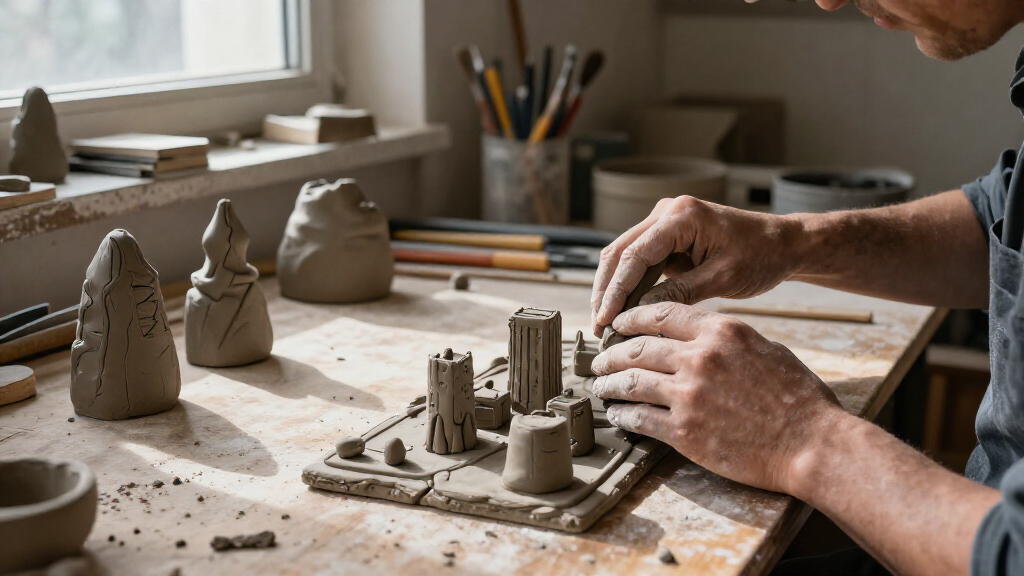
Navarro’s hometown of Mislata, in Valencia, was a lasting source of inspiration for his City sculptures. The large-scale installations arranged hundreds of abstract geometric forms to suggest an urban landscape, with visitors able to walk among shapes resembling skyscrapers. The work connected an imagined city with the experience of moving through an actual place.
Navarro’s sculptures also entered real urban settings. His public works appeared in Spain and abroad, extending his city-making beyond museums and exhibition spaces. His work is held by the Guggenheim museums in New York and Bilbao, Madrid’s Museo Reina Sofía and Paris’s Centre Pompidou, among other institutions, according to Hyperallergic.
In 1986, Navarro represented Spain at the Venice Biennale and received the Spanish Ministry of Culture’s Premio Nacional de Artes Plásticas, or National Award for Plastic Arts. The same-year recognition placed him among artists selected to represent the country internationally and recipients of one of Spain’s prominent national arts awards.
Navarro’s work made the city both a subject and a form. Rather than depicting streets and buildings in a conventional view, his installations assembled simplified structures into environments that visitors could enter and move through. That approach gave audiences a physical encounter with a city that was invented, yet rooted in the artist’s experience of Mislata.
His public commissions also carried that work into shared civic space. There, sculpture could be encountered outside the museum by people passing through the places where it stood. The combination of international exhibitions, major collections and public installations helps explain why Navarro’s death matters beyond his hometown: his work linked local memory and urban life with a wider audience.
Fernández Bielsa described Navarro as “a generous person and a world-renowned figure in sculpture, an irreplaceable creator,” in a statement translated from Spanish and quoted by Hyperallergic. The mayor’s words convey the loss felt in Mislata while also reflecting Navarro’s standing as an artist whose work reached well beyond the city.
Popular right now

Ninja Crispi 4-in-1 Portable Glass Air Fryer, Grey, FN101GY

De'Longhi Magnifica Duo Fully Automatic Espresso Machine with Milk Frother, Silver

Samsung 65-Inch Class M70H Series 4K Mini LED Smart TV (2026)
As an affiliate, we earn on qualifying purchases.
From Mislata to Venice
The supplied obituary identifies Mislata as the continuing point of reference for Navarro’s sculptural cities. His work developed a vocabulary of abstract geometric forms that could suggest a dense urban landscape without reproducing a specific city street by street. In installations, the scale and arrangement of the pieces let viewers experience the work from within rather than only from a distance.
Navarro’s career included both cultural institutions and public settings. His selection for Spain’s 1986 Venice Biennale presentation and the National Award for Plastic Arts came in the same year. The collections named in the report span Spain, France and the United States, while his outdoor works brought his sculptural language into cities in Spain and elsewhere. The source does not provide a full list of those public works or exhibition dates.
Details of His Death and Legacy
The supplied report does not state when or where Navarro died, nor does it describe the circumstances. It also gives no information about survivors, funeral arrangements or plans for a memorial. Those details should not be inferred from the mayor’s statement or the obituary’s account of his career.
The source lists several collections and describes public works in Spain and abroad but does not name every installation or specify whether any are being planned for new exhibitions or conservation work. It is not clear whether the Fundació Miquel Navarro has announced further arrangements or a fuller account of his life and career.
Further Memorial Plans Await
At the time of the supplied report, no memorial events, funeral arrangements or foundation plans were identified. The Fundació Miquel Navarro may provide further information, but the report does not say when or whether an announcement is expected. Any such details remain unconfirmed.
For now, the documented account of Navarro’s legacy rests on his sculptural city installations, public works, museum holdings and 1986 honors. Further reporting could clarify the circumstances of his death and how Mislata, the foundation and institutions that hold his work plan to mark his contribution.
Key Questions
Who was Miquel Navarro?
Miquel Navarro was a Spanish sculptor known for large-scale installations that assembled abstract geometric shapes into imagined cities. His work also included public sculptures in Spain and abroad.
How old was Navarro when he died?
Navarro was 81, according to Hyperallergic’s report. The supplied source does not give a specific date or location for his death.
His hometown of Mislata in Valencia served as a lifelong inspiration. His installations translated the idea of a city into geometric forms that visitors could walk among.
What major recognition did Navarro receive?
In 1986, he represented Spain at the Venice Biennale and received the Ministry of Culture’s National Award for Plastic Arts.
According to Hyperallergic, his work is in the collections of the Guggenheim museums in New York and Bilbao, Museo Reina Sofía and Centre Pompidou, among other institutions. His public works also appeared in Spain and abroad.
Source: hyperallergic.com