TL;DR

Get art and craft supplies delivered free with Prime
- Fast, free delivery on millions of items
- Prime Video, Amazon Music and more included
- Member-only deals all year
Artist Paul Pfeiffer discussed how stadiums and mass culture function as stages for political power in an interview with Hyperallergic. The conversation accompanies his current exhibition at Perrotin in Los Angeles, which includes new sculptures and video works. The interview offers Pfeiffer’s interpretation of cultural spectacle, not a formal policy analysis.
Artist Paul Pfeiffer told Hyperallergic that stadiums may be taking on a role as symbolic gathering places for world politics, as he discussed the relationship between mass culture, public spectacle and power. The interview accompanies his current exhibition at Galerie Perrotin in Los Angeles, which includes video, sculpture and woodcarvings that draw on sports, celebrity and religious imagery.
Pfeiffer’s comments came in response to a question about the growth of mass culture and the collective feelings it can produce, from popular appeal to potentially dystopian effects. He pointed to the proliferation of stadiums built or used for recurring international events, including the World Cup and the Olympics, and said their movement from city to city gives their architecture a political rhythm.
“Perhaps the stadium is actually the replacement for the UN as a symbolic gathering point to conduct world politics,” Pfeiffer said. He added that stadiums “hide as much as they reveal” but have become stages for political statements. His remarks are an artist’s interpretation of cultural space and diplomacy; the interview does not establish that stadiums have formally replaced international institutions.
The conversation also addressed the visibility of political action. The interviewer raised reports of Iranian athletes training outside the United States during the World Cup because of the US government’s unwillingness to host them overnight, and delegates leaving the UN assembly during Israeli Prime Minister Benjamin Netanyahu’s speech. Pfeiffer described the walkout as “heartening” and “a bit of agency,” responding to the interviewer’s account rather than offering independent reporting on those events.
Stadiums as Stages for Power
Pfeiffer’s argument connects mass entertainment to soft power and political messaging. Large sporting events bring athletes, audiences, governments and international media into shared spaces. In his view, that gathering can make a stadium more than a venue for competition: it can become a place where political positions are staged and seen.
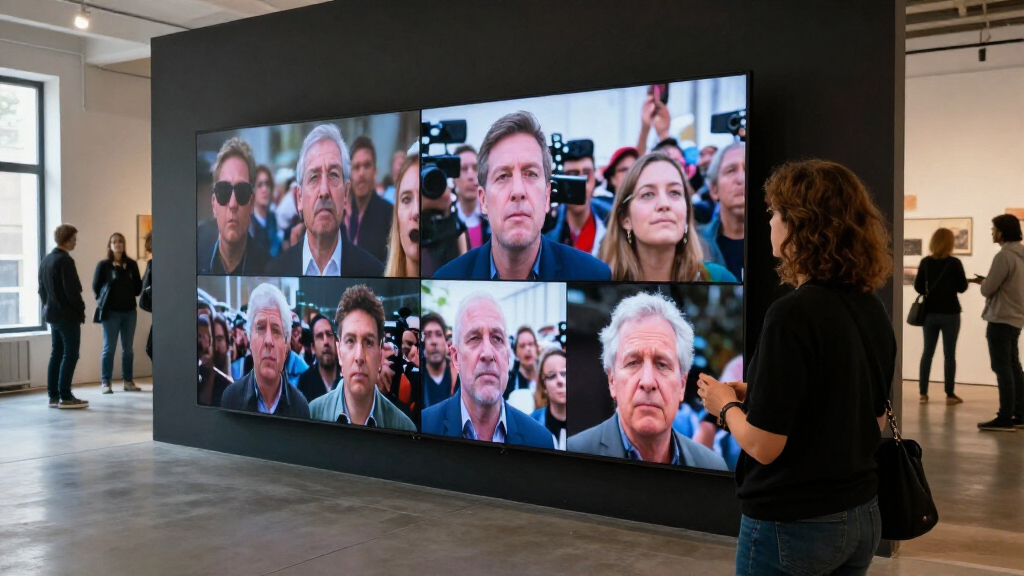
The distinction between what is visible and what remains behind the scenes runs through the interview. A public gesture, such as delegates walking out, can communicate dissent, while the arrangements and political conditions surrounding an event may be less visible. Pfeiffer’s perspective matters because his art uses altered images of sport and celebrity to make audiences examine how media spectacle shapes collective attention. It should be read as artistic commentary, not as evidence that cultural events have displaced diplomacy.
Popular right now

Ninja DualZone Smart Air Fryer, 10 Qt, 6-in-1, DZ950

KitchenAid Artisan 5-Qt Tilt-Head Stand Mixer, Cardamom

Sony WH-1000XM4C Wireless Noise-Cancelling Headphones, Black
As an affiliate, we earn on qualifying purchases.
Pfeiffer’s Art and Mass Images
Pfeiffer began making interventions in found video footage in the early 1990s. His work often removes or alters key elements in scenes featuring prominent athletes, drawing attention to how fame, media and spectatorship shape the image of a person and the crowd around them. The source describes this practice as addressing effects on individuals as well as the wider body politic.
His earlier works include the 1999 digital video installation Fragment of a Crucifixion (after Francis Bacon) and the Caryatid series of 2003–04. The Perrotin show also includes Vitruvian Figure works: sculptural maquettes and imagined plans for a million-seat stadium, as well as a 2026 digital video titled Vitruvian Figure (Los Angeles Memorial Coliseum). The exhibition’s 2026 woodcarvings of Justin Bieber use imagery associated with Christian devotion, linking celebrity culture and religious iconography.
““Perhaps the stadium is actually the replacement for the UN as a symbolic gathering point to conduct world politics.””
— Paul Pfeiffer, speaking to Hyperallergic
Limits of the Stadium Analogy
The interview presents Pfeiffer’s view, not a study comparing the political influence of stadiums and the United Nations. It does not detail which World Cup or Olympic episodes he had in mind when discussing political pronouncements, or specify how he measures the stadium’s influence. The source also gives no date for the interview’s publication, and provides no further reporting on the circumstances facing Iranian athletes or the delegates’ walkout. Those details should not be inferred from the artist’s remarks.
Exhibition as the Next Reference
The immediate development is Pfeiffer’s ongoing Perrotin exhibition in Los Angeles, which gives viewers a chance to encounter the works discussed in the interview, including the 2026 stadium video and Bieber woodcarvings. The source does not state the exhibition’s closing date or announce a related public program. Further details about the show’s schedule and the interview’s publication date were not provided.
Key Questions
What did Paul Pfeiffer say about stadiums and politics?
He suggested stadiums may serve as symbolic gathering points for world politics and called them stages for political pronouncements. This was his interpretation, not a claim that stadiums have formally replaced the United Nations.
Why was Pfeiffer discussing stadiums?
The interview explored the expansion of mass culture and the collective responses it can generate. Stadiums are central to Pfeiffer’s work on sports imagery, spectatorship and political spectacle.
What works are included in his Los Angeles exhibition?
The source describes a 2026 digital video, Vitruvian Figure (Los Angeles Memorial Coliseum), stadium-related maquettes and plans, and woodcarvings of Justin Bieber that use religious imagery.
Did Pfeiffer independently report on the athletes and UN walkout?
No. The interviewer raised those examples, and Pfeiffer responded to their political meaning. The source does not provide independent reporting or additional details about the events.
Source: hyperallergic.com