
TL;DR

Get art and craft supplies delivered free with Prime
- Fast, free delivery on millions of items
- Prime Video, Amazon Music and more included
- Member-only deals all year
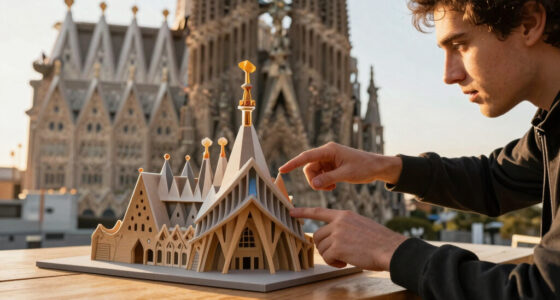
A team of mathematicians has uncovered new geometric and mathematical patterns in the design of Barcelona’s Sagrada Familia. These findings explain some of the basilica’s complex structures and may influence its ongoing construction. The discovery highlights Gaudí’s innovative use of mathematics in architecture.
Researchers have revealed new mathematical principles underlying the design of Barcelona’s Sagrada Familia, offering fresh insights into the basilica’s complex geometric structure. The discovery confirms that Gaudí employed advanced mathematical concepts, which are now being used to guide its ongoing construction. This development is significant for understanding Gaudí’s innovative techniques and the basilica’s future completion.
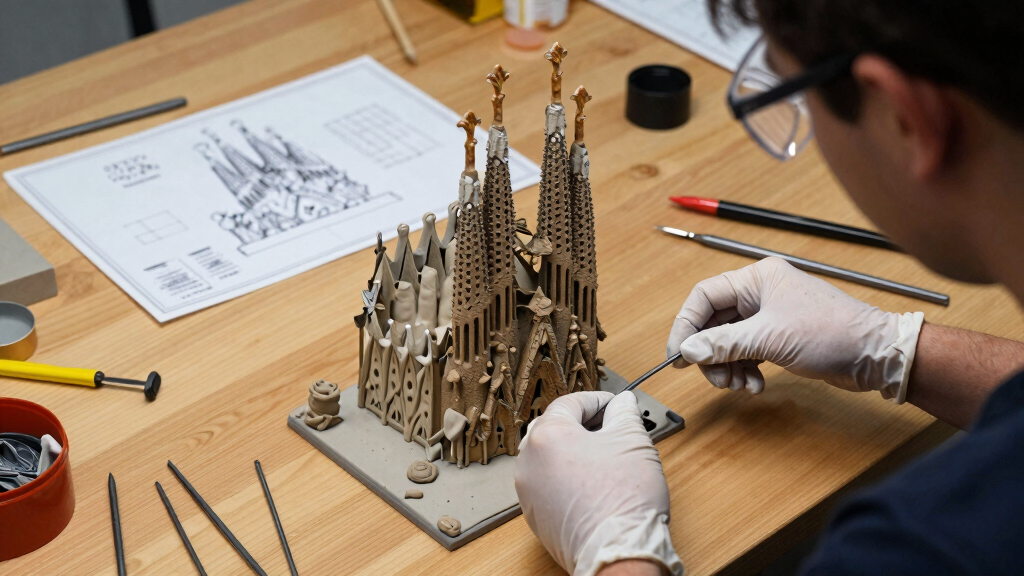
The research, conducted by a team of mathematicians from the University of Barcelona, identified specific geometric patterns and mathematical sequences embedded within the basilica’s architecture. These include the use of Fibonacci sequences, hyperbolic paraboloids, and complex symmetry principles that Gaudí integrated into the design. The team analyzed detailed blueprints, 3D models, and physical structures to uncover these hidden mathematical frameworks.
According to Dr. Maria López, lead researcher, ‘Our analysis shows that Gaudí’s design was not only artistic but also deeply mathematical. He used these principles to achieve structural stability and aesthetic harmony.’ The findings are now being incorporated into digital models to assist ongoing construction efforts, which aim to complete the basilica by 2026.
Implications of Mathematical Discoveries for Gaudí’s Architecture
This discovery matters because it deepens understanding of Gaudí’s innovative use of mathematics in architecture, which was previously considered primarily artistic. Recognizing these underlying principles could influence not only the basilica’s ongoing construction but also future architectural projects that seek to combine art with complex mathematical design. It also enhances the cultural and scientific value of Sagrada Familia as a UNESCO World Heritage site.
geometric modeling software for architecture
As an affiliate, we earn on qualifying purchases.
As an affiliate, we earn on qualifying purchases.
Historical and Architectural Context of Sagrada Familia’s Design
Construction of the Sagrada Familia began in 1882, with Antoni Gaudí taking over as chief architect in 1883. Gaudí’s work combined Gothic and Art Nouveau styles, but his innovative use of geometry and natural forms set his design apart. Over the decades, the basilica’s construction has relied heavily on models, sketches, and evolving technology. Recent efforts have focused on digital modeling and mathematical analysis to guide its completion, which is scheduled for 2026.
Previous studies have suggested that Gaudí employed geometric principles such as catenary arches and hyperboloids, but detailed mathematical analysis has been limited. The recent research builds on these ideas, revealing a more intricate mathematical framework embedded within the basilica’s design.
“Gaudí’s architecture is a testament to the seamless integration of art and mathematics, which we are only beginning to fully understand.”
— Dr. Maria López
architectural design tools with Fibonacci sequences
As an affiliate, we earn on qualifying purchases.
As an affiliate, we earn on qualifying purchases.
What Aspects of the Mathematical Framework Are Still Being Investigated
While the team has identified key geometric patterns, it is still unclear how extensively Gaudí applied these principles throughout the entire basilica. The precise algorithms or mathematical formulas Gaudí used remain partially speculative, and further analysis is needed to confirm the full scope of his mathematical approach.
Additionally, it is not yet confirmed how these new findings will directly impact the ongoing construction process or whether they will lead to modifications in current building techniques.
3D modeling software for complex structures
As an affiliate, we earn on qualifying purchases.
As an affiliate, we earn on qualifying purchases.
Future Research and Construction Integration Plans
The research team plans to publish detailed findings in an upcoming academic journal, providing more comprehensive analysis of the mathematical structures. Meanwhile, architects and engineers involved in the Sagrada Familia project are expected to incorporate these insights into digital modeling tools to refine construction techniques. The goal is to ensure that Gaudí’s mathematical vision is fully realized in the basilica’s final form by 2026.
architectural blueprints digital viewer
As an affiliate, we earn on qualifying purchases.
As an affiliate, we earn on qualifying purchases.
Key Questions
How does this discovery change our understanding of Gaudí’s work?
This discovery reveals that Gaudí used advanced mathematical concepts deliberately, adding a new dimension to his artistic and architectural methods.
Will the mathematical principles affect the basilica’s construction process?
Yes, the principles are being integrated into digital models to guide the ongoing construction and ensure structural accuracy.
Are these mathematical patterns unique to Sagrada Familia?
While Gaudí employed similar principles in other works, the specific patterns identified are unique to the basilica’s design.
When is the basilica expected to be completed?
The current plan aims for completion in 2026, with new mathematical insights helping to achieve this goal.
Could these findings influence other architectural projects?
Potentially, as the integration of complex mathematics in architecture could inspire new design approaches in the future.
Source: hn
Halloween Picks
halloween
As an affiliate, we earn on qualifying purchases.