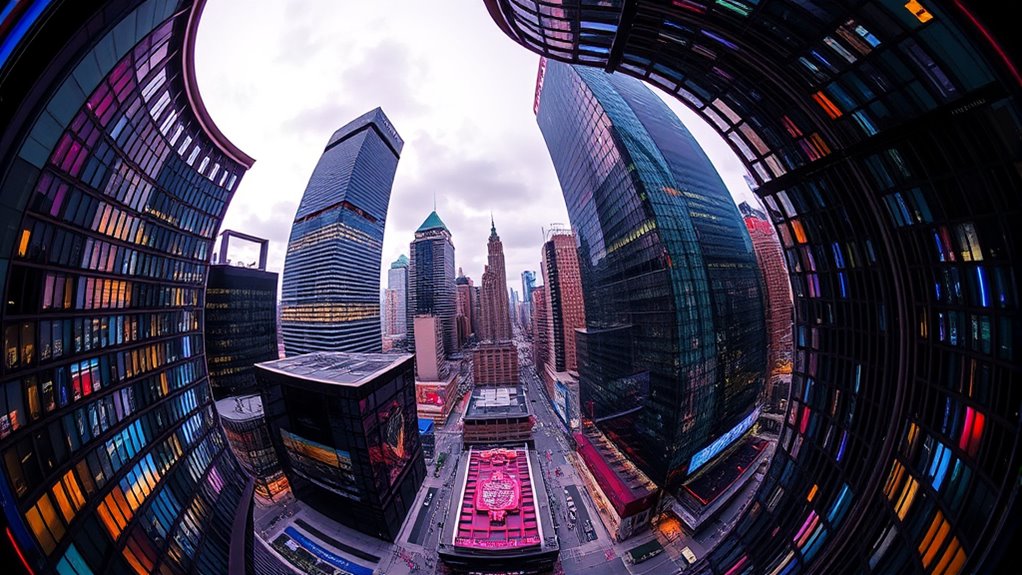

Using a fish-eye lens, you can creatively distort your photos by embracing its wide-angle, convex shape that captures up to 180 degrees. You’ll turn ordinary scenes into dynamic, immersive visuals by exaggerating perspectives and emphasizing certain features through clever angles. Experiment with lens flare and distortion to add artistic flair and depth. Mastering composition and perspective helps you reveal playful, surreal images that capture energy and movement. Keep exploring these techniques to push your creative boundaries further.
Key Takeaways
- Fish-eye lenses create wide, distorted perspectives that can transform ordinary scenes into surreal, dynamic images.
- Use strategic angles and positioning to maximize distortion effects and emphasize focal points.
- Incorporate lens flare creatively by shooting towards bright light sources for added artistic impact.
- Experiment with scene composition to leverage the lens’s curvature, enhancing depth and immersive storytelling.
- Practice and explore different lighting, angles, and flare techniques to develop unique, eye-catching distorted imagery.

Have you ever wondered how photographers achieve those striking, warped images that seem to bend and exaggerate reality? With a fish-eye lens, you’re able to create visuals that transform ordinary scenes into extraordinary, almost surreal compositions. This lens has a unique convex shape that captures a wide-angle view, often up to 180 degrees, allowing you to encompass entire landscapes, rooms, or crowds within a single frame. As you experiment with this lens, you’ll quickly notice how it introduces distinctive distortion effects, elongating or curving straight lines and giving your images an almost cartoonish or otherworldly feel. The key to mastering this look lies in understanding how the lens’s curvature influences the scene, pulling objects toward the edges and creating a sense of depth that’s both dynamic and playful.
Discover how a fish-eye lens distorts and transforms scenes into surreal, dynamic compositions with wide-angle, exaggerated perspectives.
When using a fish-eye lens, you might also encounter lens flare, especially when shooting towards a bright light source like the sun or a strong artificial light. Lens flare can add an artistic flair to your images, creating streaks or circles of light that enhance the overall mood. Alternatively, you can use lens flare intentionally to emphasize the scene’s brightness or to add a dreamy, ethereal quality to your photos. The challenge lies in controlling these effects – sometimes a flare complements the distortion effects, amplifying the surreal feeling, while other times it can be distracting. Adjusting your shooting angle, aperture, and even experimenting with filters helps you harness lens flare creatively.
The distortion effects you achieve with a fish-eye lens aren’t just random quirks—they’re powerful tools for storytelling. You can exaggerate perspectives, making close objects appear massive while pushing background elements into the distance. This effect draws viewers’ attention precisely where you want it and creates a sense of immersion. Whether you’re capturing a sprawling cityscape, a crowded street, or a tight interior, the lens’s exaggerated curvature transforms mundane scenes into visually compelling narratives. As you become more familiar with the lens’s quirks, you’ll learn how to position yourself to maximize the distortion effects, emphasizing certain features and creating a sense of movement or chaos.
In essence, mastering a fish-eye lens involves understanding how its unique shape influences your composition. Play with angles, experiment with lens flare, and embrace the distortion effects to craft images that are lively, exaggerated, and full of character. This lens opens up a playful universe of creative possibilities, allowing you to reinterpret reality in bold, enthralling ways. The more you practice, the more intuitive it becomes to use the lens’s quirks to your advantage, transforming simple scenes into eye-catching, warped works of art. Recognizing how the lens’s wide-angle view enhances scene composition will help you better utilize its full potential.
fish-eye lens for DSLR
As an affiliate, we earn on qualifying purchases.
As an affiliate, we earn on qualifying purchases.
Frequently Asked Questions
How Do Fish-Eye Lenses Affect Image Composition?
Fish-eye lenses dramatically alter your image composition by creating a wide, distorted view that emphasizes the scene’s edges. You can use panoramic techniques to capture expansive landscapes or creative framing to draw attention to specific elements. This lens encourages you to experiment with unconventional perspectives, making your photos more dynamic and engaging. Embracing the distortion allows for unique compositions that challenge traditional photography rules and add visual interest.
What Camera Settings Are Ideal for Fish-Eye Shots?
Perfectly poised for playful perspectives, set your fish-eye lens to a small aperture like f/8 or f/11 to maximize depth of field and keep more of your scene sharp. Keep your ISO low to reduce noise, and adjust shutter speed based on lighting conditions. Watch out for lens flare—use your hand or a lens hood to block stray light—and embrace the exaggerated, distorted effects for dynamic, dramatic shots.
Can Fish-Eye Lenses Be Used for Macro Photography?
Yes, you can use fish-eye lenses for macro photography, but it’s challenging due to their wide focal length and lens material. The lens material, often glass or high-quality plastic, affects clarity, which is essential for macro shots. To get close-up details, you’ll want a fish-eye lens with a shorter focal length, allowing you to capture intricate textures and patterns while maintaining that distinctive distorted effect.
How Do You Correct Distortion in Fish-Eye Images?
Think of your fish-eye shot as a wild dance that needs calming. To correct distortion, you use post-processing techniques and lens correction software, which act like a gentle choreographer. These tools straighten the curves, restoring your image’s natural harmony. By applying lens correction software, you can tame that wild distortion, revealing a more balanced scene that still retains the creative flair you intended.
Are Fish-Eye Lenses Suitable for Professional Photography?
Fish-eye lenses can be suitable for professional photography if you want to create bold, artistic images. They’re great for capturing wide scenes or unique perspectives, but watch out for lens flare and chromatic aberration, which can affect image quality. To guarantee professional results, use lens filters, proper lighting, and post-processing techniques to minimize these issues and enhance your creative distortion.
wide angle camera lens for smartphone
As an affiliate, we earn on qualifying purchases.
As an affiliate, we earn on qualifying purchases.
Conclusion
Now that you’ve grasped the magic of fish-eye lens photography, get ready to bend reality like never before. With just a simple click, you can turn everyday scenes into mind-blowing, warp-speed adventures that captivate everyone’s attention. So grab your camera, embrace the wild distortion, and watch as your images leap off the page, leaving everyone breathless. This isn’t just photography—it’s your ticket to transforming the ordinary into the extraordinary in a way you never imagined!
creative lens flare filters
As an affiliate, we earn on qualifying purchases.
As an affiliate, we earn on qualifying purchases.
surreal distortion photography lens
As an affiliate, we earn on qualifying purchases.
As an affiliate, we earn on qualifying purchases.