To photograph deep-sea life, you should use specialized underwater lighting like powerful strobes or continuous lights to reveal colors in darkness. Protect your gear with waterproof housings and stabilize your camera to prevent motion blur. Adjust settings for low light, using high ISO and manual focus for sharp images of elusive creatures. Patience and understanding animal behavior help capture fleeting moments. Keep exploring to discover more techniques that uncover the mysteries of the deep ocean.
Key Takeaways
- Use powerful, well-positioned artificial lighting to reveal colors and details in the deep dark environment.
- Employ waterproof housings, high ISO, and stabilization to capture sharp, high-resolution images in low-light conditions.
- Pre-plan shots by understanding creature behavior and ideal angles to maximize success and image quality.
- Utilize robotic or automated systems to access hazardous zones and reduce human risk while enhancing imaging capabilities.
- Maintain careful buoyancy control and patience to minimize environmental impact and capture elusive, fleeting deep-sea life.
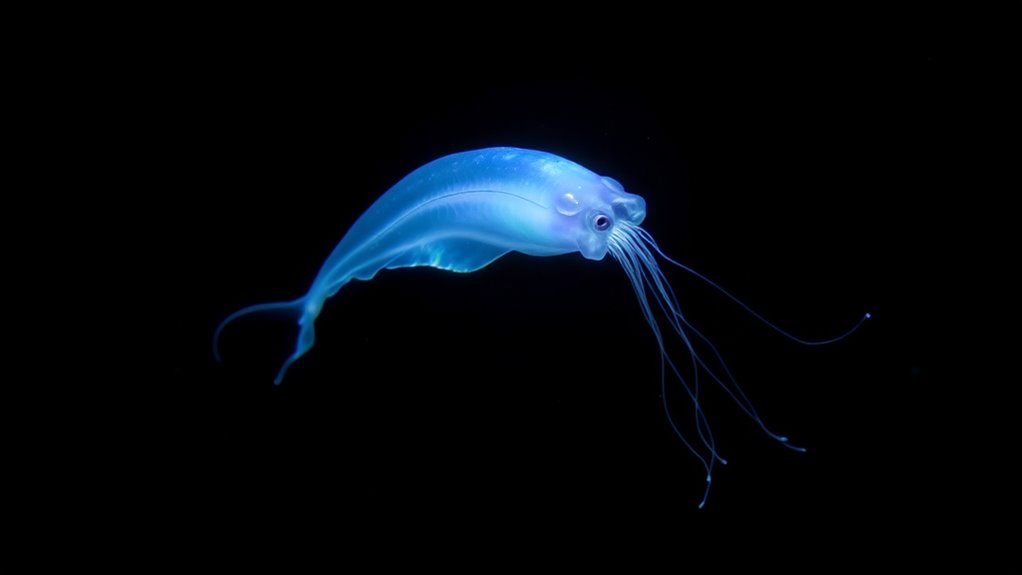
Venturing into the depths of the ocean to photograph deep-sea life presents unique challenges and rewards. As you descend into the dark, pressurized environment, you realize that conventional photography techniques won’t cut it. Underwater lighting becomes your most critical tool, as natural light barely penetrates these depths. You need specialized equipment that can handle the intense conditions while providing enough illumination to capture vivid images of elusive creatures. Your camera equipment must be robust and adaptable—think waterproof housings, high ISO capabilities, and macro lenses designed for close-up work. Without proper underwater lighting, your photos risk being dull or obscured, as the deep sea is a domain of shadows and bioluminescence. Using powerful strobes or continuous lights, you can bring out the colors and details that would otherwise be lost in darkness. It’s essential to position your lights carefully to avoid backscatter—tiny particles reflected in your flash that create unwanted spots in your images. Mastering the angles and timing of your lighting setup allows you to highlight the textures and features of deep-sea organisms, revealing their otherworldly beauty. Additionally, the increasing use of robotic and automated systems in deep-sea exploration enhances the ability to capture images in environments that are too hazardous for divers. Proper understanding of sensor sensitivity and its importance in low-light conditions can significantly improve your results. Your choice of camera equipment plays a crucial role in capturing these fleeting moments. Compact, sturdy cameras with high-resolution sensors help you document intricate details of deep-sea life. Mounting your camera on a stable rig or tripod minimizes motion blur caused by currents. Since the environment is unpredictable, having a versatile setup means you can quickly adapt to different subjects and conditions. Focus is equally vital; using manual focus or focus-lock settings ensures sharp images of fast-moving or tiny creatures. Additionally, maintaining proper buoyancy control prevents accidental damage to fragile ecosystems or your gear. You’ll find that pre-planning your shots and understanding the behavior of deep-sea creatures enhances your chances of success. Patience becomes your best friend, as many species are shy or only appear briefly.
In essence, photographing deep-sea life demands a strategic combination of specialized underwater lighting and resilient camera equipment. You’ll face technical hurdles, but overcoming them rewards you with stunning images of a hidden world few get to see. With the right tools and techniques, you can unveil the mysteries of the deep, capturing moments that showcase the ocean’s most extraordinary life forms. The journey is challenging, but the images you preserve will be worth every effort, offering a glimpse into a sphere that remains largely unexplored and endlessly fascinating.

TELESIN Underwater Case for Snorkeling & Diving, 65ft/20M Waterproof Housing for Photo & Video with Handle Grip, Fits iPhone 7-17 Pro/Pro Max/Plus/Mini, Galaxy S10-S25 Ultra/Plus & Most Phones
Bluetooth Shooting Control: TELESIN underwater phone housing is compatible with smartphones from 5.4 to 6.9 inches, including popular…
As an affiliate, we earn on qualifying purchases.
As an affiliate, we earn on qualifying purchases.
Frequently Asked Questions
How Do Deep-Sea Creatures React to Camera Flashes?
You might wonder how deep-sea creatures react to camera flashes. Their bioluminescence behavior can be affected, as sudden bright light may startle or disorient them. The camera flash impact varies; some animals ignore it, while others may retreat or become temporarily confused. Understanding these reactions helps you minimize disturbance and capture more authentic images without harming their delicate environment.
What Safety Measures Are Necessary During Deep-Sea Photography?
Imagine diving into the abyss where safety is your lifeline—it’s that critical. You must follow strict marine safety protocols, like monitoring your oxygen levels and avoiding sudden movements. Handle equipment with care to prevent damage or accidents, and always communicate with your team. Proper training, wearing protective gear, and knowing emergency procedures are essential. By prioritizing marine safety and meticulous equipment handling, you keep yourself safe while capturing breathtaking deep-sea images.
How Do You Preserve the Natural Behavior of Deep-Sea Animals?
To preserve the natural marine behavior, you should minimize your disturbance and avoid using bright lights or sudden movements that can scare deep-sea animals. Focus on ethical considerations by maintaining a respectful distance and using remote or non-intrusive equipment. This approach helps you observe authentic behavior without altering the environment, ensuring your photography supports conservation efforts and respects the fragile marine ecosystem.
What Equipment Is Essential for Deep-Sea Photography?
You need essential equipment like an underwater drone and high-pressure housing to capture deep-sea life effectively. An underwater drone lets you explore hard-to-reach areas and get close-up shots, while high-pressure housing safeguards your camera from extreme pressures at great depths. Together, they ensure clear, detailed images without risking your gear, making it possible to document the mysterious, unseen world beneath the waves confidently and safely.
How Is Light Manipulated to Achieve Clear Images at Extreme Depths?
To get clear images at extreme depths, you manipulate light through bioluminescent illumination and control light refraction. You use specialized equipment to harness the natural glow of deep-sea creatures, reducing the need for artificial light that can disturb their environment. By understanding how light refracts in water, you position your camera to minimize distortion, capturing sharp, vivid images of the mysterious deep-sea life that’s otherwise impossible to see clearly.

JatureClets Professional Underwater Strobe Flash,32 Guide Number, 100m Waterproof, 1.5s Recycle Time, Diving Strobe for DSLR Camera Underwater Photography Accessories (Black)
PROFESSIONAL UNDERWATER FLASH: Features a powerful 32 Guide Number strobe for optimal underwater photography lighting
As an affiliate, we earn on qualifying purchases.
As an affiliate, we earn on qualifying purchases.
Conclusion
As you venture into photographing the deep sea, remember that only about 1% of this world has been explored. With advanced techniques, you can capture the mysterious creatures lurking in the darkness, revealing their incredible beauty. Imagine the thrill of uncovering a creature so rare that it’s only been seen by a handful of scientists. Keep pushing the limits, and you might just bring these hidden wonders into the light for everyone to see.

Macro Lens Filters 58mm – 16X Macro Close Up Diving Lens Filter – for Underwater Photography – for 8 Action Camera
Macro lenses are used to take pictures of flowers, small collectibles, and stamps, insects, small or small objects…
As an affiliate, we earn on qualifying purchases.
As an affiliate, we earn on qualifying purchases.
![FishPRO Positioner for Underwater Fishing Camera - [Full-Aluminum] Tripod for Ice Fishing Camera Underwater, with 1/4" Tilt Mount, Remote & Manual Control, 2-Way 360° Rotating, Fit Ice Hole Max 11"](https://m.media-amazon.com/images/I/41oDBSmq9ZL._SL500_.jpg)
FishPRO Positioner for Underwater Fishing Camera – [Full-Aluminum] Tripod for Ice Fishing Camera Underwater, with 1/4" Tilt Mount, Remote & Manual Control, 2-Way 360° Rotating, Fit Ice Hole Max 11"
【Compatible with All Types of Underwater Fishing Cameras 】The positioner is specially designed for all underwater fishing camera…
As an affiliate, we earn on qualifying purchases.
As an affiliate, we earn on qualifying purchases.