TL;DR

Get art and craft supplies delivered free — and shop member deals
- Fast, free delivery on millions of items
- Access to Prime Big Deal Days deals on October 6–7
- Prime Video, Amazon Music and more included
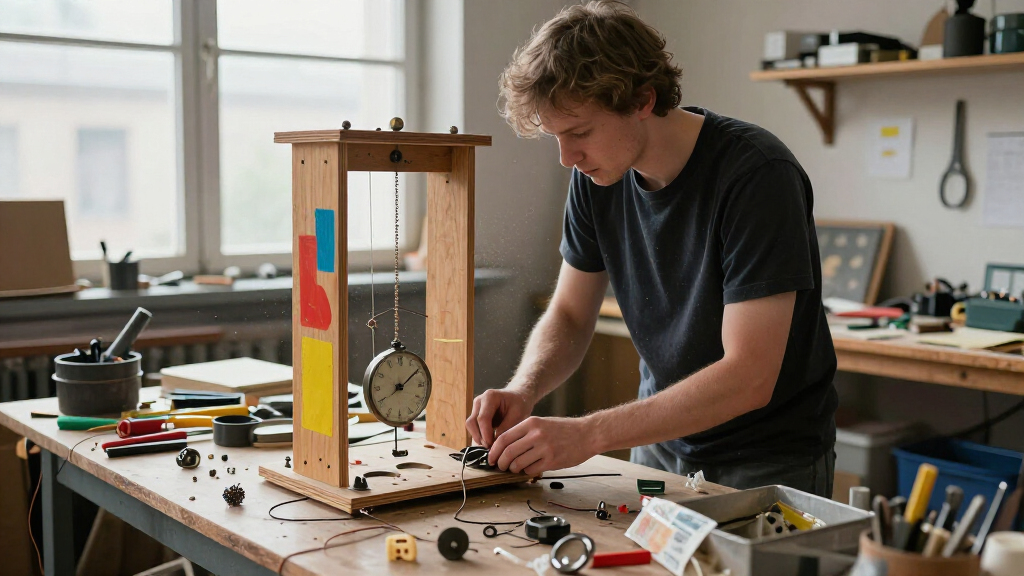
Niklas Roy built a functional pendulum clock from materials he scavenged locally during a residency in Glashütte, Germany. The artist says it runs for about half an hour and includes a paperclip escapement, a glass bottle gong and a chance-based feature called “Now or Never?”
Berlin-based artist and inventor Niklas Roy has built a working pendulum clock from materials he scavenged during a residency in Glashütte, Germany, according to a report by Colossal. Called the Glashütte Trash Clock, the mechanical sculpture runs for about half an hour and uses improvised parts including a paperclip escapement and a glass bottle gong.
Roy says he used only items and materials he could find locally. The list includes tape, zip ties, hot glue, cardboard, a yardstick and pieces of plastic, along with other objects. The report does not give a complete parts list or a step-by-step account of how he assembled the mechanism.
The clock’s escapement is made from a paperclip. In a pendulum clock, an escapement releases a gear as it moves, helping the mechanism advance the hands. Roy also fitted a glass bottle gong for sound. He describes the clock as running for about half an hour; the report does not specify whether that is a run time from a full wind or another operating interval.
A feature Roy calls a “random complication” poses the question “Now or Never?” The report links that element to games and chance rather than to conventional clockmaking. It does not explain its exact mechanism or how often it activates.
A Clock Built Against Glashütte Tradition
The project sets improvised construction against the place where it was made. Glashütte is associated with Germany’s watchmaking industry, and Roy said he wanted to make the opposite of the precision for which the town is known. That contrast gives the found materials and rough construction a clear role in the work, beyond simply serving as inexpensive components.
The clock also makes a familiar mechanism visible through unconventional parts. A paperclip can show how an escapement helps regulate a clock, while the bottle gong turns an everyday object into a sound-producing component. The result brings art and mechanical function together, though the available report does not say how accurate the clock is or whether it was intended for regular timekeeping.
Roy’s “Now or Never?” feature adds a playful element of chance to a device typically associated with steady measurement. The contrast invites viewers to think about time and decision-making, but that interpretation is not a technical claim about the clock’s performance.
Roy’s Residency in Watchmaking Country
The clock takes its name from Glashütte, a town in Saxony that Colossal describes as the birthplace of Germany’s watchmaking industry. Roy made the work while participating in a residency there this year. The report does not name the residency program or give its dates.
Colossal presents Roy as a Berlin-based artist and inventor whose work spans robotics, gaming systems, sculptures and installations. It describes his projects as combining art and technology, often with playful elements. The Trash Clock continues that approach by using a traditional timekeeping form while replacing standard clockmaking materials with locally gathered objects.
““Glashütte is synonymous with precision and centuries-old watchmaking craft, and I wanted to make the opposite.””
— Niklas Roy
Accuracy and Operation Remain Unreported
The report establishes that Roy describes the piece as functional and says it runs for about half an hour, but it does not provide measurements of its accuracy, how long it can operate under different conditions, or how it is powered or reset. It is also unclear whether the clock displays time throughout that period or strikes the bottle gong at set intervals.
The available account does not explain how the “Now or Never?” complication works, what outcomes it produces, or whether the clock is on public display. Roy’s statement that he used locally scrounged materials is attributed to him; the report does not independently document the sourcing of each component.
Further Details From Roy’s Work
Colossal directs readers to Roy’s Instagram for more of his work. The report does not announce a future exhibition, a longer demonstration of the clock or plans to build additional versions. No further public showing or technical documentation is specified in the available source.
More information about its mechanism, accuracy and operation would clarify how the clock performs beyond the reported half-hour run. Until then, the confirmed account is limited to Roy’s description and the details published by Colossal.
Key Questions
What is the Glashütte Trash Clock?
It is a functional pendulum clock made by Berlin-based artist and inventor Niklas Roy from materials he says he scavenged locally during a residency in Glashütte, Germany.
How long does the clock run?
Roy says it runs for about half an hour. The report does not explain the conditions for that operating time or provide a longer performance test.
What parts does the clock use?
The reported components include a paperclip escapement and a glass bottle gong. Roy also listed tape, zip ties, hot glue, cardboard, a yardstick and pieces of plastic among the materials he gathered.
What does “Now or Never?” mean on the clock?
Roy calls it a “random complication” and describes it as connected to games and chance. The report does not explain its mechanism or what it does in practice.
Is the clock accurate enough for everyday timekeeping?
That is not clear from the report. It describes the clock as functional and gives Roy’s estimate of its run time, but provides no accuracy measurements or details about regular use.
Source: rss
Fall Picks
fall essentials
As an affiliate, we earn on qualifying purchases.