
TL;DR

Get art and craft supplies delivered free with Prime
- Fast, free delivery on millions of items
- Prime Video, Amazon Music and more included
- Member-only deals all year
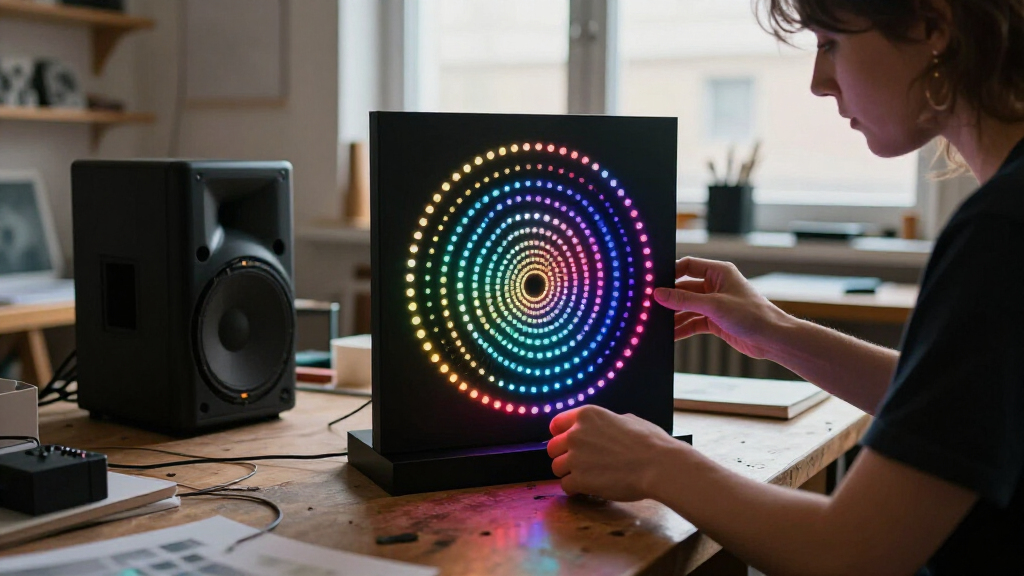
Jagi Natarajan documented Phyllotaxis, a handmade, audio-reactive LED display based on the spiral arrangement of plant growth. The project combines a 3D-printed cellular structure, 89 addressable LEDs, mulberry paper, an STM32 microcontroller and a digital microphone. The report describes a personal build; it gives no release plan, price or performance measurements.
Jagi Natarajan documented Phyllotaxis, a handmade display that turns a plant-inspired spiral into a field of 89 addressable LEDs and changes its light patterns in response to sound. The project brings together custom 3D-printed cells, diffusing paper and audio analysis on an STM32 microcontroller, showing how a mathematical pattern can shape both an object’s structure and its behavior.
Natarajan began with phyllotaxis, the pattern of expanding spirals found in the centers of sunflowers and in other plants. In a Processing sketch, a sequence of points is spaced along a radial line and rotated by increasing multiples of the golden ratio. The resulting point cloud is divided into Voronoi cells, producing a pattern Natarajan describes as resembling seed pods.
To make the pattern physical, Natarajan exported the cell edges and used CadQuery to create a three-dimensional shell with walls and an opening for an LED in each cell. The design was divided into four sections sized for a 3D printer. Natarajan then prepared a thinner faceplate, added screw holes in FreeCAD and fitted paper beneath it to diffuse the light. The source identifies the paper as mulberry paper, chosen for the way its fibers look when illuminated.
The assembled display contains 89 LEDs, wired to a spare STM32 Blackpill board. Natarajan wrote a driver that uses SPI to control the LEDs, then built a framework for creating patterns from each LED’s position. A later audio-reactive version added an INMP441 digital microphone. Using the ARM CMSIS library, the board analyzes sound with a Fourier transform, automatic gain control and frequency-band energy measurements. Natarajan says a pulsing wave moving outward from the center became the main feature of the audio-reactive sketch.
How Sound Shapes the Light
Phyllotaxis shows how one design decision—the arrangement of the cells—can guide both fabrication and animation. Because the microcontroller’s software tracks where each LED sits, Natarajan could calculate patterns from distance and angle, rather than treating the display as a conventional rectangular grid. The resulting form links the visual reference in plants to the way light moves across the finished object.
The project also documents a practical route from digital geometry to a working installation: generate points in a sketch, derive cell boundaries, model printable parts, assemble the lighting and write embedded software. Its reported use of a spare microcontroller and readily described fabrication steps may help other makers understand the components involved. The account does not, however, provide a bill of materials, build time, cost or complete assembly guide, so it cannot establish how easily another person could reproduce the display.
Audio response adds another layer: the lights are driven by sound analysis, rather than only by a preset repeating pattern. Natarajan describes the goal as making the object feel “alive and dynamic.” That is the maker’s account of the intended effect; the report supplies no measured latency, frequency response or comparison with other audio-reactive displays.
From Sunflower Geometry to Hardware
Natarajan’s report starts with an interest in patterns that appear in nature and can be generated with code. In the initial sketch, each point’s radius increases through the sequence while its angle advances by a multiple of the golden ratio. Applying a Voronoi tessellation to those points turns the arrangement into adjoining cells that can serve as physical compartments for lights.
The build developed in stages. Natarajan first made the cells and LED driver work with basic test patterns, then created a sketch framework to simplify writing effects. The software maps each LED’s position onto a unit circle, allowing a pattern to use polar coordinates. The maker says the radial sine-wave effect became a starting point for the later sound-responsive version.
For the finished object, the report describes a routed bamboo cutting board as the mounting surface. Natarajan says its grain complements the mulberry paper. The controller and microphone were assembled on perfboard and placed in a 3D-printed box with a guitar-pedal switch. This account is a project report by its maker, not a product announcement; it does not describe a commercial release.
Build Details Still Missing
The supplied report ends while Natarajan is describing electronics that were “janky and prone to noise.” It does not say what caused the noise, what changes were made to address it or whether the final setup resolved the issue. The account also does not specify the display’s dimensions, power draw, total cost, software license or whether design files and full source code are publicly available. No product availability or future release is stated.
A Further Build Update
The report’s next useful update would clarify whether Natarajan resolved the reported electrical noise and how the finished controller performs during ordinary use. Publication of detailed build files, wiring and software would let readers assess how to reproduce the 89-LED design. The supplied source gives no scheduled update or announced next milestone, so any further development remains unconfirmed.
Key Questions
What is Phyllotaxis?
It is Jagi Natarajan’s audio-reactive LED display, shaped around a spiral pattern inspired by plant growth. Its cells each hold an addressable LED.
How many LEDs does the display use?
Natarajan says the build uses 89 LEDs. The report does not provide the display’s dimensions or power consumption.
How does the display respond to sound?
An INMP441 digital microphone supplies audio to an STM32 board. Software using the ARM CMSIS library analyzes the signal, including energy across frequency bands, and uses the results to affect the light patterns.
Can readers buy or reproduce the display?
The source describes a personal maker project, not a commercial product. It does not confirm sales, published fabrication files or a complete reproduction guide.
Source: hn
Halloween Picks
halloween
As an affiliate, we earn on qualifying purchases.