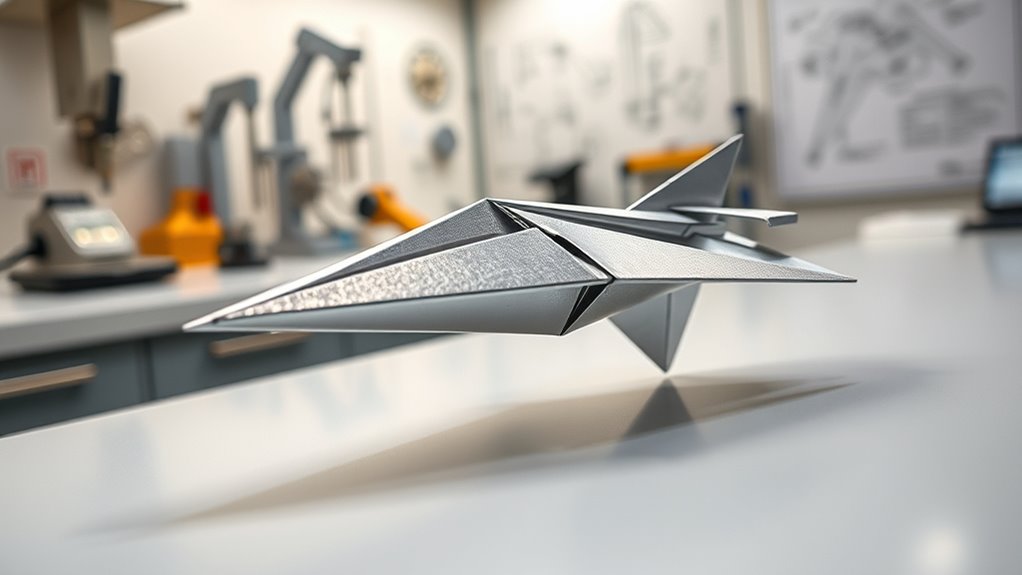

Origami engineering applies paper folding principles to space exploration, allowing you to create lightweight, compact structures that unfold reliably in space. You can design solar panels, antennas, and other large components to fold into small shapes for launch, then deploy easily in orbit. These techniques help save space, reduce weight, and improve deployment reliability in harsh conditions. If you want to explore how these innovative designs are changing space tech, there’s more to discover below.

Get art and craft supplies delivered free — and shop member deals
- Fast, free delivery on millions of items
- Access to Prime Big Deal Days deals on October 6–7
- Prime Video, Amazon Music and more included
Key Takeaways
- Origami engineering uses folding patterns to create compact, lightweight structures for space deployment, such as solar panels and antennas.
- These designs enable large structures to be folded into small forms for launch and reliably unfolded in space.
- Materials are selected for durability against space conditions, ensuring longevity through multiple folding cycles.
- Foldable structures improve payload efficiency and reduce mechanical complexity, enhancing mission reliability.
- Innovations in origami-inspired designs facilitate complex, large-scale space structures within strict launch constraints.

Origami engineering transforms simple paper folds into innovative solutions with real-world applications. By harnessing the principles of origami, you can create structures that are lightweight, compact, and capable of transforming into larger, functional forms. This approach is especially valuable in space exploration, where every gram counts and space constraints are essential. Imagine deploying solar panels or antennas in orbit—origami techniques allow these components to be folded into small, manageable shapes for launch and then unfolded into full size once in space. This clever use of folding patterns not only saves space but also simplifies the deployment process, reducing the risk of mechanical failure.
When it comes to solar panels, origami engineering enables you to design foldable arrays that can be compactly stowed during launch and then expand to their full size once in orbit. These solar arrays are indispensable for powering spacecraft, satellites, and space stations. Traditional rigid panels are bulky and difficult to store, but origami-inspired designs can be folded efficiently, fitting into small payloads and deploying reliably in the vacuum of space. Similarly, deployable antennas benefit from origami principles, allowing you to pack antennas into tight spaces and then unfold them into precise, functional shapes. These antennas are essential for communication, data transmission, and scientific measurements, and their origami-based deployment reduces complexity and weight while increasing reliability.
You play a key role in advancing space technology by applying origami patterns like the Miura fold or waterbomb fold to develop structures that are both durable and adaptable. These folds are designed to withstand the harsh conditions of space, including temperature fluctuations and radiation, without compromising their folding and unfolding capabilities. You might work on creating a satellite’s solar array that can be folded into a cube for launch and then unfolded into a broad, flat surface that maximizes sunlight absorption. Likewise, a deployable antenna can be stored as a compact shape and then precisely unfolded to ensure perfect signal transmission.
Origami engineering also opens up possibilities for future space missions, where multiple foldable components may work together seamlessly. You can innovate with materials that enhance the durability of these foldable structures, ensuring they perform reliably over extended missions. By integrating origami principles into space design, you help make complex, large-scale structures feasible within tight launch constraints. Your work guarantees that these structures deploy smoothly and function effectively, contributing to the success of space exploration efforts. Ultimately, origami transforms the way we approach space technology—making it smarter, lighter, and more adaptable.
foldable solar panels for satellites
As an affiliate, we earn on qualifying purchases.
As an affiliate, we earn on qualifying purchases.
Frequently Asked Questions
How Durable Are Origami Structures in Extreme Space Conditions?
You might wonder how durable origami structures are in extreme space conditions. Their material resilience depends on the materials used, like specialized polymers or composites designed for harsh environments. Advanced folding techniques ensure these structures can withstand temperature fluctuations, radiation, and vacuum conditions. With proper material selection and precise folding methods, origami-based space structures can maintain integrity and functionality, making them a promising solution for future space exploration challenges.
Can Origami-Inspired Designs Be Used for Large-Scale Space Habitats?
You can definitely use origami-inspired designs for large-scale space habitats because they promote sustainable design by enabling compact storage and easy deployment. These structures also offer aesthetic appeal with their innovative, foldable forms that blend functionality with beauty. By leveraging origami principles, you create lightweight, durable habitats that adapt to space constraints, making them a practical and visually appealing solution for future space exploration and colonization efforts.
What Materials Are Best Suited for Origami Engineering in Space Applications?
This question is vital because selecting the right materials can revolutionize space engineering! For space applications, you need materials that are lightweight, durable, and capable of withstanding extreme conditions. Think advanced composites, shape-memory alloys, and high-strength polymers. Your folding techniques should complement these materials, ensuring reliable deployment and compact storage. The perfect combo makes space structures resilient, adaptable, and ready to conquer the cosmos!
How Does Origami Reduce Deployment Time of Space Equipment?
You can improve deployment efficiency by using origami-inspired folding mechanisms, which allow space equipment to fold compactly and unfold quickly in orbit. This approach reduces deployment time because the pre-designed folds streamline the unfolding process, minimizing delays and potential malfunctions. By applying origami techniques, you make the deployment smoother, saving valuable time and ensuring that components expand reliably and efficiently once in space.
Are There Existing Spacecraft Utilizing Origami-Based Technology?
You’ll find that some spacecraft now utilize origami art and paper folding techniques to deploy large structures efficiently. These innovative designs allow for compact stowage during launch and easy unfolding in space. Companies and agencies are experimenting with origami-inspired technology for solar panels, antennas, and habitats, recognizing that this approach reduces deployment time and complexity. This trend is growing, making origami-based systems increasingly common in modern space missions.
As an affiliate, we earn on qualifying purchases.
Conclusion
As you fold the future with careful precision, remember that paper’s delicate strength mirrors human ingenuity. Each crease symbolizes a step forward, transforming simple material into complex marvels. In this dance of folds and dreams, origami becomes more than art—it’s a beacon guiding space’s uncharted paths. Embrace the symbolism of your craft, for in every fold lies the power to shape horizons, turning fragile beginnings into resilient journeys beyond the stars.
origami-inspired space structures
As an affiliate, we earn on qualifying purchases.
As an affiliate, we earn on qualifying purchases.
As an affiliate, we earn on qualifying purchases.
Halloween Picks
halloween
As an affiliate, we earn on qualifying purchases.