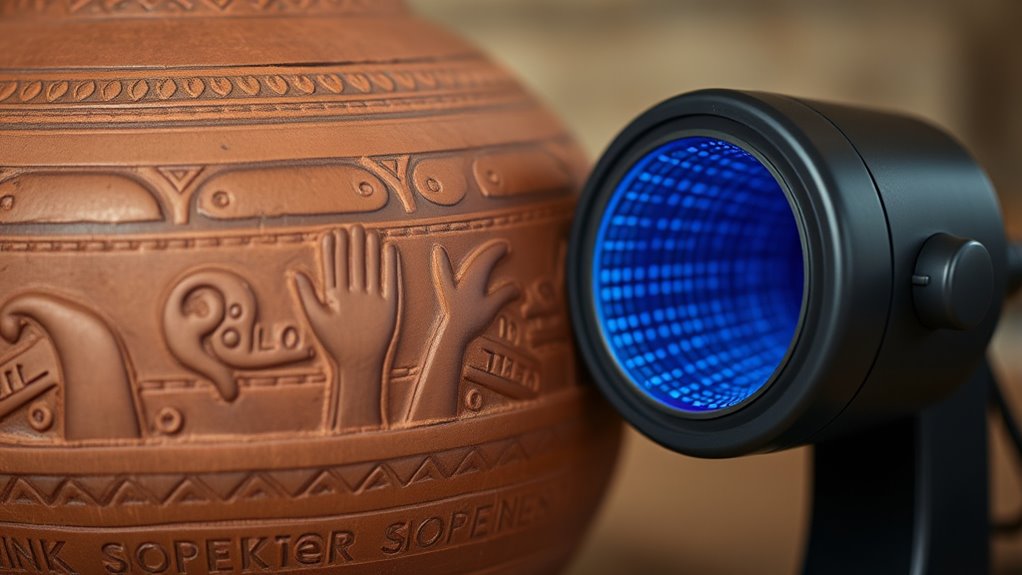

Using 3D scanning, you can transform ancient pottery into detailed digital records, capturing surface details, decorations, and craftsmanship without risking damage. This technology helps preserve cultural heritage, enables virtual reconstructions, and enhances research by revealing manufacturing techniques. It offers easier sharing with institutions worldwide and supports conservation efforts. If you explore further, you’ll see how this innovative process revolutionizes how we study and preserve pottery for future generations.

Get art and craft supplies delivered free with Prime
- Fast, free delivery on millions of items
- Prime Video, Amazon Music and more included
- Member-only deals all year
Key Takeaways
- 3D scanning creates precise digital replicas of pottery, capturing surface details, decorations, and irregularities.
- Digitization facilitates virtual reconstruction, analysis, and comparison of artifacts without physical handling.
- Digital models support cultural preservation, sharing, and virtual exhibitions accessible worldwide.
- 3D scans enable non-destructive examination, revealing manufacturing techniques and wear patterns.
- Digital archives and detailed records aid conservation, authenticity verification, and future preservation efforts.
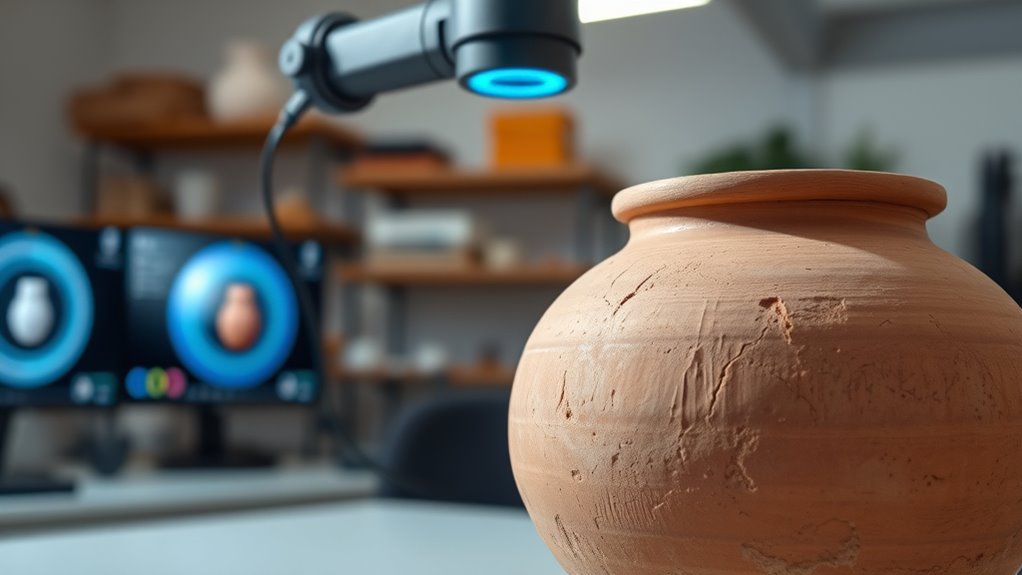
Thanks to advances in 3D scanning technology, traditional pottery is now being preserved and studied in unprecedented detail. This breakthrough has revolutionized ceramic preservation, allowing archaeologists and museums to create highly accurate digital replicas of ancient ceramics. This progress is especially crucial for digital archaeology, where every detail matters for understanding cultural contexts and craftsmanship. With 3D scans, you’re not limited by the fragility of fragile shards or the constraints of physical storage. Instead, you can examine, analyze, and share these digital artifacts across the globe, ensuring their preservation for future generations. When you scan a ceramic piece, you fundamentally convert its physicality into a detailed digital file. This process captures surface decorations, tool marks, and even subtle irregularities that might be overlooked with traditional methods. You can rotate, zoom in, and inspect every angle of the artifact without risking damage or losing valuable details. In addition, the accuracy of 3D scans enhances the ability to detect minute craftsmanship details that are often missed during manual examination. For researchers, this means gaining insights that were previously difficult to obtain, such as manufacturing techniques or wear patterns, which can reveal how ancient peoples used and valued these objects. Digital archaeology benefits immensely from this technology because it facilitates virtual reconstruction of broken or incomplete pottery, giving you a clearer understanding of historical contexts without destroying the original artifact. Moreover, the precision of 3D scanning allows for detailed material analysis, which helps differentiate authentic pieces from forgeries or later reproductions. This technology also supports the creation of digital archives that safeguard cultural heritage against loss or destruction caused by natural disasters or conflict. Additionally, 3D scanning not only preserves the physical appearance but also enables detailed analysis of surface textures and material composition, which are essential aspects of understanding craftsmanship and authenticity. This comprehensive data supports conservation efforts by providing a detailed record that can be referenced throughout the artifact’s lifespan. Furthermore, 3D scanning enhances collaborative research efforts. You can share digital models easily with colleagues, museums, or educational institutions worldwide. This democratization of access ensures that more people can study and appreciate these artifacts, regardless of geographic or financial barriers. It also opens up possibilities for virtual exhibitions, where you can display 3D models online, allowing viewers to interact with the artifacts in ways that physical displays simply can’t match. For conservationists, digital models serve as detailed records that can help monitor the condition of the original objects over time, guiding preservation efforts more effectively.
As an affiliate, we earn on qualifying purchases.
Frequently Asked Questions
How Does 3D Scanning Improve Pottery Conservation Efforts?
You see, 3D scanning enhances pottery conservation by enabling precise digital preservation of fragile artifacts. It creates detailed models that help you analyze and document condition over time, making restoration techniques more accurate. With these digital copies, you can safely study and share artifacts without risking damage, ensuring their longevity. This technology improves conservation efforts by providing a reliable reference for future restoration and research, safeguarding cultural heritage effectively.
What Materials Can Be Effectively Scanned Using 3D Technology?
You can effectively scan materials like ceramics and clay, but keep in mind that ceramic durability and surface reflectivity influence scan quality. Smooth, matte surfaces are easier to capture, while shiny or reflective surfaces may require special preparation or settings. By adjusting scanning parameters, you guarantee accurate digital models, making 3D scanning a powerful tool for preserving and studying pottery, regardless of material complexity or surface finish.
Can 3D Scans Replace Physical Pottery Displays in Museums?
Imagine virtual exhibits as windows into history, where 3D scans serve as digital keys. While they can perfectly recreate details for digital archiving, they can’t fully replace the tactile, sensory experience of physical pottery in museums. You can explore and learn from virtual exhibits anytime, but the feel and presence of real artifacts offer an irreplaceable connection. 3D scans complement, rather than substitute, the authenticity of physical displays.
How Accessible Is 3D Scanning Technology for Small Archaeological Projects?
You might wonder how accessible 3D scanning is for small archaeological projects. While the technology offers great benefits, cost barriers can be significant, especially for limited budgets. Additionally, you’ll need some technical expertise to operate the scanners and process the data effectively. However, affordable options are emerging, and training resources are becoming more available, making it increasingly feasible for smaller projects to incorporate 3D scanning into their work.
What Are the Limitations of Current 3D Scanning Methods for Pottery?
Like a mirror reflecting a faded image, current 3D scanning methods face resolution constraints that blur fine details, limiting accuracy. Surface reflectivity acts as a barrier, causing scans to falter on shiny or uneven pottery surfaces. These technical limitations hinder capturing the full richness of artifacts, making it harder to preserve intricate designs or textures. Overcoming these challenges is essential to truly access the stories held within each piece.
digital artifact preservation tools
As an affiliate, we earn on qualifying purchases.
As an affiliate, we earn on qualifying purchases.
Conclusion
Now, imagine holding a centuries-old masterpiece in your hands—digitized with such precision, it’s like time travel at your fingertips. Thanks to 3D scanning, you’re not just preserving pottery; you’re revealing secrets of ancient civilizations and making history accessible to everyone. This technology doesn’t just change the game—it completely rewrites it. So, get ready to witness the impossible, because the future of art and archaeology is now, and it’s more incredible than you ever dreamed!
3D modeling software for ceramics
As an affiliate, we earn on qualifying purchases.
As an affiliate, we earn on qualifying purchases.
portable 3D scanner for art conservation
As an affiliate, we earn on qualifying purchases.
As an affiliate, we earn on qualifying purchases.
Halloween Picks
halloween
As an affiliate, we earn on qualifying purchases.