
TL;DR

Get art and craft supplies delivered free with Prime
- Fast, free delivery on millions of items
- Prime Video, Amazon Music and more included
- Member-only deals all year
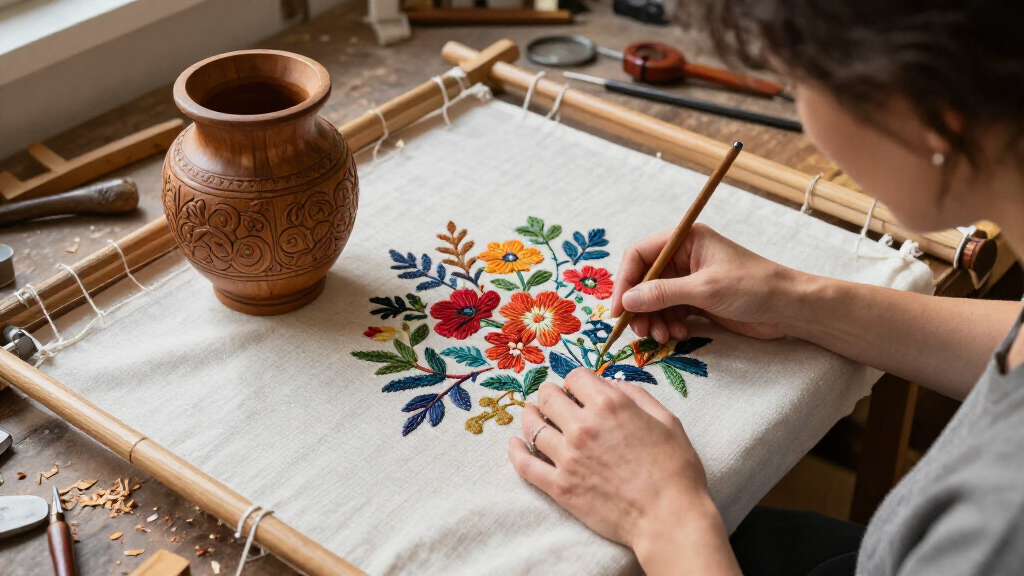
Furniture-maker and artist Aspen Golann has translated motifs from early American embroidery into carved wooden vessels and a five-foot-tall cabinet. The work emerged from an 18-month artisan residency organized by The Metropolitan Museum of Art and Vacheron Constantin; Crewel Cabinet is scheduled to appear in a New York group exhibition opening November 6, 2026.
Artist and furniture-maker Aspen Golann has translated motifs from early American needlework into hand-carved wooden vessels and a five-foot-tall cabinet, bringing a historically domestic craft into sculptural furniture. Her Crewel Cabinet is scheduled to be shown in the group exhibition Pattern Recognition: Superhouse at Five, opening November 6 in New York City.
The wooden works grew out of Golann’s research into early embroidery, a practice pursued largely by women in colonial America. She began the vessel series through an 18-month artisan residency organized by The Metropolitan Museum of Art and Vacheron Constantin, a program focused on preserving and reinterpreting traditional craft techniques. Ceramicist Ibrahim Said and jeweler Joy Harvey also took part in the residency.
In works including Pouring Vessel and Strap-Carved Vessel, Golann uses strapworking and carving to adapt needlework patterns to solid wood. The flatter vessel remains hollow, according to the report, while its unusual shape draws attention to its decorated surface. The pieces explore the boundary between useful object and display piece.
Crewel Cabinet, completed during the residency, stands five feet, four inches tall. Its rounded form is built from 37 narrow wooden staves, each made from 14 colored layers. Golann carved images of plants and animals, including rabbits and dogs, into the layered material; the changing colors evoke the threads used in colonial-era crewel embroidery.
Embroidery Recast at Furniture Scale
The project gives Golann a way to bring the imagery of small, often private needlework into large-scale carved furniture. The historical embroideries were frequently made by young women and served as dowry objects, according to Golann. Her cabinet takes visual cues from that tradition but changes the medium, scale and presentation.
That shift matters because, as Golann told Colossal, the needlework is under-researched and under-displayed in major art institutions. The carved forms do not replace or preserve the fragile textiles themselves; instead, they interpret their patterns and imagery in a durable material intended to be seen as sculpture as well as furniture. The work also raises questions about how domestic objects record their makers’ creativity and circumstances.
Popular right now

Shark Clean & Empty Cordless Stick Vacuum with Auto-Empty System, BU3521

Dyson Ball Animal 3 Upright Vacuum

Dyson V8 Cyclone Cordless Vacuum
As an affiliate, we earn on qualifying purchases.
From Colonial Needlework to Carving
Golann’s earlier furniture work also draws on early American design. In the 17th century, colonial furniture-makers adapted motifs and techniques associated with England. Golann’s Meeting Bench, made with chairmaker Peter Galbert, and Union Settee refer to a Boston interpretation of the high-backed Windsor chair, while giving the historical forms contemporary sculptural treatments.
Her interest in how objects connect people and function carries into the embroidery-inspired pieces. Golann has also explored everyday forms through imaginative brushes and brooms. The residency provided a framework for developing the wooden vessels and cabinet, combining research into traditional practice with her own approach to form, material and use.
““[The embroidery] is under-researched and under-displayed, and it’s fragile, rare, and stowable. I wanted to make some version of this thing that couldn’t be put away.””
— Aspen Golann, speaking to Colossal
Exhibition and Commission Details
The supplied report gives the dates and venue for the New York group exhibition but does not specify how many of Golann’s works will be shown there or whether the vessels will be included alongside Crewel Cabinet. It also does not provide details about ticketing or public access.
Golann said she is developing a furniture commission for the U.S. Treasury, but the report does not give a completion date or a confirmed public display schedule. The scope and opening date of her planned solo exhibition at Fuller Craft Museum are also not detailed beyond the report’s stated target of next November.
New York Show and Future Work
Pattern Recognition: Superhouse at Five is scheduled to open at Superhouse in New York City on November 6, 2026, and run through December 19. The report identifies Crewel Cabinet as part of the exhibition. Golann is also working toward a solo exhibition at the Fuller Craft Museum, slated to open next November, and developing the Treasury commission using reflective surfaces that will mirror viewers in its landscape.
Further details on the Treasury piece, the Fuller Craft Museum presentation and the works included in the Superhouse show have not been provided in the source report.
Key Questions
What is Aspen Golann’s Crewel Cabinet?
Crewel Cabinet is a five-foot-four-inch wooden cabinet carved with plants and animals inspired by early American embroidery. It is built from 37 wooden staves, each assembled from 14 colored layers.
Where can the cabinet be seen?
The cabinet is scheduled to appear in Pattern Recognition: Superhouse at Five at Superhouse in New York City. The exhibition is set to run from November 6 through December 19, 2026.
How does Golann translate embroidery into wood?
Golann uses carving and layered, colored wood to evoke needlework patterns and threads. Her works include carved vessels such as Pouring Vessel and Strap-Carved Vessel, as well as the larger cabinet.
What is Golann working on next?
Golann told Colossal she is developing a furniture piece for the U.S. Treasury inspired by early American embroidery and working toward a solo exhibition at Fuller Craft Museum, slated for next November. Further dates and details were not provided.
Source: thisiscolossal.com