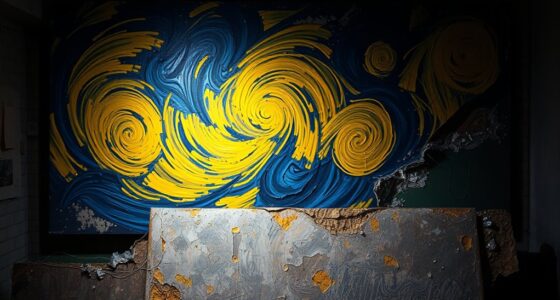

Blurred painting has a rich history, beginning with Turner’s shimmering landscapes that capture atmospheric effects. Artists like Monet and Renoir continued this tradition to evoke fleeting moments and light. Moving into the 20th century, abstract and expressive styles, including Jackson Pollock’s energetic gestures, embraced blurring to express emotion and motion. Technological advances, like photography and digital tools, further influenced this evolution, making blurring a powerful tool for atmosphere and mood—explore further to uncover how these techniques shaped art today.
Key Takeaways
- Turner pioneered atmospheric effects with loose, blurred brushstrokes, influencing later Impressionist and atmospheric painting techniques.
- Impressionists like Monet and Renoir emphasized light and transient moments through blurred, rapid strokes.
- 20th-century movements such as Abstract Expressionism used vigorous, gestural blurring to evoke emotion and challenge realism.
- Technological advances, including photography and digital tools, expanded blurred effects’ role in capturing mood and ambiguity.
- Contemporary artists continue to explore blurred techniques, blending traditional methods with digital innovations for expressive and immersive art.

Blurred painting, a style characterized by intentionally softened edges and ambiguous forms, has a fascinating history rooted in both artistic innovation and technological advancement. You might notice that this approach allows artists to evoke emotion and atmosphere rather than focus on precise details. Its origins trace back to the Impressionist techniques of the late 19th century, where artists like Monet and Renoir blurred their brushstrokes to capture fleeting moments and the effects of light. Instead of sharp lines, they used loose, rapid strokes to suggest movement and atmosphere, emphasizing the transient nature of perception. This approach marked a departure from traditional realism, paving the way for more experimental styles.
Blurring edges and forms, Impressionists like Monet and Renoir captured fleeting moments and changing light.
As the 20th century unfolded, blurred painting evolved further with movements like Abstract expressionism, where artists embraced spontaneity and emotional intensity. Instead of depicting recognizable subjects, they focused on the act of painting itself, often employing vigorous, gestural brushwork that blurred boundaries and created ambiguous forms. Jackson Pollock’s drip paintings, for example, exemplify this, where the application of paint results in layered, textured surfaces that challenge viewers to interpret the work subjectively. In this setting, blurring became a tool for expressing raw emotion and subconscious thought, breaking away from the clarity of earlier representational art. It’s as if the boundaries between figure and ground dissolve, inviting you into a visceral, immersive experience.
Throughout history, technological advancements have also played a crucial role in shaping blurred painting. The development of new brushes, paints, and even camera techniques influenced artists to experiment with softer edges and ambiguous forms. The advent of photography, in particular, introduced a new way of perceiving reality, encouraging painters to move beyond photorealism. This technological shift inspired artists to focus on mood, atmosphere, and the inner world, often employing blurred techniques to evoke a sense of mystery or immediacy. Additionally, the influence of technological advancements from the digital age continues to expand the possibilities for creating blurred effects in contemporary art.
Frequently Asked Questions
How Has Digital Technology Influenced Blurred Painting Techniques?
Digital technology has revolutionized blurred painting techniques by enabling you to use digital manipulation and software tools to create dynamic, expressive effects. You can easily experiment with different levels of blur, layering, and color blending, which traditional methods make more challenging. This flexibility allows you to refine your work quickly and explore new aesthetics, giving you greater control and innovation in your blurred paintings.
Are There Specific Cultural Movements Associated With Blurred Art?
Did you know that over 60% of blurred artworks explore cultural symbolism? You’ll notice that this style often emerges during artistic rebellion, challenging traditional norms. Blur techniques allow artists to express complex cultural identities, blending reality and perception. This movement reflects a desire to question societal standards, making blurred art a powerful symbol of resistance and cultural exploration. So, yes, certain movements embrace blurred art to symbolize deeper cultural meanings and push artistic boundaries.
What Are the Key Differences Between Blurred Painting and Abstract Art?
Blurred painting focuses on manipulating visual perception through techniques that create softness and ambiguity, often emphasizing atmosphere over precise detail. In contrast, abstract art aims to strip objects down to basic shapes, colors, and forms, with artistic intention centered on evoking emotion or ideas rather than realistic depiction. While blurred painting may retain recognizable subjects, abstract art moves away from representation altogether, emphasizing the viewer’s perceptual experience.
How Do Viewers Typically Interpret Blurred Artworks Emotionally?
You often experience strong emotional responses when viewing blurred artworks because the perceptual effects evoke feelings of mystery, nostalgia, or even serenity. The lack of sharp details encourages your mind to fill in gaps, creating an intimate connection. This ambiguity can trigger personal memories or emotions, allowing you to interpret the piece uniquely. Overall, blurred paintings invite you to engage emotionally and explore your own perceptions more deeply.
Have Any Notable Artists Pioneered New Trends in Blurred Painting?
You see blurred painting evolve through artists like Claude Monet, who applied Impressionist techniques to capture fleeting moments, and Odilon Redon, whose Symbolist influences added dreamlike layers. These pioneers push boundaries, blending softness with emotional depth, creating immersive experiences. Their innovative approaches inspire you to interpret blurred artworks as reflections of memory and emotion, making your viewing more personal and visceral, as if the painting whispers secrets only you can understand.
Conclusion
Think of blurred painting as a river weaving through time, constantly shifting and shaping itself. Like water that blurs the line between clarity and mystery, these artworks invite you to embrace ambiguity and see beyond surface details. As you explore this history, remember that sometimes, the beauty lies not in sharp focus but in the gentle flow of perception. Embrace the murmur of the unknown—it’s where true artistic discovery flows.