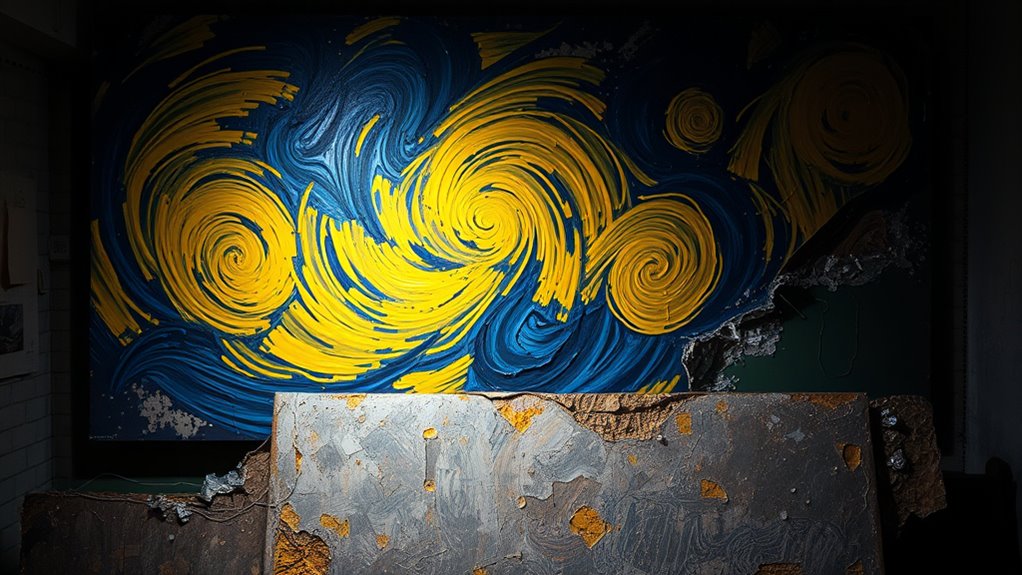

You’ll notice that Van Gogh’s expressive brushwork and vibrant colors influence Anselm Kiefer’s art through textured surfaces and layered materials that evoke strong emotions. Kiefer uses symbolic colors, like fiery reds and earthy browns, to communicate themes of memory, trauma, and spiritual awakening. His emotional intensity and physicality reflect Van Gogh’s raw human emotion. If you explore further, you’ll discover how Kiefer channels Van Gogh’s legacy to deepen cultural and personal storytelling through his art.
Key Takeaways
- Kiefer adopts Van Gogh’s expressive brushwork and textured surfaces to evoke raw emotional depth in his work.
- The use of bold, symbolic colors in Kiefer’s art reflects Van Gogh’s influence on emotional and thematic expression.
- Both artists utilize color symbolism to explore themes of memory, trauma, and spiritual awakening.
- Kiefer’s layered materials and physical textures mirror Van Gogh’s impasto technique, emphasizing tactile emotional engagement.
- Van Gogh’s legacy as an emotional and symbolic colorist significantly informs Kiefer’s artistic approach and thematic depth.
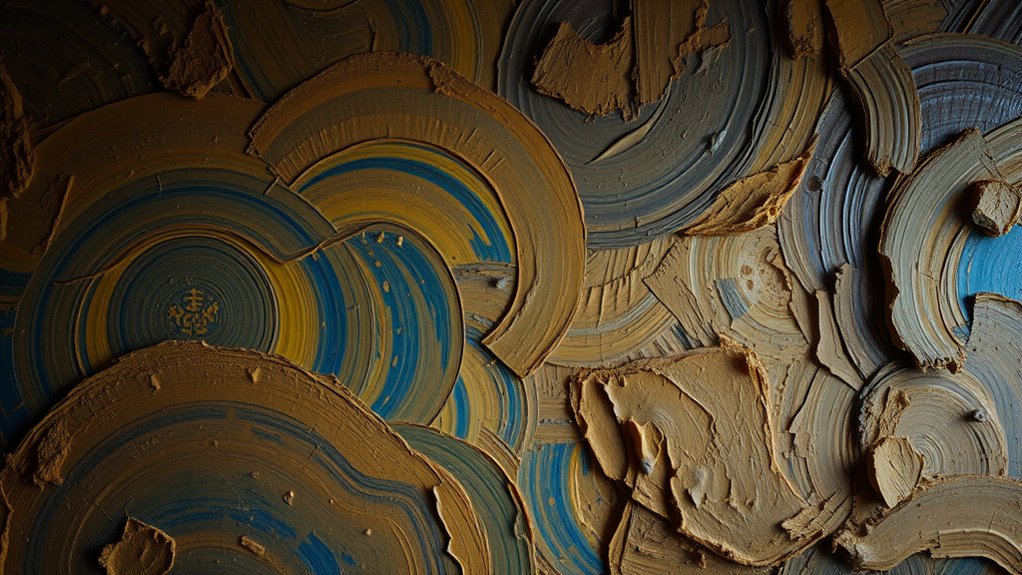
Van Gogh’s bold use of color and expressive brushwork have profoundly influenced Anselm Kiefer’s approach to art, shaping his exploration of history, memory, and trauma. When you look at Kiefer’s work, you notice how he employs color symbolism to evoke deep emotional responses. Just as Van Gogh used vivid, often contrasting hues to convey feelings, Kiefer harnesses color to symbolize complex themes like despair, hope, loss, and resilience. You might see fiery reds and dark earth tones in Kiefer’s canvases, which evoke a sense of urgency or mourning, reflecting the weight of historical trauma. These choices aren’t random; they serve as emotional signposts, guiding you through layers of collective memory and personal history. Additionally, Kiefer’s use of textured surfaces and layered materials echoes Van Gogh’s impasto technique, creating a tactile quality that pulls viewers into an emotional dialogue with the artwork. The emotional expression in Kiefer’s art echoes Van Gogh’s intent to communicate raw human emotion. You feel it in the textured surfaces, the thick impasto, and the layered materials that give his works a visceral quality. Kiefer, like Van Gogh, doesn’t shy away from expressing anguish or hope; instead, he amplifies these feelings through physicality and color. When you stand before a Kiefer piece, you can sense the tumult of the artist’s emotional landscape, similar to how Van Gogh’s swirling skies and vibrant fields seem to pulse with his inner life. This emotional intensity invites you to connect intimately with the artwork, experiencing the raw power of human vulnerability. Van Gogh’s influence also manifests in Kiefer’s deliberate use of color to symbolize broader historical and cultural themes. You might see earthy browns and ochres representing memory and decay, or luminous yellows symbolizing enlightenment or spiritual awakening. These colors aren’t just aesthetic choices—they act as visual metaphors that deepen your understanding of the layered narratives within Kiefer’s work. You’re encouraged to interpret the symbolism, to reflect on how color can carry emotional resonance beyond mere representation. Through this, Kiefer channels Van Gogh’s legacy: making color a language for emotional expression that transcends words. In this way, Kiefer’s work exemplifies how color symbolism can serve as a powerful conduit for emotional expression and cultural commentary. In essence, Van Gogh’s mastery of color symbolism and emotional expression became a blueprint for Kiefer’s artistic language. Your engagement with Kiefer’s work is shaped by this lineage, where color acts as a conduit for conveying profound feelings and complex histories. As you observe his textured surfaces and layered hues, you recognize how Kiefer’s art continues Van Gogh’s tradition of using color as a powerful tool to evoke emotion, provoke thought, and connect deeply with viewers on a visceral level.
art textured palette knives
As an affiliate, we earn on qualifying purchases.
As an affiliate, we earn on qualifying purchases.
Frequently Asked Questions
How Did Van Gogh’s Color Palette Influence Kiefer’s Works?
You can see Van Gogh’s influence in Kiefer’s use of bold, expressive colors that evoke strong emotions through color symbolism. Van Gogh’s vibrant, textured palette inspires Kiefer’s layered techniques and expressive brushwork. By incorporating intense hues and dynamic contrasts, Kiefer emphasizes themes of memory and history. His artistic techniques, like thick impasto and vivid color choices, reflect Van Gogh’s passion for conveying raw, emotional depth in his artwork.
Are There Specific Van Gogh Paintings That Inspired Kiefer?
You’ll find Kiefer’s inspiration in Van Gogh’s “Starry Night” and “Wheatfield Encounter,” which echo in his bold, swirling textures and vivid colors. Imagine standing beneath Van Gogh’s tumultuous sky and feeling its energy energize Kiefer’s layered, emotional landscapes. These paintings sparked his fascination with nature’s raw power, inspiring him to explore themes of memory and history through similar vivid, expressive palettes.
Did Kiefer Ever Directly Reference Van Gogh in Interviews?
In interviews, Kiefer does reference Van Gogh, revealing how deeply the artist’s work influences his own artistic references. You’ll find he discusses Van Gogh’s emotional intensity and use of color, which inspire his approach to texture and expression. Kiefer appreciates Van Gogh’s ability to convey profound personal and historical themes, integrating these insights into his art. His interview insights highlight a conscious dialogue with Van Gogh’s legacy, shaping Kiefer’s powerful visual language.
How Does Kiefer Interpret Van Gogh’s Emotional Expression?
You see Kiefer interpret Van Gogh’s emotional expression through symbolism in brushwork and his use of spiritual motifs. He emphasizes raw, visceral textures to convey intense feelings, reflecting Van Gogh’s passionate style. Kiefer also incorporates spiritual symbols, such as crosses or celestial elements, to deepen the emotional resonance. This approach allows him to connect viewers with Van Gogh’s inner turmoil and spiritual quest, making his emotional expression more profound and layered.
Are There Thematic Overlaps Between Van Gogh and Kiefer’s Art?
You’ll see that Van Gogh and Kiefer share a tapestry woven with symbolism and spirituality, revealing deep mental health themes. Their art acts like mirrors reflecting inner struggles and search for transcendence. Kiefer’s textured landscapes and haunting symbolism echo Van Gogh’s emotional intensity and spiritual quests. Both artists challenge viewers to confront raw human experience, making their works resonate as powerful commentaries on mental health and the divine.
impasto painting brushes
As an affiliate, we earn on qualifying purchases.
As an affiliate, we earn on qualifying purchases.
Conclusion
You might think Van Gogh’s vibrant brushwork only inspires emotion, but it also challenges you to see beauty in imperfection and chaos. Kiefer’s work shows that true influence goes beyond style—it’s about embracing raw, transformative power. Don’t dismiss these connections as mere homage; they remind you that art’s deepest impact lies in how it pushes you to confront uncomfortable truths and find meaning amid disorder.
layered materials for mixed media art
As an affiliate, we earn on qualifying purchases.
As an affiliate, we earn on qualifying purchases.
symbolic color acrylic paints
As an affiliate, we earn on qualifying purchases.
As an affiliate, we earn on qualifying purchases.