TL;DR

Get art and craft supplies delivered free with Prime
- Fast, free delivery on millions of items
- Prime Video, Amazon Music and more included
- Member-only deals all year
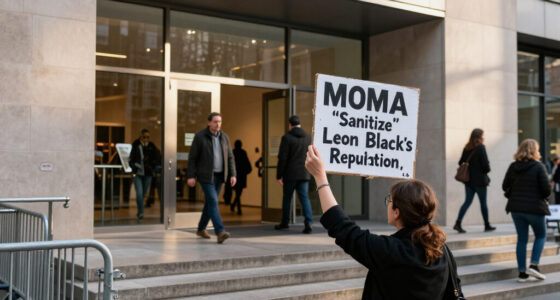
A person who identifies as a survivor of Jeffrey Epstein’s abuse has published an opinion essay in Hyperallergic calling on the Museum of Modern Art to remove Leon Black from its board. The essay argues that cultural institutions can lend prestige to powerful figures and should reckon with their associations; it does not report a new MoMA decision or establish wrongdoing by Black.
A person who identifies as a survivor of Jeffrey Epstein’s abuse has called on the Museum of Modern Art to remove Leon Black from its board, arguing in a Hyperallergic opinion essay that the museum should confront how its prestige can legitimize powerful figures. The essay presents a demand for institutional accountability, not an announcement that MoMA has acted or a report of a new finding about Black.
The essay, titled “I’m an Epstein Survivor. MoMA Must Drop Leon Black,” says the author has spent more than two decades asking why Epstein abused them. The writer argues that the explanation lies not only in Epstein’s manipulation but also in institutions and social structures that, in the author’s view, helped create conditions in which abuse of power could persist.
The author describes Black’s position on the MoMA board as an example of what they call institutional ignorance and a “look-the-other-way mentality.” Those descriptions are the writer’s judgments and the essay’s central argument. The supplied source material does not include a response from MoMA or Black, nor does it establish that the museum has considered or accepted the demand.
The article is explicitly labeled opinion by Hyperallergic. Its call for Black’s removal is advocacy by the author; it should not be read as a new legal finding or as confirmation of allegations beyond what the source reports. The material provided does not detail the specific basis for the author’s demand beyond Black’s connection to Epstein and his role at the museum.
The Stakes for MoMA’s Board
The demand focuses attention on how a major cultural institution handles the reputational consequences of its leaders’ associations. MoMA’s board role carries public visibility, and the writer argues that a prestigious museum can confer legitimacy. The question raised is whether the institution should treat board membership as separate from scrutiny of a member’s public associations.
For readers, the distinction between institutional accountability and proof of individual wrongdoing matters. The essay makes a moral and governance argument: that MoMA should act because of what the author sees as the risk of lending institutional standing. It does not, on the supplied information, establish that Black committed abuse or that MoMA’s board has reached a conclusion about his status.
Popular right now

Dyson Cyclone V10 Origin Cordless Vacuum

Ninja Foodi 10-Quart DualZone 6-in-1 Air Fryer, Black, DZ302

Samsung 42-Inch S90H OLED 4K Smart TV Bundle
As an affiliate, we earn on qualifying purchases.
The Essay’s Argument About Prestige
The essay links the author’s personal experience of abuse to a broader criticism of institutions that, in the writer’s view, can shield powerful people from scrutiny. Rather than offering a general account of Epstein’s crimes, it directs its argument at MoMA’s decision to retain Black on its board and asks the museum to take responsibility for the public meaning of that association.
The supplied source is a single opinion article, not a reported account of a board vote, an investigation, or a new museum policy. It identifies Black as a MoMA board member and frames his presence there as a matter requiring institutional reckoning. No additional timeline or detailed account of MoMA’s prior deliberations is included in the material provided.
““head-in-the-sand, look-the-other-way mentality””
— The essay’s author
MoMA’s Response Is Not Reported
The supplied source material does not say whether MoMA has responded to the essay, whether its board has discussed Black’s position, or whether any action is being considered. It also does not provide a statement from Black. The essay’s demand and its descriptions of institutional responsibility remain the author’s stated position; the material does not offer further evidence or a response that would resolve the dispute.
The source excerpt does not give a publication date or additional detail about the underlying allegations and investigations. Readers should distinguish the author’s account and argument from independently established facts not documented in the supplied material.
Any Board Decision Remains Unknown
The next development would be a public response from MoMA, a decision by its board about Black’s role, or further reporting that clarifies the museum’s position. None is described in the supplied source. Until then, the published essay stands as a public call for the museum to act, rather than evidence that it has decided to do so.
Any account of subsequent developments should establish whether MoMA or Black has commented and whether the board has taken formal action. The available material does not set out a timetable for a decision.
Key Questions
What is the news development?
A person identifying as an Epstein survivor published an opinion essay in Hyperallergic urging MoMA to remove Leon Black from its board.
Has MoMA agreed to remove Black?
The supplied source material does not report a MoMA decision or response. The removal demand is the essay author’s position.
Does the essay report a new legal finding about Black?
No new legal finding is reported in the supplied material. The article is labeled opinion and argues for institutional accountability.
Why does the author want MoMA to act?
The author argues that a prestigious institution can lend legitimacy to powerful people and says MoMA should reckon with Black’s association with Epstein and his board role.
Source: rss