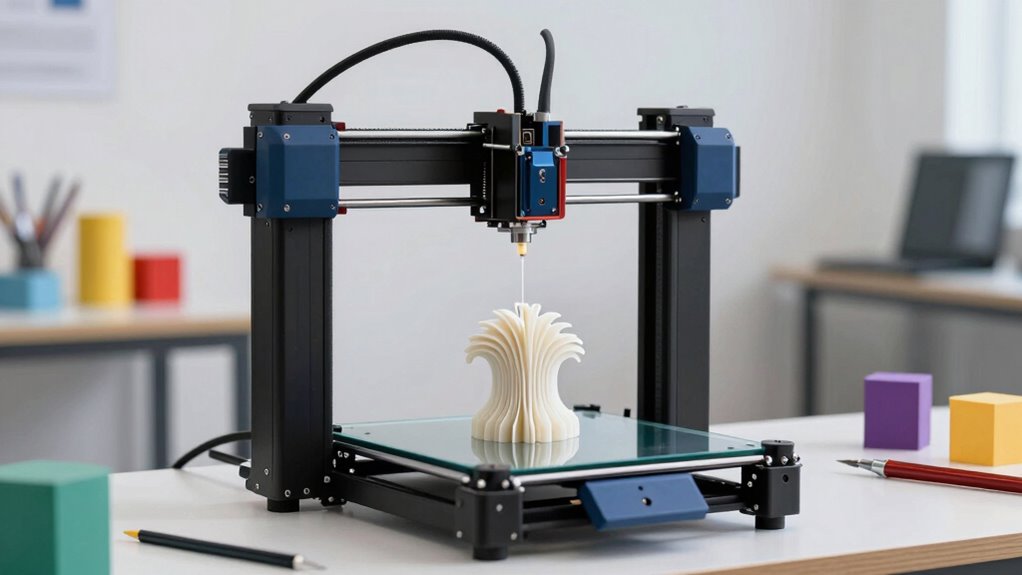
To prevent ugly prints, follow key design rules like maximizing contrast for detail visibility, maintaining simple textures, and ensuring smooth, well-organized surfaces. Shape your model with clean topology and avoid tiny details that can cause print failures. Use supports wisely on steep overhangs and choose materials suited to your artistic goals. Fine-tune settings for layer height and temperature. Keep these principles in mind, and you’ll discover effective ways to achieve professional-looking results every time.

Get art and craft supplies delivered free — and shop member deals
- Fast, free delivery on millions of items
- Access to Prime Big Deal Days deals on October 6–7
- Prime Video, Amazon Music and more included
Key Takeaways
- Ensure high color contrast and simple textures to enhance detail visibility and prevent surface defects.
- Maintain smooth, well-organized surfaces and manage complex geometry to reduce warping and layer separation.
- Design with gradual slopes and minimal overhangs to lessen support requirements and improve print quality.
- Choose appropriate materials and optimize print settings for clarity, precision, and artistic intent.
- Regularly troubleshoot by checking model strength, support placement, and environmental factors for a polished final print.
3D printing filament for artists
As an affiliate, we earn on qualifying purchases.
As an affiliate, we earn on qualifying purchases.
What Are the Key Design Rules to Prevent 3D Printing Failures?
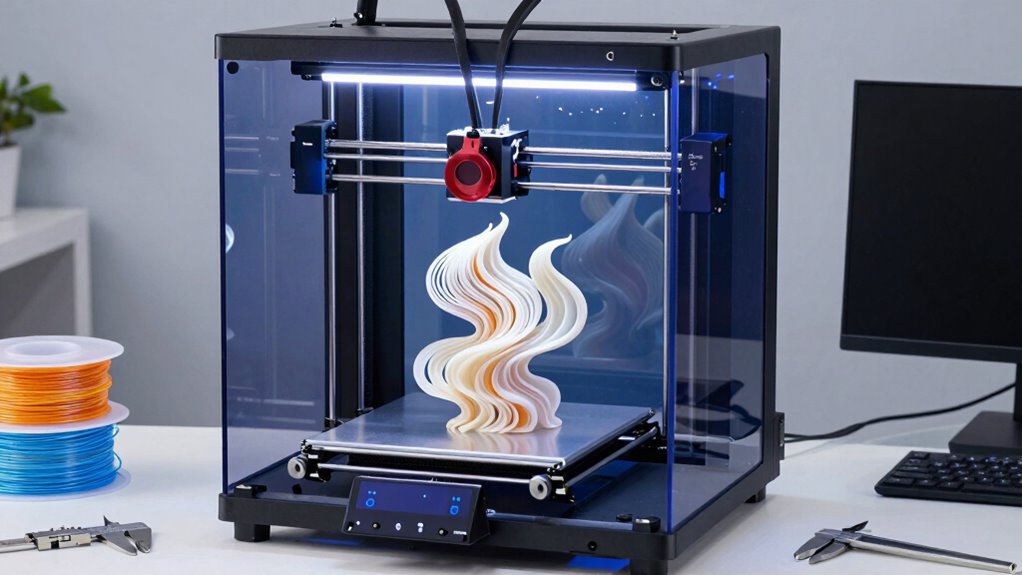
To prevent 3D printing failures, you need to follow essential design rules that guarantee your model prints successfully. One key rule involves considering color contrast, especially if you plan to use multiple filament colors. High contrast helps identify details and ensures color transitions print clearly. Additionally, surface texture matters; overly complex or rough textures can cause print defects or adhesion issues. Smooth surfaces reduce the risk of warping or layer separation, making your print more reliable. Keep your design simple and avoid tiny details that are hard to reproduce. Paying attention to digital content formats can also help you optimize your models for printing. By paying close attention to color contrast and surface texture, you minimize common failures and improve your chances of achieving a clean, professional-looking print. These guidelines help you create models optimized for successful 3D printing.
support structures for 3D printing
As an affiliate, we earn on qualifying purchases.
As an affiliate, we earn on qualifying purchases.
How Can You Shape Your Model’s Geometry for Better Prints?
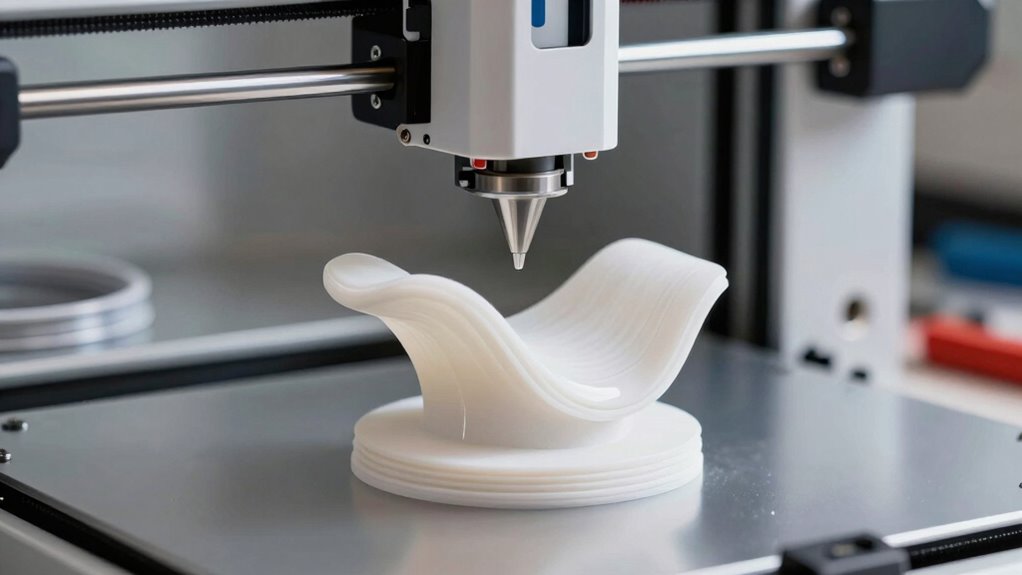
Have you considered how shaping your model’s geometry can improve print quality? Focusing on good model topology ensures your design has clean, well-organized surfaces that print smoothly. Avoid complex, unnecessary details that can create weak spots or cause layer misalignments. Use surface smoothing techniques to eliminate sharp edges or uneven areas, resulting in a more uniform surface. Simplify complex curves into manageable polygons to prevent overhang issues and improve layer adhesion. Properly distributing polygons and maintaining consistent wall thickness also enhance strength and finish. By refining your model’s geometry, you reduce print errors and surface imperfections, leading to cleaner, more professional results. Thoughtful topology and surface smoothing are essential steps for achieving high-quality 3D prints.
As an affiliate, we earn on qualifying purchases.
How to Use Support Structures and Overhangs Effectively?
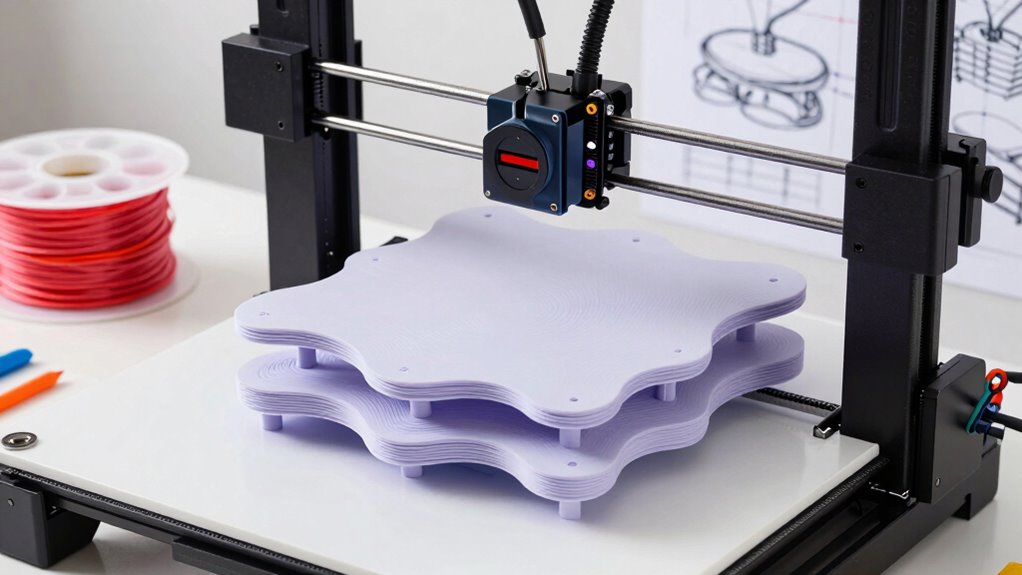
Optimizing your model’s geometry sets the stage for better support placement and overhang management. Focus on minimizing steep overhangs and designing gradual slopes to reduce support needs. Use support structure optimization tools to place supports only where necessary, avoiding excess material that can mar the surface. For overhang management, angle thresholds help you identify problematic areas; keep overhangs below 45° when possible. Here’s a quick guide:
| Overhang Angle | Support Strategy |
|---|---|
| 0-45° | Minimal or no support |
| 45-60° | Add supports selectively |
| 60°+ | Full support required |
| Steep angles | Use bridging techniques |
| Flat surfaces | No supports needed |
high contrast filament for 3D printing
As an affiliate, we earn on qualifying purchases.
As an affiliate, we earn on qualifying purchases.
Which Materials and Settings Will Bring Your Artistic Vision to Life?
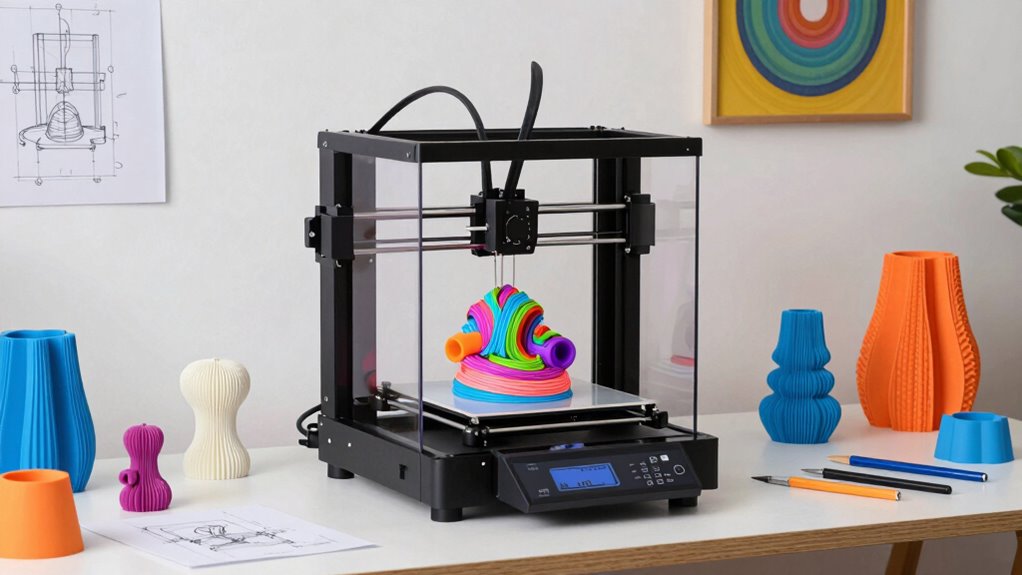
Choosing the right materials and settings is essential for transforming your artistic ideas into reality. Your material selection influences the final look, durability, and feel of your print, so select based on your aesthetic considerations—whether you want transparency, gloss, or matte finishes. For detailed, fine art, consider using resin or high-resolution filaments. For larger, structural pieces, ABS or PETG offer strength and stability. Adjust your print settings accordingly: layer height affects detail, print speed influences finish quality, and temperature impacts adhesion and surface smoothness. Fine-tuning these parameters ensures your artwork aligns with your creative vision. Remember, material properties and experimenting with different materials and settings helps you discover the perfect combination that brings your artistic expression to life with clarity and precision. Additionally, understanding print optimization techniques can help you avoid common issues such as warping or layer misalignment, ensuring a professional finish.
How Can You Troubleshoot and Refine Your Designs for Professional Results?

To achieve professional results, you need to carefully troubleshoot and refine your designs throughout the printing process. Your artistic inspiration and creative experimentation are vital, but attention to detail guarantees success. Start by examining your model for weak points, like overhangs or thin walls, and adjust accordingly. Use slicing software to tweak layer height, infill, and supports, optimizing print quality. Check for filament inconsistencies or clogs that could cause defects. Consider environmental factors like temperature and humidity that affect adhesion. Visualize your print as a sculpture in progress, with layers stacking smoothly. Think of your workflow as a series of creative experiments—each issue uncovered is a step toward mastery. Regularly review and refine your designs to build a polished, professional masterpiece. Additionally, understanding the ethical implications of 3D printing materials can help you choose sustainable options that align with responsible artistry.
Frequently Asked Questions
How Do Different 3D Printers Impact Design Considerations for Artists?
Different 3D printers impact your design considerations by influencing material compatibility and print resolution. You need to choose a printer suited for your chosen materials to avoid print failures. Higher resolution printers let you add intricate details, but may require more precise designs. Understanding your printer’s capabilities helps you optimize your models, ensuring they print smoothly and look professional, regardless of the printer’s specific features.
What Are the Best Practices for Optimizing Print Speed Without Sacrificing Quality?
To optimize print speed without sacrificing quality, you should adjust your print settings carefully. Use print speed optimization techniques like increasing layer height and reducing infill density where possible, but keep critical areas at higher quality settings. Make certain your printer’s temperature and cooling are properly calibrated. Regularly monitor your prints for issues, and consider using faster print modes for less detailed parts to balance speed and quality preservation effectively.
How Can I Incorporate Complex Textures Into My 3D Printed Artwork?
To incorporate complex textures into your 3D printed artwork, focus on texture mapping techniques that transfer intricate surface detailing onto your models. Use high-resolution textures and detailed meshes to capture fine features. Incorporate bump maps or normal maps to add depth without increasing print time. Combining these methods guarantees your prints showcase rich surface detailing, making your artwork stand out with realistic, complex textures that enhance visual interest.
What Post-Processing Techniques Enhance the Final Appearance of 3D Prints?
Think of post-processing as giving your sculpture a final polish. You can improve your print’s appearance through surface finishing, like sanding or applying fillers, to smooth rough areas. For color enhancement, consider painting, airbrushing, or applying dyes to bring vibrancy to your piece. These techniques transform your 3D print from raw to refined, making details pop and creating a professional, museum-ready artwork that truly captures your vision.
How Do Environmental Factors Influence Successful 3D Printing for Artists?
Environmental factors directly impact your 3D printing success. Material stability depends on maintaining consistent ambient temperature; fluctuations can cause warping or layer separation. Make sure your workspace is climate-controlled, avoiding drafts and temperature swings. Humidity also affects filament quality, so keep materials dry. By controlling these factors, you improve print adhesion, reduce errors, and achieve smoother, more professional results in your artistic projects.
Conclusion
By following these design rules, you’ll turn your 3D prints from rough to remarkable. Think of each mistake as a stepping stone toward mastery—perfection takes patience. Remember, “a journey of a thousand miles begins with a single step,” so keep experimenting, refining, and learning. With persistence and attention to detail, your artistic vision will come to life beautifully, avoiding ugly prints and creating works that truly stand out.
Halloween Picks
halloween
As an affiliate, we earn on qualifying purchases.