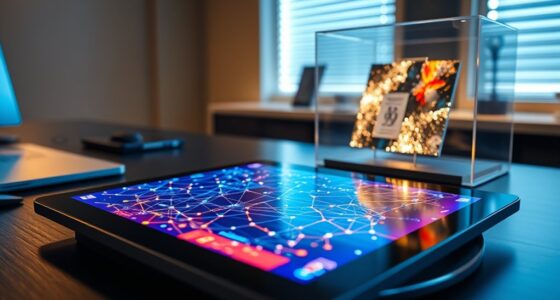
Digital twins for museums and heritage sites let you create accurate, real-time digital replicas of artifacts and locations. They help you visualize conservation efforts, plan maintenance, and monitor environmental conditions to prevent damage. You can also offer immersive virtual tours and interactive displays, enhancing visitor engagement and education. These tools make preservation more precise and cost-effective while increasing accessibility. Stay tuned to discover how this innovative technology is shaping cultural heritage preservation worldwide.
Key Takeaways
- Create accurate, real-time digital replicas of artifacts and sites for enhanced preservation, restoration, and monitoring.
- Enable immersive virtual tours and interactive displays to engage visitors remotely and deepen their cultural experience.
- Support non-invasive conservation methods by simulating repairs and testing techniques digitally before physical implementation.
- Facilitate educational initiatives through manipulatable digital models, virtual exhibits, and storytelling to promote cultural understanding.
- Assist heritage managers in ongoing site management by tracking environmental conditions and structural health remotely.

Digital twins are revolutionizing how museums and heritage sites are preserved, managed, and experienced. By creating accurate, real-time digital replicas of physical objects and environments, you gain powerful tools to enhance preservation and accessibility. One of the most exciting applications is virtual restoration, where digital twins allow you to simulate repairs or conservation efforts without risking damage to the original artifacts. This process lets you visualize how restored pieces will look, test different conservation techniques, and plan interventions more effectively. Instead of invasive procedures or physical handling, you can perform virtual restorations that preserve the integrity of precious artifacts, making conservation safer, more precise, and cost-efficient.
As a visitor, you benefit from these innovations through increased engagement and immersive experiences. Digital twins enable you to explore artifacts and sites in ways that were previously impossible. You can virtually walk through a reconstructed ancient city or examine a fragile artifact up close, all from the comfort of your home or on-site via interactive displays. This level of engagement deepens your understanding and appreciation, transforming passive observation into active participation. Additionally, virtual restoration projects can be showcased through engaging digital presentations, allowing you to see the evolution of artifacts over time—how they’ve been restored or conserved—adding a new layer of storytelling and context.
In addition to enhancing your experience, digital twins serve as crucial tools for educational outreach. They allow you to access detailed, accurate replicas that can be manipulated, rotated, and examined from different angles, enriching your learning process. Museums can also use these digital models to create personalized tours or virtual exhibits, making cultural heritage more accessible regardless of your location. For visitors and curators alike, this means a more interactive, engaging, and informative experience that bridges the gap between the past and present.
Furthermore, digital twins facilitate ongoing management and monitoring of heritage sites. They enable real-time tracking of environmental conditions, structural integrity, and conservation status, which helps prevent deterioration and plan maintenance. This proactive approach ensures that artifacts and sites are preserved for future generations, and you can be confident that the cultural treasures you value are being cared for with cutting-edge technology. Additionally, understanding the role of cybersecurity in protecting digital twin data is essential for maintaining the integrity and security of these valuable digital assets.
In essence, digital twins enhance visitor engagement by opening up new avenues for interaction while supporting virtual restoration efforts that preserve the authenticity and history of heritage sites. They empower museums and heritage managers to present history in innovative ways, making cultural education more dynamic, accessible, and sustainable. As you explore these digital innovations, you become part of a future where preserving and experiencing cultural heritage is more immersive and meaningful than ever before.

The Truth About Stem Cells
As an affiliate, we earn on qualifying purchases.
As an affiliate, we earn on qualifying purchases.
Frequently Asked Questions
How Do Digital Twins Impact Visitor Engagement?
Digital twins markedly boost your visitor engagement by offering interactive exhibits that immerse you in the experience. With augmented reality, you can explore artifacts and sites virtually, making learning more dynamic and personalized. These technologies make visits more memorable and engaging, encouraging you to spend more time exploring and discovering. As a result, digital twins create a deeper connection to the exhibits, enriching your overall experience and fostering lasting interest.
What Are the Costs Involved in Creating Digital Twins?
Like Da Vinci’s sketches, creating digital twins requires careful planning. You’ll need to contemplate costs like 3D scanning, software development, and ongoing maintenance. Cost estimation helps you allocate your budget efficiently, ensuring you don’t overspend. You should also factor in hardware, data storage, and staff training. By doing thorough budget planning upfront, you can avoid surprises and make smart investments that bring your digital twin project to life effectively.
How Is Data Privacy Maintained With Digital Twins?
You guarantee privacy concerns and data security by implementing strict access controls and encryption methods. Regularly update security protocols to protect sensitive information from breaches. You also anonymize data where possible and follow relevant regulations like GDPR. By monitoring data activity and conducting security audits, you keep digital twins safe from unauthorized access, giving visitors and stakeholders confidence that their data remains private and protected at all times.
Can Digital Twins Be Updated in Real-Time?
Yes, digital twins can be updated in real time. You benefit from real-time synchronization, ensuring your digital replica reflects live changes instantly. They also support dynamic content updates, allowing you to adapt information, visuals, or environmental data on the fly. This continuous updating enhances your experience, providing current insights and a more immersive, accurate representation of the physical counterpart at any given moment.
What Are the Technical Challenges of Implementing Digital Twins?
You face several technical challenges when implementing digital twins, especially with sensor integration and data synchronization. Ensuring seamless sensor data collection and real-time updates can be complex, requiring robust hardware and software. You also need to manage data consistency across systems, avoid latency issues, and handle large volumes of data efficiently. Overcoming these hurdles is vital for creating accurate, reliable digital twins that enhance your understanding and management of heritage sites.

3D VR Headset, Virtual Reality Glasses Headset Helmets, Compatible with 5.0-7.0 inch with Controller, for Mobile Games & Movies(Black)
【Immersive 3D Movie Viewing】Gaming and watching movies in 3D works best when proper your eyes properly align with…
As an affiliate, we earn on qualifying purchases.
As an affiliate, we earn on qualifying purchases.
Conclusion
Embracing digital twins is like holding a timeless key, opening access to history and culture from anywhere. They symbolize the bridge between the past and future, allowing you to explore heritage sites in vivid detail while preserving their spirit. By adopting this technology, you become a guardian of history, ensuring that these treasures continue to inspire generations. Let digital twins be your guiding light, illuminating the path to enduring cultural preservation and connection.

3DeVOK MT 3D Scanner Kit for Reverse Engineering, CAD Modeling, 3D Printing, Product Design, Animation, Game Design, Art, Architecture, Car Repairs, Research & Industrial Quality Inspection
Trusted by the pros due to its unmatched accuracy & speed. Achieve up to 0.0016 inches (0.04 mm)…
As an affiliate, we earn on qualifying purchases.
As an affiliate, we earn on qualifying purchases.
environmental monitoring sensors for heritage sites
As an affiliate, we earn on qualifying purchases.
As an affiliate, we earn on qualifying purchases.