
TL;DR

Get art and craft supplies delivered free with Prime
- Fast, free delivery on millions of items
- Prime Video, Amazon Music and more included
- Member-only deals all year
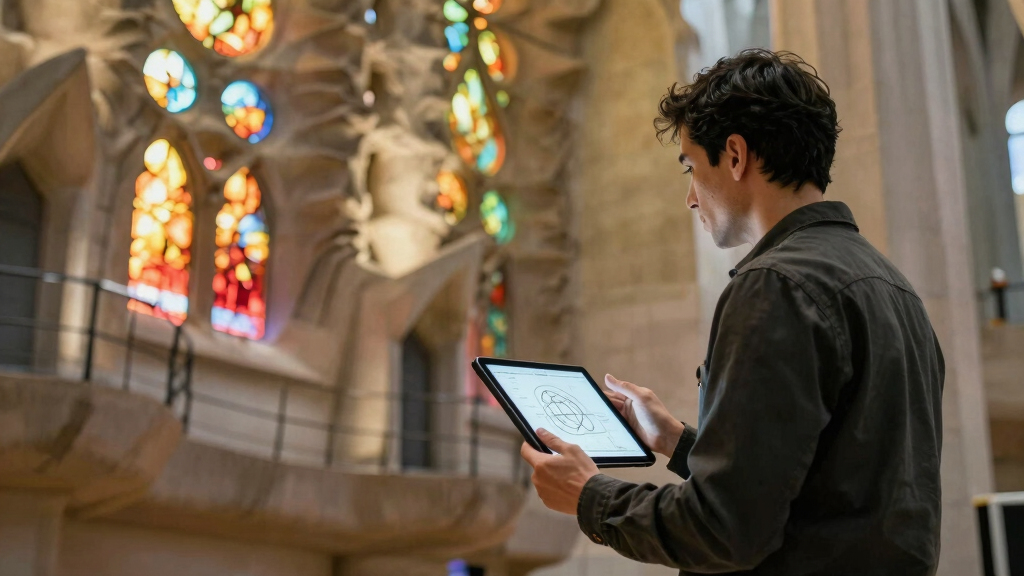
Recent research suggests that Antoni Gaudí’s crypt at Colònia Güell significantly influenced the emergence of parametricism. Experts are examining how Gaudí’s innovative use of geometry paved the way for modern computational architecture. This connection reshapes understanding of architectural evolution.
Recent scholarly analysis indicates that Antoni Gaudí’s crypt at Colònia Güell played a crucial role in shaping the principles of parametricism, a contemporary architectural style driven by computational design. This connection highlights Gaudí’s innovative use of complex geometry as a foundational influence on modern architecture.
Architectural historians and researchers are examining Gaudí’s crypt, constructed between 1898 and 1915, as an early example of complex, organic geometries that prefigure parametric design. While Gaudí’s work was primarily handcrafted, its emphasis on intricate, rule-based forms aligns with the computational logic central to parametricism. Recent studies suggest that Gaudí’s pioneering use of hyperbolic paraboloids and catenary arches served as a conceptual bridge to later parametric techniques.
Experts note that Gaudí’s integration of natural forms and geometric precision in the crypt exemplifies a non-linear approach to architecture that resonates with current parametric methods. Although Gaudí did not use digital tools, his methodology of employing geometric rules and iterative processes laid groundwork that contemporary architects have drawn upon with advanced computational tools.
Scholars emphasize that this reinterpretation of Gaudí’s work does not diminish his originality but rather contextualizes his influence within a broader historical evolution of architectural thought, leading up to the digital age.
Implications of Gaudí’s Crypt for Modern Architectural Theory
This connection underscores how early architectural experimentation with complex forms influenced the development of parametricism, a style dominant in contemporary architecture. Recognizing Gaudí’s crypt as a precursor challenges traditional narratives that associate parametricism solely with digital tools, highlighting instead the foundational role of geometric innovation. This insight may influence current architectural education and practice, emphasizing the importance of historical precedents in computational design.
As an affiliate, we earn on qualifying purchases.
Gaudí’s Innovative Geometry and Its Historical Impact
Antoni Gaudí, active in the late 19th and early 20th centuries, was renowned for his organic, highly detailed architectural style. His work on the crypt at Colònia Güell is notable for its complex geometries, including hyperbolic paraboloids and catenary arches, which he crafted through meticulous manual calculations and modeling. Although predating digital computation, Gaudí’s approach embodied a rule-based, iterative process that aligns with principles later formalized in parametric design.
Recent scholarly interest has shifted towards understanding how Gaudí’s geometric explorations anticipated the capabilities of modern computational tools. This perspective situates Gaudí as a visionary whose work foreshadowed the parametric paradigm that now dominates architecture.
“Gaudí’s crypt exemplifies a non-linear approach to form generation that resonates deeply with the core principles of parametricism.”
— an anonymous researcher
geometric modeling software for architects
As an affiliate, we earn on qualifying purchases.
As an affiliate, we earn on qualifying purchases.
Extent of Gaudí’s Influence on Digital Parametricism
While scholars agree that Gaudí’s geometric experimentation prefigured aspects of parametric design, it remains unclear to what extent his work directly influenced specific practitioners or digital techniques. The degree of intentional conceptual continuity is still debated, and further research is needed to establish clear links between Gaudí’s manual methods and modern computational workflows.
As an affiliate, we earn on qualifying purchases.
Future Research to Clarify Gaudí’s Role in Parametricism
Ongoing scholarly investigations aim to analyze Gaudí’s geometrical models in greater detail and compare them with early digital parametric tools. Additionally, architects and historians may collaborate to develop educational materials that highlight these historical connections, potentially influencing contemporary design approaches. Further interdisciplinary studies are expected to deepen understanding of Gaudí’s influence on digital architecture.
digital design tools for architecture
As an affiliate, we earn on qualifying purchases.
As an affiliate, we earn on qualifying purchases.
Key Questions
How did Gaudí’s crypt influence modern parametric design?
Recent research suggests that Gaudí’s innovative use of complex geometries in his crypt laid conceptual groundwork for the principles of parametricism, emphasizing rule-based form generation that predates digital tools.
Was Gaudí aware of parametric principles?
Gaudí did not have access to digital tools or formal parametric methods; his work was based on manual calculations and geometric intuition. His influence on parametricism is understood as a conceptual precursor rather than a direct lineage.
Why is this connection between Gaudí and parametricism important?
It challenges the common perception that parametricism is solely a digital phenomenon, highlighting the historical continuity of geometric experimentation in architecture.
Will this influence how architects design today?
Recognizing Gaudí’s role may inspire architects to revisit manual geometric techniques and integrate historical insights into digital workflows, enriching design innovation.
What further evidence is needed to confirm Gaudí’s influence?
More detailed comparative analyses of Gaudí’s models and early digital parametric tools are needed, along with historical documentation of influences within architectural circles.
Source: Dezeen
Halloween Picks
halloween
As an affiliate, we earn on qualifying purchases.