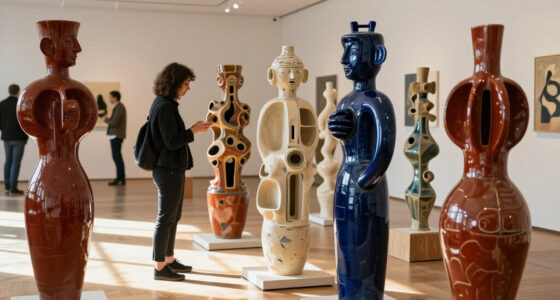

Celebrating Rauschenberg, Cage, Cunningham, Johns, and Twombly reveals how their close friendships fueled groundbreaking collaborations that reshaped 20th-century art and music. Through shared curiosity and experimentation, they blurred boundaries, merging disciplines and challenging conventions. Their innovative use of found objects, chance, and spontaneous expression created lasting legacies that continue to influence contemporary art. Discover more about how these artists’ connections sparked a revolutionary creative movement that still resonates today.

Get art and craft supplies delivered free with Prime
- Fast, free delivery on millions of items
- Prime Video, Amazon Music and more included
- Member-only deals all year
Key Takeaways
- The friendships among Rauschenberg, Cage, Cunningham, Johns, and Twombly fueled groundbreaking collaborations across art and music.
- Their collective work challenged conventions by merging disciplines, using found objects, chance, and spontaneity.
- These artists’ innovative relationships inspired future generations, shaping contemporary interdisciplinary art and performance.
- Their collaborations emphasized shared curiosity, experimentation, and emotional honesty, creating enduring legacies in 20th-century art.
- Celebrating these five friends highlights how their collective creativity transformed artistic boundaries and practices worldwide.

Few artistic friendships have fueled innovation as powerfully as the bond among Rauschenberg, Cage, Cunningham, Johns, and Twombly. As you explore their collaborative influence, you’ll see how their interactions reshaped the boundaries of 20th-century art and music. Their relationships weren’t just personal; they were catalysts for groundbreaking ideas that continue to influence creative fields today. These friends challenged conventions, merging disciplines and blurring distinctions between art forms. Their shared curiosity and willingness to experiment created a synergy that pushed each of them to new heights, establishing artistic legacies that endure beyond their individual works.
Imagine how their dialogue and collaboration amplified their creative output. Rauschenberg, with his innovative combines, transformed the idea of painting into a multi-layered experience. Cage’s revolutionary approach to music, emphasizing chance and non-traditional sounds, broke away from classical constraints. Cunningham’s dance choreography embraced randomness and spontaneity, echoing Cage’s musical philosophies. Johns’s focus on everyday objects and text challenged viewers to see art in the mundane, while Twombly’s scribbles and poetic markings added a raw, emotional layer to the conversation. Together, their influence created a fertile environment where ideas could freely collide and evolve.
As you follow their artistic journeys, you’ll notice how their legacies are intertwined. They didn’t work in isolation; instead, they built upon each other’s innovations, inspiring generations of artists to come. Their collaborative influence can be seen in the way contemporary art and performance continue to embrace interdisciplinarity and experimentation. For example, the way Rauschenberg incorporated found objects prefigured later mixed-media practices. Cage’s emphasis on chance operations became a staple in experimental music and art. Cunningham’s dance methods influenced performance art, and Johns’s use of common imagery opened doors for conceptual art. Twombly’s poetic markings and raw spontaneity inspired later generations to explore emotional honesty in their work. Additionally, their shared openness to interdisciplinary collaboration exemplifies how embracing multiple disciplines can lead to groundbreaking innovation.
As an affiliate, we earn on qualifying purchases.
Frequently Asked Questions
How Did Their Friendships Influence Their Individual Artistic Styles?
Your friendships deeply shaped each artist’s style through dynamic interactions and shared ideas. Friendship dynamics fostered an environment where they constantly challenged and inspired one another, leading to artistic influence that pushed boundaries. You can see how their collaborations and exchanges fueled experimentation, helping them evolve uniquely yet interconnected. Their relationships created a fertile ground for innovation, proving that close artistic friendships ignite creativity and shape individual artistic directions.
What Collaborations or Projects Did They Work on Together?
Think of their collaborations as a vibrant tapestry woven from interdisciplinary experiments and collaborative performances. You’ll see they worked together on projects like John Cage’s experimental compositions, Merce Cunningham’s dance collaborations, and Rauschenberg’s combining of visual art with performance. These artists didn’t just share ideas; they fused them, creating innovative works that blurred boundaries and inspired new artistic languages, showing how collective efforts can spark groundbreaking creativity.
How Did Their Relationships Evolve Over the Decades?
Over the decades, your understanding of their relationships reveals evolving interpersonal dynamics and sustained creative synergy. You see how initial camaraderie deepened through shared experiments, yet occasional tensions arose as individual visions clashed. Despite this, their mutual respect and passion for pushing boundaries kept their collaborations vibrant. You recognize that their ability to adapt, communicate, and challenge each other fueled their growth, shaping a lasting legacy of innovation and artistic friendship.
Which Specific Artworks Were Inspired by Their Friendships?
You see that artworks like Rauschenberg’s “Combines” and Cage’s experimental compositions were directly inspired by their friendship dynamics and artistic synergy. Their collaborations fueled innovative ideas and pushed boundaries, reflecting their close relationships. Their friendships fostered a creative environment where ideas flowed freely, resulting in pieces that embody their mutual influence and trust. These artworks stand as attestations to how strong personal bonds can shape groundbreaking artistic achievements.
What Personal Anecdotes Highlight Their Camaraderie?
You’ll find that their camaraderie shines brightest during late-night discussions in their shared studio, where artistic mentorship blossomed. Rauschenberg recalls how Cage’s encouragement pushed him to experiment boldly, while Cunningham’s playful spirit kept everyone inspired. These personal anecdotes reveal a close-knit bond, like family, showing how their friendships fueled creativity and innovation. Their mutual support and shared moments made their collaborative journey unforgettable, truly a demonstration to friendship’s power in art.
As an affiliate, we earn on qualifying purchases.
Conclusion
As you reflect on these five friends, it’s clear their bonds fueled groundbreaking art and ideas. Their collaborations prove that true friendship can be the secret sauce behind innovation. You see, when creative minds come together, they can move mountains. So, embrace your own circle—sometimes, it’s the support and sparks exchanged between friends that truly make history. After all, there’s no better way to turn dreams into reality than with a trusted crew by your side.
experimental music instruments for beginners
As an affiliate, we earn on qualifying purchases.
As an affiliate, we earn on qualifying purchases.
performance art costume accessories
As an affiliate, we earn on qualifying purchases.
As an affiliate, we earn on qualifying purchases.
Columbus Day / Indigenous Peoples' Day Picks
long weekend sales
As an affiliate, we earn on qualifying purchases.