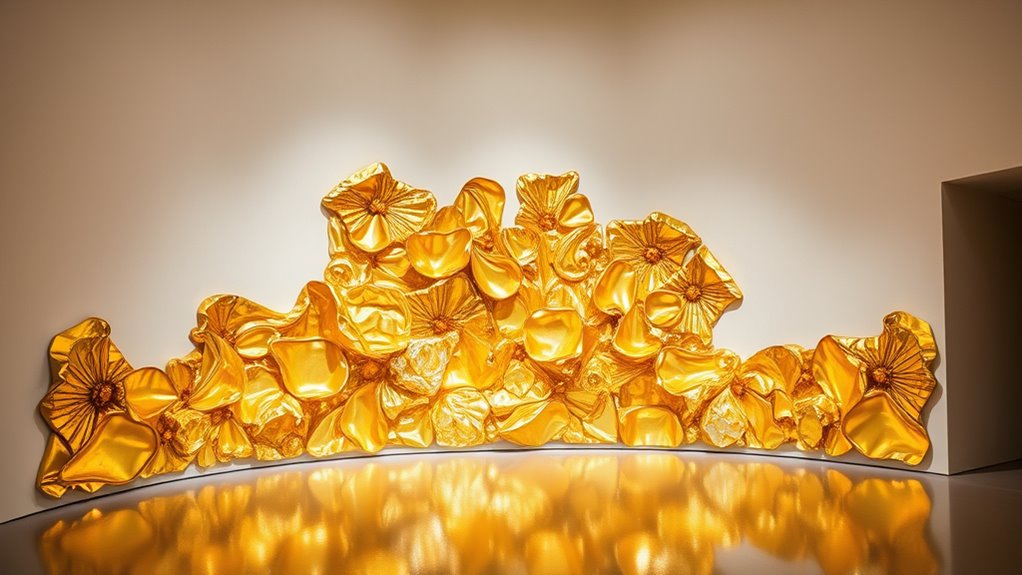

Rashid Johnson’s “A Poem for Deep Thinkers” at the Guggenheim uses layered symbols and textured materials to explore themes of identity, history, and resilience. You’ll notice familiar objects transformed into powerful cultural markers, encourage self-reflection, and challenge societal narratives. The installation’s layered approach invites you to see beyond surface appearances and recognize complex stories of cultural survival and resistance. If you continue exploring, you’ll uncover even deeper insights into how art sparks understanding and conversation.

Get art and craft supplies delivered free with Prime
- Fast, free delivery on millions of items
- Prime Video, Amazon Music and more included
- Member-only deals all year
Key Takeaways
- “A Poem for Deep Thinkers” is an installation by Rashid Johnson that explores identity, resilience, and cultural history through layered symbols.
- The artwork employs familiar objects and reflective surfaces to encourage self-reflection and collective memory.
- It critiques societal issues like systemic racism, promoting awareness and cultural critique within a layered visual narrative.
- The installation invites active engagement, prompting viewers to interpret symbols and connect personal and societal stories.
- Displayed at the Guggenheim, the piece emphasizes art’s role in fostering societal reflection and understanding of marginalized communities.

Rashid Johnson’s “A Poem for Deep Thinkers” at the Guggenheim invites visitors into a space of introspection and layered meaning. As you step into the installation, you immediately notice the careful use of visual symbolism that weaves together themes of identity, history, and resilience. Johnson’s work isn’t just visually striking—it’s intentionally layered to challenge your perceptions and encourage reflection. Every element within the piece acts as a symbol, prompting you to contemplate deeper narratives beyond the surface. For example, familiar objects like books, mirrors, and everyday materials are repurposed, transforming into powerful markers of cultural commentary. These symbols serve as a dialogue with history and society, forcing you to confront issues of race, memory, and representation.
Through this visual symbolism, Johnson guides you to see the connections between personal experience and collective history. The objects aren’t randomly placed—they evoke stories of cultural survival, adaptation, and resistance. When you observe the mirrored surfaces, you’re invited to see yourself within the narrative, emphasizing the universality of these themes. The layered materials and textures symbolize the complex layers of identity that people carry, especially within marginalized communities. This layered approach makes you realize that cultural history isn’t linear but a tapestry of intertwined stories, each adding depth and nuance. Additionally, understanding the importance of newborn sleep patterns and other health considerations can deepen your appreciation for the layered complexities of human experience, whether in art or everyday life. Johnson’s work becomes a visual language that speaks to shared histories and collective struggles, making you an active participant rather than a passive observer.
The cultural commentary embedded in the installation is unmistakable. Johnson uses his art to critique societal structures, highlighting ongoing issues of systemic racism and social inequality. His strategic use of symbols acts as a visual shorthand that communicates powerful messages about how culture is constructed, challenged, and reshaped. You’re encouraged to question the narratives presented by mainstream culture and to recognize the resilience embedded in marginalized communities. This commentary isn’t overtly didactic; instead, it’s woven seamlessly into the visual fabric of the piece, making it accessible yet thought-provoking. By engaging with these symbols, you gain insight into how art functions as a tool for cultural critique, pushing you to reflect on your own perceptions and the broader societal landscape. Johnson’s “A Poem for Deep Thinkers” ultimately serves as a visual and cultural mirror, urging you to examine the layers beneath surface appearances and to find meaning in the symbols that shape our collective consciousness.
art installation symbolism books
As an affiliate, we earn on qualifying purchases.
As an affiliate, we earn on qualifying purchases.
Frequently Asked Questions
What Inspired Rashid Johnson’s “A Poem for Deep Thinkers”?
You’re inspired by a mix of artistic influences and cultural symbolism when creating “A Poem for Deep Thinkers.” Johnson draws from diverse traditions, blending visual art and poetry to explore identity and history. His work encourages viewers to reflect deeply, connecting personal stories with broader cultural themes. This piece is a tribute to those who seek meaning beyond the surface, inviting you to engage with layered symbols and introspective ideas.
How Does the Guggenheim Display This Artwork?
Like a beacon calling out to deep thinkers, the Guggenheim displays this artwork with strategic museum lighting that highlights its textures and details. You’ll find yourself drawn in, engaging actively with the piece as light and shadow dance across it. The display encourages visitor engagement by creating an immersive experience, prompting you to reflect and connect emotionally, making the artwork not just seen but felt on a profound level.
What Materials Did Johnson Use in This Piece?
In “A Poem for Deep Thinkers,” Johnson uses mixed media to create a compelling piece of conceptual art. You’ll notice he incorporates materials like books, black soap, and wood, blending everyday objects with symbolic significance. This combination invites viewers to interpret the work on multiple levels, encouraging reflection on cultural identity and history. His thoughtful use of mixed media enhances the artwork’s depth, making it a powerful example of contemporary conceptual art.
Are There Interactive Elements in the Installation?
You might expect high-tech gadgets, but this installation isn’t about digital engagement or flashy interactivity. Instead, Johnson’s work invites you to immerse yourself in a sensory experience through thoughtfully curated materials and spatial design. Though it lacks traditional interactive elements, it encourages deep thinking and personal reflection. So, while it may not have digital screens or buttons, it still engages your senses and mind in a profound, understated way.
How Has the Audience Reacted to the Artwork?
You’ll find that the public reception to the artwork is overwhelmingly positive, with many visitors engaging deeply and sharing their insights. Critics have also lauded the piece, praising its thought-provoking nature and emotional impact. People often leave the installation inspired to reflect on its themes, and the critical acclaim highlights its significance within contemporary art. Overall, your experience with the piece is likely to be both moving and intellectually stimulating.
mirrored surfaces for art projects
As an affiliate, we earn on qualifying purchases.
As an affiliate, we earn on qualifying purchases.
Conclusion
As you step back from Johnson’s work, you find yourself gently lifted into a quiet garden of contemplation. The colors and shapes whisper softly, guiding your mind through a peaceful dance of reflection. In this serene space, your deepest thoughts bloom like delicate flowers, unfolding quietly beneath the surface. You leave with a gentle reminder that even the most profound ideas can be like a subtle breeze—hard to see, but impossible to ignore.
cultural history and resilience art prints
As an affiliate, we earn on qualifying purchases.
As an affiliate, we earn on qualifying purchases.
As an affiliate, we earn on qualifying purchases.
Halloween Picks
halloween
As an affiliate, we earn on qualifying purchases.