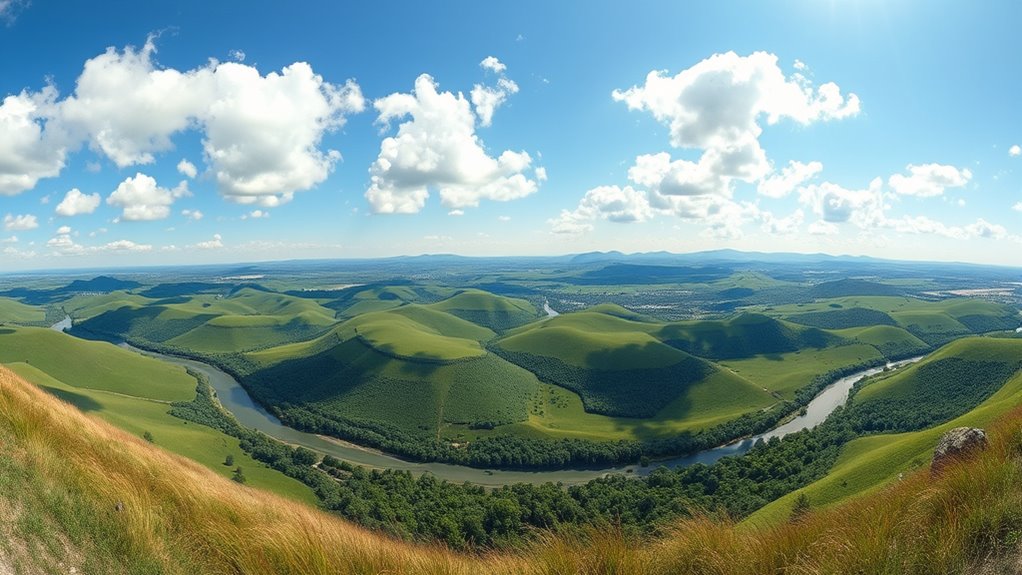

To capture wide perspectives in panorama photography, you’ll want to use a stable tripod, keep your camera level, and overlap each shot by 20-30%. Shooting in HDR allows you to handle scenes with high contrast, like landscapes with bright skies and dark foregrounds. Proper composition, including interesting foreground elements and straight horizons, enhances your results. If you continue exploring, you’ll discover detailed tips that help you master this technique and create stunning panoramic images.
Key Takeaways
- Use a sturdy tripod and overlap shots by 20-30% for seamless stitching and consistent exposure.
- Capture multiple exposures (HDR) to retain detail in both sky and landscape elements.
- Compose with leading lines, natural framing, and level horizons to enhance scene depth and balance.
- Maintain smooth camera movement and proper alignment to prevent stitching artifacts.
- Post-process with software capable of merging HDR images and stitching wide perspectives for professional results.
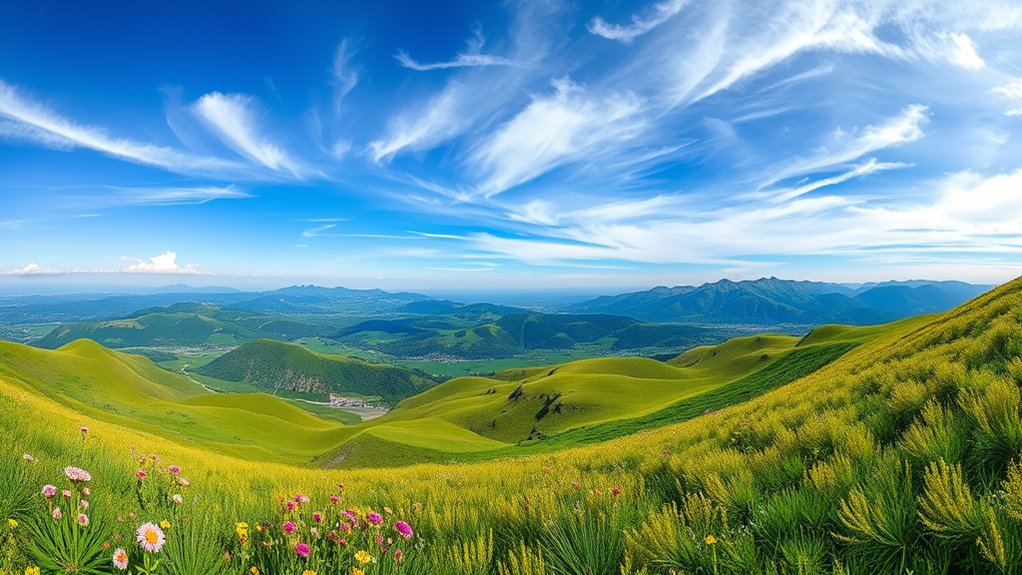
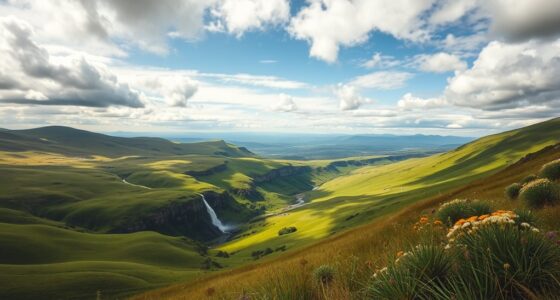
Have you ever wanted to capture an entire landscape in a single shot? That’s where panorama photography comes in, allowing you to showcase sweeping views and expansive scenes in one powerful image. To make the most of your panoramic shots, it’s essential to understand how to use HDR techniques and composition tips effectively. HDR, or High Dynamic Range, can be a game-changer when photographing broad scenes with varying light levels. Instead of risking washed-out skies or shadowed foregrounds, you can take multiple exposures—underexposed, correctly exposed, and overexposed—and merge them to retain detail across the entire image. This technique guarantees your panorama maintains a balanced exposure, revealing the vibrant colors of the sky and the textures in the landscape without losing any information. When applying HDR to panoramic shots, use a tripod to keep your camera steady, and align your images carefully to prevent stitching issues later. Remember, even if HDR isn’t your thing, bracketing exposures can still give you more control over the final image. Incorporating compatible equipment like a sturdy tripod ensures consistent results and easier post-processing.
Alongside mastering HDR, paying attention to composition tips will help you create stunning panoramas. Before you start shooting, scout the location and decide on your focal points. Think about leading lines, natural framing, and the rule of thirds to guide the viewer’s eye across the scene. When capturing the panorama, keep your camera level and move it smoothly from one side to the other, overlapping each shot by about 20-30%. Overlapping ensures easier stitching later and helps maintain consistency in exposure and focus. Also, consider the horizon line—keeping it straight is vital; a crooked horizon can distract viewers and diminish the overall impact of your image. If you’re shooting during sunrise or sunset, be mindful of changing light conditions and plan your exposures accordingly. Use a tripod to stabilize your camera, which helps maintain alignment and sharpness across all frames. Additionally, pay attention to foreground elements; including interesting foreground features can add depth and dimension to your panoramic scene.
Finally, when stitching your images, use quality software that can handle multiple exposures and automatic blending with minimal artifacts. This will elevate your panoramic photography, making your wide landscapes look seamless and professional. Combining HDR techniques with thoughtful composition tips will give you the tools to produce breathtaking wide perspectives that truly capture the grandeur of your scene. With practice, you’ll learn to anticipate lighting conditions and framing, turning simple shots into expansive, mesmerizing images. Panorama photography isn’t just about capturing a wide view; it’s about telling a story of space, light, and landscape that draws viewers into the scene, making them feel like they’re right there with you.

Amazon Basics 50-inch Lightweight Portable Camera Tripod Stand with Quick-Release Plate, Adjustable Height, Aluminum, for Travel Photography, Champagne
Camera mount tripod stand with zippered storage bag
As an affiliate, we earn on qualifying purchases.
As an affiliate, we earn on qualifying purchases.
Frequently Asked Questions
What Are the Best Camera Settings for Panorama Shots?
To get the best panorama shots, guarantee camera stability by using a tripod or steady surface, preventing blurry images. Choose a wide-angle lens to capture more of the scene in each shot. Set your camera to manual mode, use a consistent aperture (like f/8), and keep ISO low for clarity. Overlap your shots by about 20-30% to make stitching easier, and use a panoramic mode if available for seamless results.
How Do I Prevent Stitching Errors in Panoramic Photos?
You can prevent stitching errors by ensuring proper image alignment and consistent exposure blending. Start by using a tripod for stability, which helps keep your camera level and images aligned. Overlap each shot by about 30%, making it easier for software to stitch seamlessly. Also, set your camera to manual mode to maintain consistent exposure and focus across all images. This approach minimizes mismatched colors and alignment issues, resulting in a smooth panoramic shot.
Can Smartphones Capture High-Quality Panoramic Images?
Yes, smartphones can capture high-quality panoramic images, especially when you use HDR techniques to enhance dynamic range. To get the best results, hold your phone steady and overlap shots slightly. Be mindful of lens distortion, which can affect image quality, and try to keep the camera level. Many smartphones automatically correct distortion, but manually adjusting your position helps make certain of sharp, wide perspectives with minimal stitching errors.
What Accessories Improve Panorama Photography Results?
Think of your smartphone as a paintbrush—accessories turn it into an artist’s toolkit. To boost your panorama shots, use a sturdy tripod for stability, preventing shaky images. Consider a wide-angle lens or clip-on lens attachments to capture more of the scene seamlessly. These accessories help you create crisp, expansive images that truly reflect the vastness you’re aiming to portray. Your wide landscapes will thank you for the upgrade!
How Do I Choose the Right Panorama Mode on My Camera?
You should choose the right panorama mode on your camera by first considering tripod stability, ensuring your camera stays steady during shots. Use a mode that aligns with your scene, like spherical or wide-angle panorama. Select a lens with good coverage and minimal distortion for sharp, seamless images. Adjust settings for exposure and focus beforehand, and use a tripod for stability, so your wide perspectives come out clear and well-aligned.

PANOEAGLE 4MP Dual Lens PoE IP Security Camera Outdoor with 180° Panoramic Wide Angle,Smart Color Night Vision,Smart Motion Detection,2-Way Audio & Micro SD Slot(512G),IP67 Waterproof,NDAA Complaint
💡【180° Wider View Features 4MP Clarity】This dual lens security camera combines two 1/2.9" CMOS sensor into ONE stunning…
As an affiliate, we earn on qualifying purchases.
As an affiliate, we earn on qualifying purchases.
Conclusion
As you master panorama photography, remember you’re like an artist painting with the horizon, capturing endless stories within a single frame. With each click, you open a window to worlds beyond sight, inviting viewers to wander through your perspective. Embrace the adventure, for in your hands lies the power to reveal vast, breathtaking vistas—turning fleeting moments into timeless landscapes. Just as the horizon stretches infinitely, so too does your creative journey ahead.
![Quickstart: Panorama Studio [Download]](https://m.media-amazon.com/images/I/61GHCWTeOtL._SL500_.jpg)
Quickstart: Panorama Studio [Download]
Panoramas in Minutes
As an affiliate, we earn on qualifying purchases.
As an affiliate, we earn on qualifying purchases.

Altura Photo 58MM 0.43x HD Wide Angle Lens with Macro – Attaches to 58MM Filter Thread (Not Camera Body) – DSLR Accessories for Canon Rebel T7, T7i, T8i, T6i, T6s, T6, SL2, SL3, EOS 70D, 77D, 80D, 90D
LENS ATTACHMENT: Easily screws on to the front of your lens, and instantly expands the field of view…
As an affiliate, we earn on qualifying purchases.
As an affiliate, we earn on qualifying purchases.