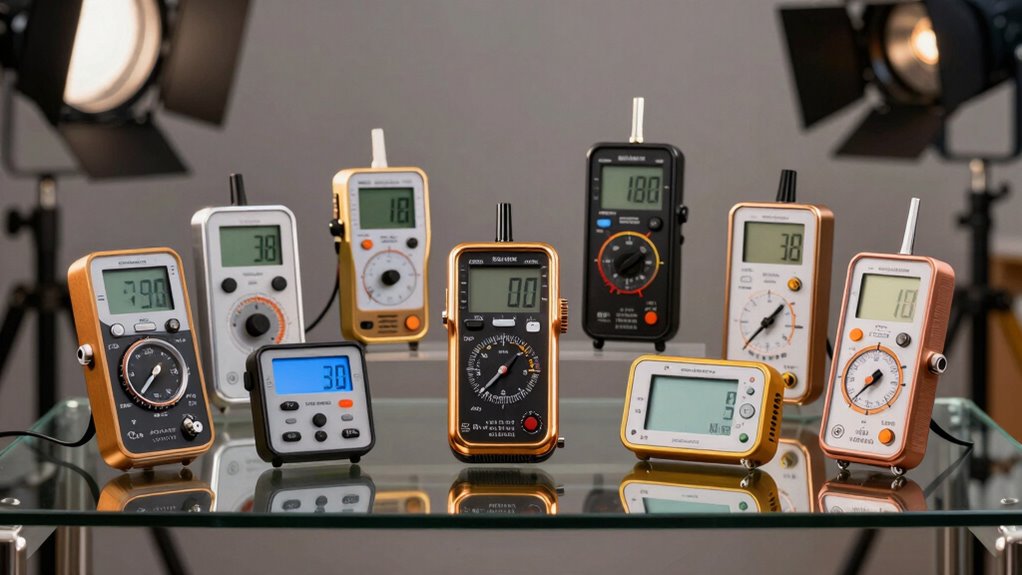
Finding the right studio light meter is essential for precise lighting control in photography. The Sekonic LiteMaster Pro L-478D-U stands out as the overall top choice thanks to its advanced touchscreen and versatile measurement modes. For those seeking simplicity, the Sekonic L-398A Studio Deluxe III offers reliable analog performance at a lower price. Meanwhile, the LightMate Lite 2R excels for film photographers who need high-precision digital readings. These options illustrate common tradeoffs: advanced features often come with higher costs, while basic models may lack some professional capabilities. Continue reading for a detailed breakdown of each model and what makes them suitable for different types of photographers.
Key Takeaways
- The top-ranked Sekonic LiteMaster Pro offers comprehensive features, but its complexity and price may be overkill for casual users.
- Analog meters like the Sekonic L-398A deliver reliable performance without digital distractions, ideal for traditional workflows.
- Digital meters such as the LightMate Lite 2R provide high precision, especially useful for film shooters needing detailed exposure data.
- Wireless and smartphone-compatible features, like those in the Sekonic L-478DR-U, add convenience but increase cost and complexity.
- Choosing the right meter depends on balancing features, ease of use, and budget—more advanced tools aren’t always necessary for every photographer.
| Sekonic LiteMaster Pro L-478D-U Light Meter with Touchscreen Incident & Reflected Meter, Cine Frame Rate & Shutter Angle Control |  | Best Overall for Versatile Professional Use | Display: Large color LCD touchscreen | Measurement Modes: Incident ambient, reflected spot, flash, illuminance, luminance | Cine Features: Frame rate and shutter angle control | VIEW ON AMAZON | See Our Full Breakdown |
| Sekonic L-398A Studio Deluxe III Analog Light Meter |  | Best for Analog Purists and Traditionalists | Operation: Battery-Free | Photocell: Amorphous photocell | Measurement: Incident & reflected light | VIEW ON AMAZON | See Our Full Breakdown |
| LightMate Lite 2R Light Meter – High Precision Digital Exposure Meter for Film Cameras |  | Best Compact Digital for Film Enthusiasts | Screen Size: 0.96 inch | Battery Life: Over 20 hours | Weight: 26g | VIEW ON AMAZON | See Our Full Breakdown |
| Sekonic FLASHMATE L-308X Photographers and Film Makers Exposure Meter – Black/Blue |  | Best Compact Multi-Mode Light Meter | Measurement Range: 0 to 19.9 EV at ISO 100 | Flash Range: f/1.0 to f/90.9 at ISO 100 | Modes: Photo, HD Cine, Cine | VIEW ON AMAZON | See Our Full Breakdown |
| Sekonic L-478DR-U PocketWizard Lightmeter with Wireless Flash Triggering, 3-Year Warranty |  | Best for Wireless Control and Professional Motion Use | Type: Touchscreen digital light meter | Features: Incident and flash metering, PocketWizard transmitter, optional reflected spot, cine controls | Warranty: 3 years | VIEW ON AMAZON | See Our Full Breakdown |
| Sekonic L-308X-U Flashmate Light Meter, Compact Digital Incident & Reflected Exposure Meter with Photo, Cine & HD Cine Modes |  | Best for Compact Digital Functionality | Exposure Accuracy: Down to a tenth-of-a-stop | ISO Range: ISO 100 | Ambient EV Range: 0 to 19.9 | VIEW ON AMAZON | See Our Full Breakdown |
| studio light meters for photographer | Modes |
|---|---|
| Sekonic LiteMaster Pro L-478D- | — |
| Sekonic L-398A Studio Deluxe I | — |
| LightMate Lite 2R Light Meter | Aperture priority, Shutter priority, Single trigger, Automatic, Average |
| Sekonic FLASHMATE L-308X Photo | Photo, HD Cine, Cine |
| Sekonic L-478DR-U PocketWizard | — |
| Sekonic L-308X-U Flashmate Lig | Photo, HD Cine, Cine |
More Details on Our Top Picks
Sekonic LiteMaster Pro L-478D-U Light Meter with Touchscreen Incident & Reflected Meter, Cine Frame Rate & Shutter Angle Control
The Sekonic LiteMaster Pro L-478D-U stands out for its comprehensive feature set that combines precise incident and reflected light measurement with cine-specific controls. Unlike the simpler Sekonic L-398A, it offers advanced cine settings like frame rate and shutter angle, making it ideal for filmmakers and photographers who need multi-environment flexibility. The large color touchscreen streamlines adjustments, but its complexity can overwhelm beginners, and additional accessories are often required for reflected spot metering. Its higher price reflects its professional-grade capabilities, so casual users may find it excessive. This model makes the most sense for professionals who want a one-stop-shop for both photography and cinematography needs.Pros:- Intuitive large touchscreen for quick adjustments
- Versatile measurement modes including cine-specific settings
- Accurate flash and ambient light analysis
- Supports data handling and software integration
Cons:- Complex features may require a learning curve
- Additional accessories needed for reflected spot metering
- Higher price point for casual users
Best for: Professional photographers and cinematographers needing a versatile, high-precision meter with cine features
Not ideal for: Beginners or hobbyists who prefer simple, straightforward meters without cine-specific controls
- Display:Large color LCD touchscreen
- Measurement Modes:Incident ambient, reflected spot, flash, illuminance, luminance
- Cine Features:Frame rate and shutter angle control
- Flash Analysis:Flash-to-ambient ratio evaluation
- Connectivity:Supports data handling and software integration
Our verdict“This is the top choice for experienced professionals who need a highly adaptable, feature-rich light meter.”
Sekonic L-398A Studio Deluxe III Analog Light Meter
The Sekonic L-398A Studio Deluxe III appeals to those who prefer battery-free operation and tactile controls, offering full dial readouts that provide immediate, intuitive exposure adjustments. Compared with digital options like the LiteMaster Pro, its analog dial and swivel head give it a classic feel and reliability in environments where electronics might fail. Its bulkier design and analog display can be less precise in fine-tuning exposure, especially for those accustomed to digital readouts. The included professional accessories extend versatility, but the lack of digital connectivity makes it less suitable for modern workflows. This meter is best suited for users who value durability, simplicity, and traditional operation.Pros:- Battery-free operation powered by ambient light
- Full aperture/shutter dial readout for quick adjustments
- Swivel head for flexible positioning
- Includes professional accessories for diverse applications
Cons:- Analog display less precise than digital meters
- Bulkier design can be cumbersome for portable use
- Limited to manual operation, no digital connectivity
Best for: Film photographers and studio shooters who prefer analog tools and robust build quality
Not ideal for: Digital-only users or those who need quick, digital readouts and advanced features
- Operation:Battery-Free
- Photocell:Amorphous photocell
- Measurement:Incident & reflected light
- Display:Full aperture/shutter dial readout
- Head:Swivel head design
- Included Accessories:Lumisphere, lumidisc, lumigrid, high slide, strap, soft case, manual
Our verdict“This meter is ideal for traditionalists who prioritize durability and tactile feedback over digital convenience.”
LightMate Lite 2R Light Meter – High Precision Digital Exposure Meter for Film Cameras
The LightMate Lite 2R offers impressive accuracy in a compact package, making it perfect for film shooters who need reliable, on-the-go exposure data. Its small size and lightweight design outperform bulkier analog meters like the Sekonic 398A, especially for fieldwork. While its high precision and multiple metering modes make it appealing, understanding and navigating its interface might challenge those less familiar with digital meters, and some users might find its compatibility limited to certain camera types. The rechargeable battery ensures over 20 hours of use, a significant advantage over many smaller digital meters. This pick makes the most sense for enthusiasts and professionals valuing portability without sacrificing accuracy.Pros:- Extremely portable and lightweight at 26g
- High precision with multiple metering modes
- Long-lasting rechargeable USB-C battery
- Suitable for a variety of photography scenarios
Cons:- Requires familiarity with camera settings for full benefit
- Limited compatibility with some camera types
- Interface may be complex for beginners
Best for: Film shooters and mobile photographers seeking a compact, high-precision digital meter
Not ideal for: Photographers who prefer larger screens or more complex digital features with broad camera compatibility
- Screen Size:0.96 inch
- Battery Life:Over 20 hours
- Weight:26g
- Metering Lens:30°
- Rechargeable:Yes
- Modes:Aperture priority, Shutter priority, Single trigger, Automatic, Average
Our verdict“This is the go-to for practitioners needing a small, accurate digital meter for film and portable use.”
Sekonic FLASHMATE L-308X Photographers and Film Makers Exposure Meter – Black/Blue
The Sekonic FLASHMATE L-308X offers a reliable, pocket-sized solution for measuring ambient, flash, and video lighting, making it suitable for location work and on-set adjustments. Its wide metering range and dedicated modes for cinematography set it apart from simpler digital meters like the LightMate Lite 2R, providing greater flexibility in diverse lighting conditions. However, its multiple modes can initially seem complex for newcomers, and details such as battery life are less emphasized. Its compact size and repeatability make it a favorite among location scouts and videographers who need quick, accurate readings without bulk. This meter is best for those who want a portable, multi-purpose tool that handles both photography and filmmaking environments.Pros:- Compact and portable for on-location use
- Accurate measurement with <0.1 EV repeatability
- Wide range suitable for various lighting conditions
- Multiple modes for photography and cinematography
Cons:- Initial complexity with multiple modes
- Limited details on power options and battery life
- Requires understanding of professional lighting terms
Best for: Location scouts, videographers, and on-set lighting technicians needing a portable, versatile meter
Not ideal for: Users seeking detailed digital control or advanced cine-specific features
- Measurement Range:0 to 19.9 EV at ISO 100
- Flash Range:f/1.0 to f/90.9 at ISO 100
- Modes:Photo, HD Cine, Cine
- Reception Angle:40°
- Repeatability:<0.1 EV
- Includes:Soft case, strap, synchro terminal cap, instructions
Our verdict“This is an excellent choice for professionals needing a small, reliable, multi-mode light meter for diverse shooting scenarios.”
Sekonic L-478DR-U PocketWizard Lightmeter with Wireless Flash Triggering, 3-Year Warranty
The Sekonic L-478DR-U combines digital precision with wireless flash control via its built-in PocketWizard transmitter, making it ideal for complex lighting setups in studio or motion environments. Compared to the L-308X, it offers more advanced light measurement with cine controls, but its reliance on optional viewfinder attachments for reflected spot metering adds some inconvenience. Its large touchscreen simplifies operation, yet the complexity of wireless features may challenge less experienced users. The 3-year warranty underscores its professional-grade durability. This model is best suited for professionals who need integrated wireless flash management and extensive light control in dynamic shooting conditions.Pros:- Wireless flash triggering and remote control built-in
- Intuitive large touchscreen interface
- Supports both photography and motion production modes
- Includes cine frame rate and shutter angle controls
Cons:- Requires optional viewfinder for reflected spot metering
- Complex setup for beginners
- Limited to professional environments
Best for: Professional photographers and videographers requiring wireless flash control and cine features
Not ideal for: Hobbyists or those seeking a simple, plug-and-play light meter without wireless capabilities
- Type:Touchscreen digital light meter
- Features:Incident and flash metering, PocketWizard transmitter, optional reflected spot, cine controls
- Warranty:3 years
Our verdict“This is the right choice for demanding professionals who need seamless wireless control and extensive features in a single device.”
Sekonic L-308X-U Flashmate Light Meter, Compact Digital Incident & Reflected Exposure Meter with Photo, Cine & HD Cine Modes
The Sekonic L-308X-U Flashmate stands out for its precise readings in both ambient and flash conditions, making it ideal for photographers and videographers needing quick, reliable exposure data. Compared to the Sekonic LiteMaster Pro L-478D-U, which offers advanced touchscreen controls and more extensive frame rate options, the Flashmate keeps things simple and portable without sacrificing critical accuracy. Its multiple modes, including Photo, HD Cine, and Cine, cater well to those working across still and video projects, but its fixed ISO of 100 can be a limitation, requiring manual adjustments for other ISO settings—an extra step that might slow down workflow. The compact design makes it perfect for on-the-go use, especially in tight shooting environments, though beginners may find its multiple modes slightly overwhelming without prior experience with light meters.
Pros:- Highly accurate exposure readings for ambient and flash lighting
- Multiple modes tailored for photography and videography
- Compact, pocket-sized design for portability
- Auto backlit LCD display for easy use in various lighting conditions
Cons:- Limited to ISO 100, requiring manual adjustments for other ISO settings
- Can be complex for users unfamiliar with light metering concepts
Best for: Photographers and videographers who need a portable, multi-mode light meter with precise readings but are comfortable with manual ISO adjustments.
Not ideal for: Beginners or those requiring an all-in-one device with automatic ISO or advanced touchscreen controls, as the unit’s complexity and manual setup could be a hurdle.
- Exposure Accuracy:Down to a tenth-of-a-stop
- ISO Range:ISO 100
- Ambient EV Range:0 to 19.9
- Flash F/Stop Range:f/1.0 to f/90.9
- Shutter-Speed Span:60 seconds to 1/8000th of a second
- Modes:Photo, HD Cine, Cine
Our verdict“This pick is best suited for experienced photographers and videographers seeking a precise, portable light meter with versatile modes, accepting the need for manual ISO adjustments.”
How We Picked
Our evaluation focused on performance, usability, build quality, and value for money. We examined each meter’s measurement accuracy, user interface, durability, and compatibility with different lighting setups. Additionally, we considered whether the features matched typical workflows—whether digital or analog, studio or location. The ranking reflects the overall balance of these factors, prioritizing tools that deliver consistent, precise readings while offering good usability and longevity for professional and serious amateur photographers alike.| studio light meters for photographer | Modes |
|---|---|
| Sekonic LiteMaster Pro L-478D- | — |
| Sekonic L-398A Studio Deluxe I | — |
| LightMate Lite 2R Light Meter | Aperture priority, Shutter priority, Single trigger, Automatic, Average |
| Sekonic FLASHMATE L-308X Photo | Photo, HD Cine, Cine |
| Sekonic L-478DR-U PocketWizard | — |
| Sekonic L-308X-U Flashmate Lig | Photo, HD Cine, Cine |
Factors to Consider When Choosing Studio Light Meters For Photographers
When selecting a studio light meter, understanding key factors can help you make an informed decision that aligns with your photography style and needs. Not all meters are created equal—some excel in features like wireless connectivity or cine-specific measurements, while others focus on simplicity and durability. Considering these factors ensures you choose a tool that improves your workflow without unnecessary complexity or expense.Measurement Modes and Accuracy
Look for meters offering both incident and reflected light measurements, as these provide the most accurate exposure data for studio setups. Digital models often include additional modes tailored to cine or flash photography, which can be critical depending on your work. Accuracy matters most when precise lighting is essential for your images; poorly calibrated or limited meters can lead to inconsistent results, especially in complex lighting environments.
Ease of Use and Interface
A clear, intuitive interface speeds up your workflow. Touchscreens and digital displays with backlighting are advantages, especially in low-light conditions. Conversely, analog meters may appeal to those who prefer tactile controls and straightforward operation, reducing the risk of technical issues during critical shoots. Consider your familiarity with digital tools versus traditional methods when choosing between these options.
Build Quality and Durability
Studio environments can be demanding, so a sturdy, well-made meter is worth the investment. Look for models with protective casings, water resistance, and solid construction. Cheaper or poorly built meters might save money upfront but could fail under regular use, leading to costly replacements or repairs. Think about how often you’ll carry or expose the meter to challenging conditions.
Additional Features and Connectivity
Features like wireless triggering, smartphone integration, and cine-specific modes add convenience and expand your creative possibilities. However, these extras often come at a higher price and may complicate the device’s interface. Evaluate whether these features align with your workflow and whether they justify the added expense—sometimes, simpler tools are more reliable and less prone to technical issues.
Price and Value
High-end meters offer extensive features but come with a steep cost. Conversely, basic models may suffice for hobbyists or those on a tight budget. Balance your needs against your budget; investing in a more capable meter can save time and improve accuracy, but only if those features genuinely enhance your work. Always consider long-term value and whether the additional features will be actively used.
Frequently Asked Questions
Should I choose an analog or digital light meter?
Choosing between analog and digital meters depends on your workflow and personal preference. Analog meters are known for their simplicity, durability, and long battery life, making them ideal for traditional studio work or those who prefer tactile controls. Digital meters often provide more features, faster readings, and easier data storage, which can be advantageous for complex setups or shooting in rapidly changing conditions. Consider how comfortable you are with digital interfaces and whether additional features justify the switch.
Do I need a wireless light meter?
Wireless capabilities can streamline workflows by allowing remote readings and triggering flashes without physical contact, which is helpful in large studios or when working with multiple light sources. However, these features typically increase the cost and complexity of the device. If your work involves frequent adjustments or complex lighting setups, a wireless meter might save time. For straightforward studio use, a wired or basic digital meter may be sufficient.
How important is measurement accuracy in a studio light meter?
Accuracy is vital when precise exposure is required, especially for professional work like commercial shoots or fine art photography. A slightly imprecise meter can lead to inconsistent results, necessitating multiple adjustments and retakes. High-quality meters are calibrated to provide reliable readings, reducing guesswork and ensuring consistency across shoots. For casual or hobbyist use, slightly lower accuracy may be acceptable, but for professional standards, investing in a precise device is wise.
Can I use a camera’s built-in light meter instead of a dedicated studio light meter?
While camera meters are useful for general exposure settings, they often lack the precision and flexibility needed for studio lighting control. Dedicated light meters measure incident light directly, providing more accurate data unaffected by camera metering patterns or scene complexity. They are especially valuable when working with multiple light sources, complex lighting ratios, or when precise control over exposure is critical. Relying solely on a camera’s built-in meter can lead to inconsistencies in studio environments.
When should I upgrade my light meter?
If your current meter no longer provides accurate readings, struggles with new lighting setups, or lacks features needed for your evolving work, it might be time to upgrade. Advances in digital technology and connectivity can offer significant workflow improvements, especially if you’re moving into cine or multi-light setups. Consider whether your current device supports your current needs; investing in a more capable model can enhance efficiency and image quality, especially in professional contexts.
Conclusion
For photographers new to studio lighting or working on a tight budget, a basic analog meter like the Sekonic L-398A offers reliable performance without complexity. Professionals seeking comprehensive control and advanced features should consider the Sekonic LiteMaster Pro L-478D-U for its versatility and touchscreen interface. Those needing high-precision digital readings will find the LightMate Lite 2R or the Sekonic L-478DR-U ideal, especially if wireless operation is a priority. Ultimately, your choice should match your workflow, skill level, and lighting complexity—balancing features against cost to get the best fit.