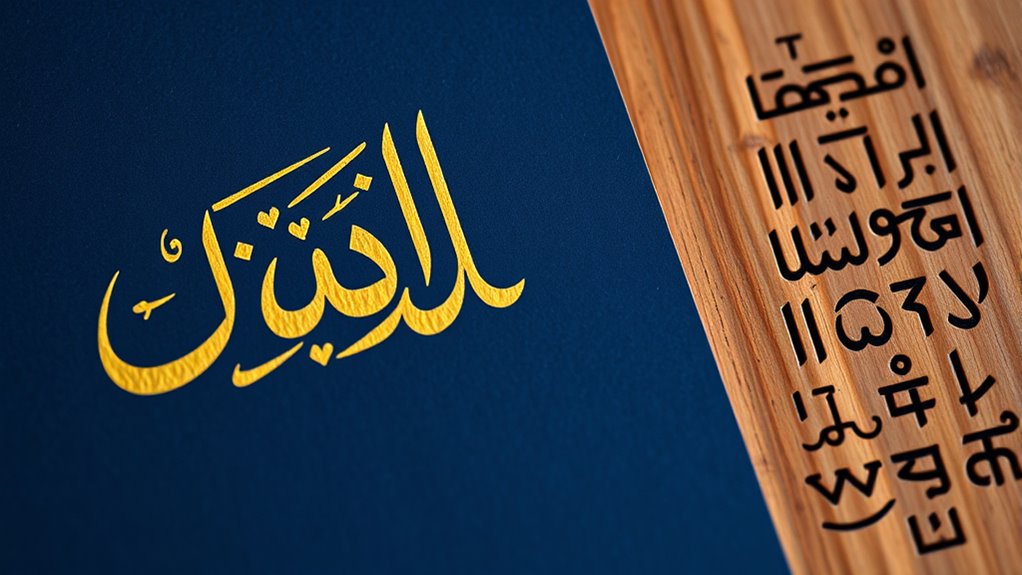

Calligraphy across cultures showcases how different societies use artistic writing to express their identity, beliefs, and history. Arabic calligraphy emphasizes elegant, flowing scripts with complex ornamentation, reflecting Islamic cultural and religious values. In contrast, Cherokee syllabary focuses on simple, clear characters designed for ease and practicality. These scripts reveal each community’s artistic techniques, tools, and historical evolution. Exploring further uncovers how these distinct styles preserve cultural heritage and symbolize resilience across generations.
Key Takeaways
- Arabic calligraphy emphasizes fluidity, geometric harmony, and ornamental intricacy, reflecting Islamic artistic and religious values.
- Cherokee syllabary features simple, block-like characters prioritizing clarity and ease of learning for cultural resilience.
- Both scripts serve cultural identities: Arabic for religious expression and artistic beauty, Cherokee for literacy and cultural preservation.
- Tools differ: reed pens and ink for Arabic, straightforward characters for Cherokee, shaping their distinct artistic techniques.
- Calligraphic styles evolve with cultural needs, preserving history while adapting to technological and societal changes.
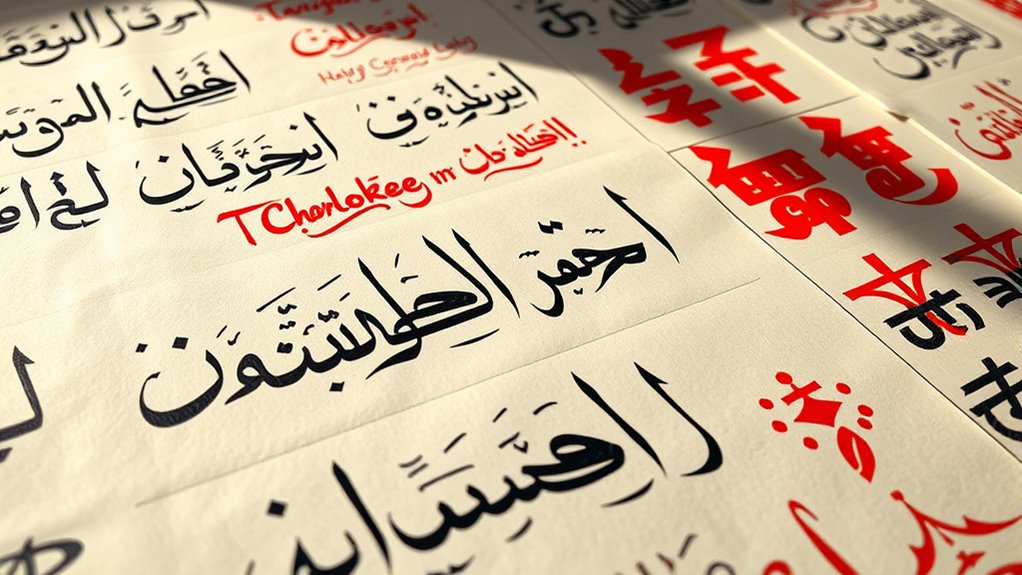
Have you ever wondered how different cultures express their artistic and spiritual values through writing? When exploring calligraphy across various societies, you’ll notice that each script carries a unique history and style that reflects its cultural identity. The historical evolution of calligraphy reveals how societies adapted their writing forms to serve religious, social, and aesthetic purposes. For example, Arabic calligraphy developed over centuries, influenced by Islamic teachings that emphasized the beauty of the Quranic text. Its artistic techniques emphasize fluidity, geometric harmony, and intricate ornamentation, making each stroke a form of reverence. Similarly, Cherokee syllabary, created in the early 19th century by Sequoyah, marked a significant shift in Native American literacy. Its visual style is more straightforward, designed for practicality and ease of learning, but it also embodies cultural resilience and innovation. Understanding these differences requires appreciating the artistic techniques employed in each script. Arabic calligraphy, for instance, employs a variety of tools like reed pens and ink, allowing for sweeping curves and complex compositions that often intertwine to form decorative patterns. Artists utilize varying line thicknesses to convey rhythm and emphasis, transforming written words into visual poetry. In contrast, Cherokee writing uses simple, block-like characters that are easy to reproduce and memorize, emphasizing clarity and functionality over ornate design. The artistic techniques in Cherokee calligraphy prioritize legibility and quick reproduction, reflecting its purpose as a practical means of communication. The evolution of calligraphy also mirrors technological advances and cultural exchanges. Arabic calligraphy, for example, evolved alongside the expansion of the Islamic empire, adapting to new materials and stylistic influences, leading to diverse styles like Kufic and Naskh. Meanwhile, the Cherokee syllabary was devised intentionally as a modern innovation to promote literacy among Native Americans, demonstrating how artistic techniques can be purposefully designed to meet community needs. Additionally, the study of visual language in calligraphy reveals how artistic expression serves as a cultural archive, preserving history and beliefs through intricate design. Exploring how cultural identity influences script style can deepen our understanding of each society’s values and history. Furthermore, techniques such as calligraphic ornamentation are integral to appreciating the aesthetic depth of these scripts and their cultural significance. Moreover, ongoing quality assurance practices in the preservation and study of these scripts ensure their techniques are accurately documented and appreciated for future generations. As you explore these scripts, you’ll see that calligraphy isn’t just about aesthetic appeal; it’s a reflection of history, spirituality, and cultural resilience, expressed through deliberate artistic techniques that have developed over centuries.

An Introduction to Arabic Calligraphy
As an affiliate, we earn on qualifying purchases.
As an affiliate, we earn on qualifying purchases.
Frequently Asked Questions
How Did Calligraphy Influence Cultural Identity in Different Regions?
You see that calligraphy shapes cultural identity by serving as a powerful form of identity expression and cultural symbolism. It connects communities to their history, traditions, and beliefs, fostering a sense of pride and belonging. Through unique scripts, regions showcase their artistic values and spiritual heritage, making calligraphy a crucial tool for preserving cultural identities across diverse societies. This artistic form ultimately unites people and reinforces their cultural stories.
What Tools Are Traditionally Used in Arabic and Cherokee Calligraphy?
You’ll find that Arabic calligraphy often uses reed pens, which create elegant, flowing lines, while Cherokee calligraphy traditionally employs brush pens for their expressive strokes. notably, both cultures value tools that enhance their script’s unique beauty. Reed pens give Arabic scripts their characteristic curves, and brush pens add a lively, textured quality to Cherokee writing. These tools connect you to centuries of tradition, shaping each stroke with cultural significance.
Are There Modern Adaptations of Traditional Calligraphy Styles Worldwide?
You’ll find that modern calligraphy adapts through digital innovations, blending tradition with technology. Contemporary reinterpretations emerge worldwide, with artists using tablets, software, and social media to share their work. These adaptations preserve cultural essence while exploring new styles and techniques. As a result, traditional calligraphy continues to evolve, inspiring fresh creativity and making ancient scripts accessible to a global audience.
How Do Calligraphy Techniques Reflect Religious or Spiritual Beliefs?
You might think calligraphy is just decorative, but it often reflects deep spiritual symbolism. Many believe that the precise strokes and flowing forms express reverence for sacred texts and divine presence. By dedicating time and skill to their craft, calligraphers embody spiritual beliefs, turning writing into a sacred act. This connection highlights how calligraphy techniques serve not only aesthetic purposes but also convey reverence for religious and spiritual ideals.
What Is the Role of Calligraphy in Preserving Endangered Languages?
You can see that calligraphy plays a crucial role in linguistic preservation, helping endangered languages stay alive. By creating beautiful, handwritten scripts, you actively contribute to safeguarding cultural heritage and passing it on to future generations. Calligraphy becomes a powerful tool for communities to celebrate their unique identities, ensuring that their language and traditions remain vibrant and accessible, even when faced with the threat of extinction.

Simply Cherokee: Let’s Learn Cherokee: Syllabary
As an affiliate, we earn on qualifying purchases.
As an affiliate, we earn on qualifying purchases.
Conclusion
As you explore these diverse scripts, you realize they’re like branches of a grand tree—each unique yet connected by a shared love for beauty and expression. From Arabic’s flowing curves to Cherokee’s strong, symbolic lines, every script tells a story of culture and identity. Embrace this mosaic of writing styles, and see how they weave together to form a vibrant tapestry of human creativity—proof that language, like art, knows no borders.

Ktsxxops 5Pcs 5pcs Calligraphy Dip Pen, Bamboo Reed Qalam Pens, Vintage Handcrafted Manga Calligraphy Pens, Comic Pen Nib Set for Writing, Calligraphy, Painting, Drawing
Size: The calligraphy dip pen measures approximately 7.1 inches in length and comes with 5 different nib widths….
As an affiliate, we earn on qualifying purchases.
As an affiliate, we earn on qualifying purchases.

The Ultimate Guide to Modern Calligraphy & Hand Lettering for Beginners
As an affiliate, we earn on qualifying purchases.
As an affiliate, we earn on qualifying purchases.