
TL;DR
Rome has opened the 230-foot underground gallery beneath the Baths of Trajan as the Museo delle Terme di Traiano. Its main displays include what Hyperallergic identifies as the largest surviving wall mosaic in the Roman world, alongside an unusual fresco; the two works have no clear relationship to one another.
Rome has opened the Museo delle Terme di Traiano in a 230-foot underground gallery beneath the Baths of Trajan, giving visitors access to the largest surviving wall mosaic in the Roman world, according to Hyperallergic. The gallery also displays an unusual fresco, though the two works have no clear relationship to one another.
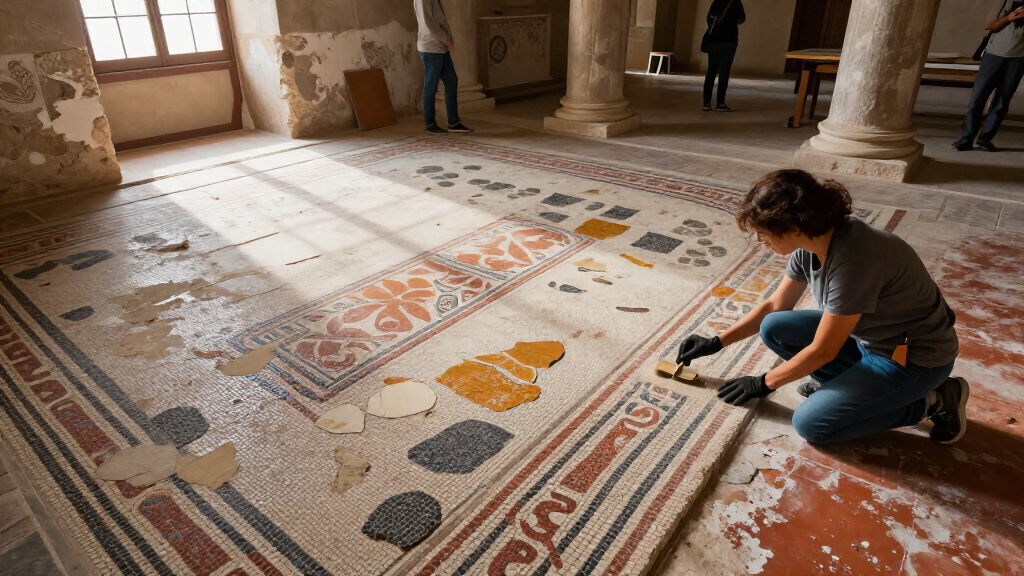
The gallery lies beneath the remains of the Baths of Trajan on Rome’s Oppian Hill, across from the Colosseum. Archaeologists uncovered the buried buildings in excavations conducted between 1997 and 1999. The newly opened museum uses the ancient vaulted space to show works preserved in place, including a large-scale mosaic extending across two sides of a hall.
Despite its name, the museum is not primarily a display of objects from Trajan’s public baths. The report describes eight enormous lead pipes bearing the raised words “THERM TRAIANI” as the only objects in the space that pertain to the Baths themselves. Most of the gallery is devoted instead to the mosaic and fresco, which the report describes as unique works without clear parallels elsewhere in the Roman Mediterranean.
The museum’s entrance includes a small bookshop. To the left, an irregular ancient room holds the pipes; the main gallery continues through the vaulted underground structure. The mosaic remains in its original setting, allowing visitors to see it as part of the architecture in which it survived.
A Mosaic Preserved Beneath Trajan’s Baths
The opening makes a major surviving example of Roman wall decoration accessible within the ancient structure where it was found. Its in situ presentation connects the artwork to the buried buildings and the later construction that covered them, rather than separating it from that setting for display elsewhere.
The site also shows how one prominent ancient landmark contains traces of different periods and uses. Trajan’s Baths were built over earlier buildings, while the newly opened gallery presents artworks from those buried structures. Visitors to the museum therefore encounter evidence of a layered archaeological site, alongside the surviving remains of the Baths above ground.
Top picks for "breathtak sight ancient"
As an affiliate, we earn on qualifying purchases.
From Buried Buildings to Museum
Oppian Hill was a densely built neighborhood in antiquity. Emperor Trajan later cleared the area to create a platform for his public baths, which were inaugurated in 109 CE. That construction buried a series of buildings beneath the Baths. The site also includes the Domus Aurea, Nero’s “Golden House,” whose decorated rooms can be visited in a separate immersive experience.
The 1997–99 excavations exposed the buried buildings in a gallery measuring about 230 feet, or 70 meters. Rome has now opened that underground space as the Museo delle Terme di Traiano. The museum’s name refers to the Baths above, while most of its display space is given to the two artworks found in the gallery.
““the largest surviving wall mosaic in the Roman world””
— Hyperallergic
What Is Known About the Artworks
The available report does not identify the mosaic’s subject, date, makers, dimensions, or the methods used to preserve it. It also provides no details about the fresco’s imagery or origin. The works’ relationship to one another is explicitly described as unclear, and the report does not establish what purpose the buildings beneath the Baths served.
The report calls the mosaic the largest surviving wall mosaic in the Roman world but does not provide measurements or explain the basis for comparing it with other surviving mosaics. Further information about the museum’s operating arrangements and visitor access is not included in the source material.
Public Access to the Underground Gallery
The gallery is now open to visitors as the Museo delle Terme di Traiano. The source report does not announce a future excavation, conservation project, or additional opening date. Its immediate development is the public presentation of the underground space and the artworks found there.
Visitors can see the mosaic and fresco in the main vaulted gallery and the inscribed lead pipes in a room near the entrance. Further details about programming, access schedules, and plans for the site have not been provided in the available report.
Key Questions
What has Rome opened?
Rome has opened the Museo delle Terme di Traiano, a museum in an underground gallery beneath the Baths of Trajan.
What is the museum’s main artwork?
The gallery displays a wall mosaic that Hyperallergic identifies as the largest surviving wall mosaic in the Roman world.
When were the buried buildings found?
Excavations that brought the buildings to light took place between 1997 and 1999.
Are the mosaic and fresco connected?
The available report says the two artworks have no clear relationship. It does not provide further evidence about their connection.
Does the museum mainly display objects from the Baths?
No. The report says the eight inscribed lead pipes are the only objects in the space that pertain to the Baths themselves. Most of the gallery is devoted to the mosaic and fresco.
Source: rss