Experimental printmaking with 3D printing allows you to explore complex forms, textures, and materials beyond traditional methods, giving you unprecedented control over your artwork. You can create detailed digital models and quickly test different shapes, surfaces, and material effects like resins, metals, or composites. This technology democratizes experimentation, making innovative ideas more accessible and versatile. If you continue exploring, you’ll discover even more ways to push creative boundaries and achieve groundbreaking results.
Key Takeaways
- 3D printing enables artists to experiment with complex and intricate forms impossible with traditional printmaking techniques.
- Digital sculpture allows rapid testing of shapes, textures, and structures before physical realization.
- Material experimentation with resins, metals, and composites creates diverse surface qualities and finishes.
- The technology democratizes innovative printmaking, reducing reliance on traditional carving and casting methods.
- 3D printing fosters groundbreaking artworks by exploring new aesthetic territories beyond conventional boundaries.
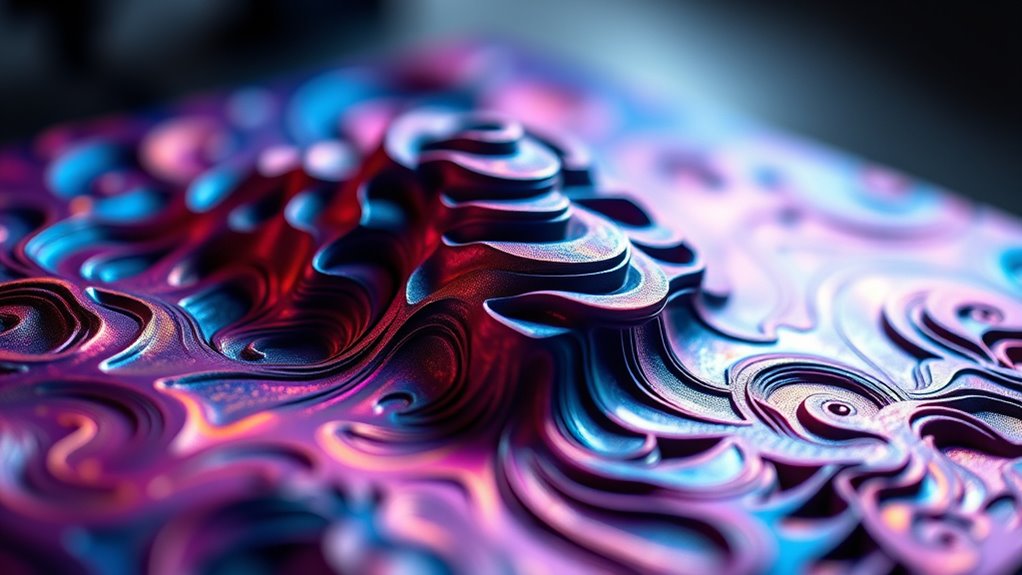
3D printing is revolutionizing traditional printmaking by offering artists new tools to experiment with form, texture, and process. It opens up a world of possibilities for creating complex, intricate designs that were previously impossible or too labor-intensive to produce by hand. One of the most exciting aspects of this technology is digital sculpture, which allows you to craft detailed, three-dimensional digital models that can be directly translated into physical objects. This process gives you unprecedented control over your work, enabling you to explore forms and structures that push the boundaries of conventional printmaking.
With digital sculpture, you’re not limited by traditional materials or techniques. Instead, you can experiment with a wide range of virtual textures, shapes, and compositions before committing to a final piece. This flexibility means you can test ideas rapidly, refine details, and explore new aesthetic territories without the constraints of physical materials. When you move to material experimentation, 3D printing becomes even more dynamic. You can choose from various printable materials—resins, plastics, metals, or composites—and see how they behave in real life. This experimentation can lead to surprising discoveries about how different textures and finishes influence the overall impact of your piece.
Material experimentation is at the heart of innovative printmaking. By trying out different materials and settings, you gain insights into how surface qualities, transparency, and strength affect the final product. For example, you might print a delicate lattice in a flexible resin to mimic organic structures or create a rugged, textured surface with a metallic filament. Each material offers unique possibilities, encouraging you to think beyond conventional boundaries and push your artistic vision further. This hands-on exploration often results in unexpected textures and forms, enriching your creative process.
Additionally, 3D printing democratizes experimentation, making it accessible to artists regardless of their technical background. You don’t need to master traditional carving or casting techniques to produce complex sculptures or textured prints. Instead, you can focus on digital modeling and material choices, allowing for rapid iteration and innovation. As you become more comfortable with digital sculpture and material experimentation, you’ll find new ways to combine form and function, pushing the limits of what printmaking can achieve. Incorporating the use of natural materials such as wood or stone in 3D printing can further enhance the authenticity and tactile quality of your work. Ultimately, this blend of technology and artistry empowers you to realize ideas that challenge conventional notions of printmaking, leading to truly experimental and groundbreaking works.

FLASHFORGE AD5X Multi-Color 3D Printer, CoreXY 600mm/s High-Speed, 1-Click Auto Leveling, 300°C Direct Drive Extruder, 220x220x220mm Build Volume, Ideal for Precision and Efficiency
Vivid Multi-Color Printing: Bring your creations to life with vibrant, multi-color prints. This printer supports up to 4…
As an affiliate, we earn on qualifying purchases.
As an affiliate, we earn on qualifying purchases.
Frequently Asked Questions
What Materials Are Best for 3D Printed Printmaking Tools?
You should consider using resistant filament like ABS or PETG for printmaking tools, as they offer durability and strength. Flexible materials such as TPU can create versatile, bendable tools suited for detailed or textured work. These materials allow you to craft custom tools tailored to your printmaking needs, providing both resilience and flexibility. Experimenting with different filaments helps you develop innovative tools for your printmaking projects.
How Does 3D Printing Influence Traditional Printmaking Techniques?
Your artistic innovation skyrockets as 3D printing transforms traditional printmaking, making it feel like wielding a magic wand. Digital integration allows you to craft intricate, custom tools and textures impossible by hand, expanding creative possibilities. This influence empowers you to experiment freely, blend techniques, and push boundaries, turning your printmaking into a cutting-edge fusion of technology and art. It’s a game-changer that redefines what’s possible in your creative process.
Can 3D Printed Prints Be Mass-Produced Efficiently?
Yes, 3D printed prints can be mass-produced efficiently, but scaling challenges and production costs may arise. You’ll need to optimize your 3D printing process to increase speed and reduce expenses. By selecting suitable materials and printers, you can improve consistency and output quality. While initial investments might be high, ongoing adjustments help you produce large quantities more cost-effectively, making 3D printing a viable option for mass production.
What Software Is Recommended for Designing 3D Printmaking Templates?
For designing 3D printmaking templates, I recommend exploring OpenSCAD, a powerful software for digital design. It’s perfect for precise, programmable models, allowing you to customize your creations effortlessly. Alternatively, you might consider Tinkercad for its beginner-friendly interface or Blender for more complex, artistic designs. Whichever you choose, mastering these tools will help you craft consistent, enthralling prints that push creative boundaries.
Are There Environmental Concerns With 3D Printing in Art?
You should consider environmental concerns with 3D printing in art, especially regarding waste and material sustainability. Using sustainable materials like biodegradable filaments helps reduce environmental impact. Additionally, you can minimize waste by optimizing designs for waste reduction and recycling unused filament. Being mindful of these practices allows you to create innovative art while also protecting the environment, making your work more eco-friendly and responsible.

Creality 3D Printer Filament 1.75mm, Rainbow Upgrade PLA+ Filament Strong Toughness No-Tangling Vacuum Packaging 3D Printing Filament Fit Most 3D Printers, 1kg Spool, Accuracy +/- 0.02mm, Multi-Color
【Strong Toughness without Breakage】Compare with other PLA filament, the Creality Ender PLA+ filament enhances the toughness of the…
As an affiliate, we earn on qualifying purchases.
As an affiliate, we earn on qualifying purchases.
Conclusion
As you explore experimental printmaking with 3D printing, you’ll notice how unexpected coincidences often spark your creativity. A simple misalignment or a chance material choice can lead to stunning, unplanned textures and forms. Sometimes, it feels like the machine itself whispers ideas, guiding your hand in new directions. In this dance of technology and intuition, you’ll find that the most mesmerizing artworks emerge from these happy accidents, turning coincidence into your greatest creative ally.

voltrish 11-Blade Deburring Tool for 3D Printing, Premium High-Speed Steel Blades for Smooth Edge Finishing – Ideal for HVAC, Metal & Resin & Professional Conduit Reaming, 3D Printer Accessories
Precision Edge Finishing: Achieve smooth, burr-free edges with high-speed steel blades for your 3D printing
As an affiliate, we earn on qualifying purchases.
As an affiliate, we earn on qualifying purchases.

Anatomy for 3D Artists: The Essential Guide for CG Professionals
As an affiliate, we earn on qualifying purchases.
As an affiliate, we earn on qualifying purchases.