

Understanding the science of pigments reveals how natural compounds like crushed beetles create vibrant dyes, thanks to their unique molecular structures that absorb specific light wavelengths. Modern advances include quantum dots—tiny particles with tailored properties that produce bright, stable colors for tech and medical uses. Studying how these pigments interact with light helps develop eco-friendly dyes and innovative materials. Continue exploring to discover how this fascinating science shapes the colors around us.
Key Takeaways
- Natural pigments like carminic acid from crushed cochineal insects have been used historically for vibrant dyes.
- Advances in molecular science enable the synthesis of artificial pigments mimicking natural hues.
- Quantum dots represent cutting-edge nanotechnology-based pigments with tunable optical properties.
- Understanding pigment structures enhances development of eco-friendly, stable dyes for industry applications.
- The evolution from traditional biological sources to nanomaterials showcases the scientific progress in pigment technology.
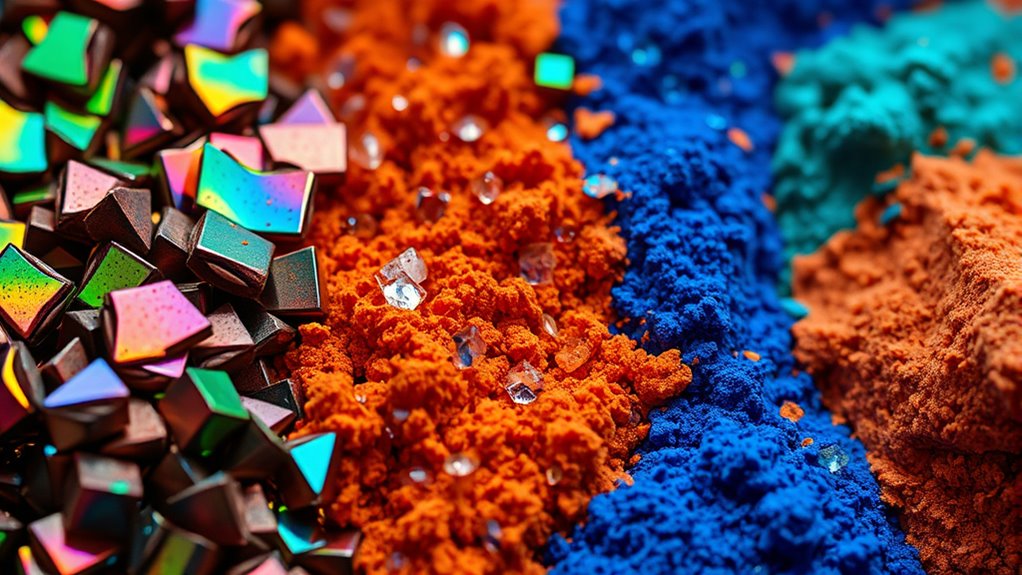
Have you ever wondered what gives colors their vibrancy and permanence? It all comes down to the science behind pigments—substances that absorb and reflect specific wavelengths of light. These pigments are essential in everything from the natural hues in flowers and fruits to the vivid shades in textiles and artworks. At the heart of this are biological pigments, which are naturally occurring compounds produced by living organisms. For example, chlorophyll gives plants their rich green, while carotenoids provide the reds, oranges, and yellows we see in pumpkins and carrots. These pigments are stable within their biological contexts, allowing plants and other organisms to thrive and communicate through color. Their structures are highly specialized, often involving complex organic molecules that can absorb certain wavelengths and reflect others, creating the colors we observe. Because of their importance in ecosystems, biodiversity plays a crucial role in the variety and stability of natural pigments found in different species. Additionally, advances in understanding their molecular structures are facilitating the development of bio-inspired pigments that can be used sustainably in various industries. Furthermore, the study of natural pigment stability helps scientists design more durable synthetic alternatives. The evolution of these molecules over millions of years has resulted in remarkably efficient systems for color production, which scientists are now studying to replicate and improve upon through biomimicry. Research into molecular structures of pigments has also led to innovations in creating vibrant and environmentally friendly dyes.
Top picks for "science pigment crush"
Open Amazon search results for this keyword.
As an affiliate, we earn on qualifying purchases.
Frequently Asked Questions
How Do Pigments Affect Human Health Over Long-Term Exposure?
Long-term exposure to certain pigments can pose toxicity risks you might not notice immediately. Chronic exposure, especially to toxic dyes and heavy metals, could lead to health issues like respiratory problems, skin irritation, or even more serious conditions over time. You should be cautious with pigments in your environment, avoid inhaling or ingesting them, and guarantee proper safety measures to minimize these risks and protect your health.
Can Pigments Be Engineered to Change Color Under Different Conditions?
Ever wondered how colors could shift in response to your surroundings? You can engineer pigments like photochromic dyes and thermochromic inks to change color under specific conditions. These smart pigments react to light or temperature changes, creating dynamic visual effects. By manipulating their molecular structures, scientists tailor their responses, making them perfect for innovative applications in fashion, safety, and technology. Isn’t it amazing how pigments can adapt like that?
What Role Do Pigments Play in Digital and Display Technologies?
You see pigments in digital and display technologies, where they help create vibrant images by covering a wide color gamut. They influence how colors are displayed and contribute to display calibration, ensuring accurate color reproduction. As technology advances, engineered pigments enhance color depth and consistency, making screens more realistic. Your understanding of pigments’s role helps appreciate how they enable the stunning visuals and true-to-life colors you experience on screens daily.
Are There Environmental Concerns Associated With Synthetic Pigment Production?
You might wonder if synthetic pigment production raises environmental concerns. It does, as traditional manufacturing can cause pollution and resource depletion. However, exploring sustainable alternatives like plant-based or mineral pigments helps reduce the environmental impact. By choosing eco-friendly options, you support greener practices and lessen harmful effects. Staying informed about sustainable pigments encourages responsible production and consumption, making a positive difference for the environment.
How Are Ancient Pigments Preserved for Archaeological Study?
You might think ancient pigments are lost forever, but preservation techniques help you uncover their secrets. Archaeologists use methods like careful excavation, controlling temperature and humidity, and applying chemical stabilizers to prevent degradation. For ancient dyeing, they often analyze tiny samples with advanced tools like microscopy or spectroscopy. These techniques enable you to study pigments’ composition and history, revealing insights into past cultures and their artistry.
Conclusion
Now that you’ve uncovered the fascinating journey of pigments, you can see how they’ve transformed art, technology, and even your everyday life. From tiny beetle shells to mind-blowing quantum dots, these colors shape your world in ways you’d never imagine—like magic, but real. So next time you admire a vibrant hue, remember, it’s the incredible science of pigments working behind the scenes, turning ordinary materials into extraordinary marvels that make life brighter and more beautiful.