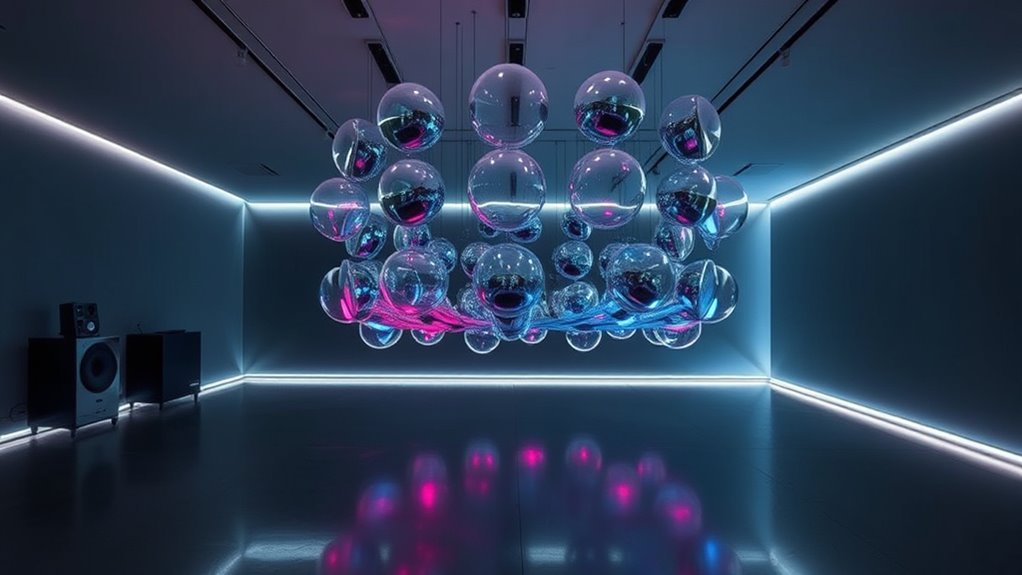

Spatial audio technology transforms sound art by immersing you in three-dimensional environments that blend sound and space seamlessly. Using techniques like binaural recording, it captures realistic, lifelike acoustic experiences that surround you via headphones or installations. This creates a sense of depth, depth, and presence, making your interaction more engaging and emotional. If you’re curious about how this technology continues to evolve and shape immersive experiences, you’ll find there’s much more to explore.
Key Takeaways
- Spatial audio enhances sound art by creating immersive, three-dimensional sound environments that surround and engage listeners.
- Binaural recording techniques capture realistic spatial sound cues, vital for lifelike sound art installations.
- Spatial audio in sound art allows for precise placement of sounds, transforming passive listening into an interactive experience.
- It deepens emotional connection and presence by simulating real-world acoustics and spatial cues.
- Emerging technologies expand sound art’s potential for storytelling, virtual experiences, and emotional evocation through advanced spatial audio.
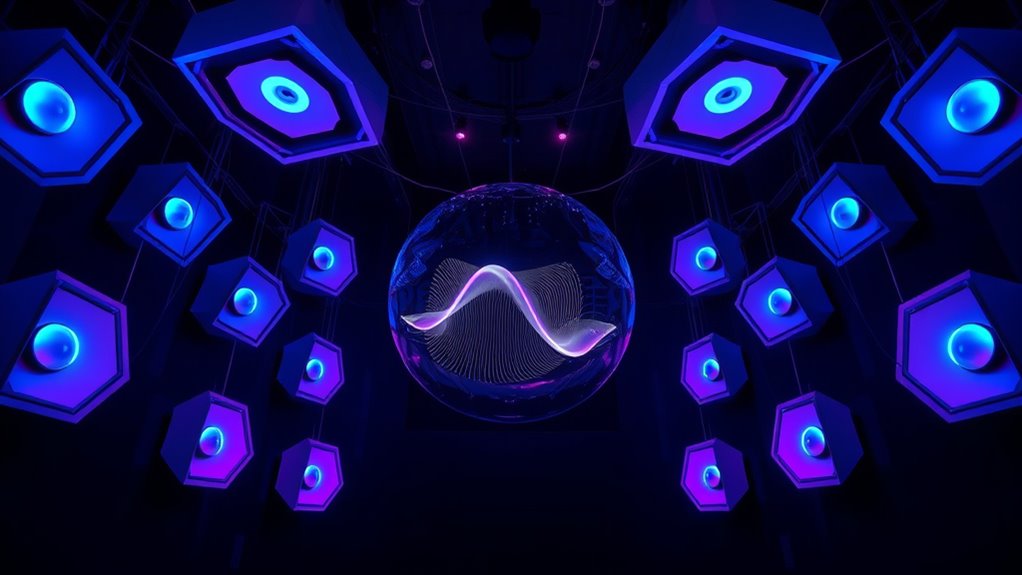
Sound art and spatial audio technology are transforming how we experience and interpret sound in both artistic and immersive environments. As you step into an immersive installation, the boundaries between sound and space blur, pulling you into a world where sound seems to surround you from all directions. These installations often utilize binaural recording techniques, which capture sound in a way that replicates how your ears naturally perceive it. Binaural recordings are created using two microphones placed at a person’s ears, capturing the subtle nuances of sound as it would reach your own head. When played back through headphones, this technique produces a remarkably realistic three-dimensional soundscape, making you feel like you’re physically present within the environment.
Binaural recordings create immersive, realistic three-dimensional soundscapes that surround you naturally through headphones.
In an immersive installation, binaural recording elevates the experience by providing a sense of depth and spatial accuracy that traditional stereo cannot match. You might find yourself walking through a virtual forest where each rustle of leaves or bird call feels precisely positioned around you, or standing in a recreated concert hall where the sound of the orchestra surrounds you as if you’re in the front row. The power of spatial audio technology lies in its ability to simulate real-world acoustics, immersing you fully in the environment. This creates a visceral connection to the soundscape, allowing you to explore sounds in a way that feels natural and intuitive.
The use of spatial audio in sound art also invites you to interact more actively with the piece. Unlike conventional listening, where your role is passive, spatial audio encourages you to move your head or body to perceive different angles and distances. This interactivity enhances your engagement and deepens your emotional response. Artists and sound designers leverage binaural recording and spatial audio to craft experiences that are not only auditory but also spatially rich, heightening your sense of presence and immersion.
Furthermore, these technologies open up new possibilities for storytelling and artistic expression. You can be transported to distant locations or imagined worlds, experiencing sounds that are precisely engineered to evoke specific emotions or responses. Whether you’re exploring an art installation or participating in a virtual reality environment, spatial audio transforms the way you perceive sound, making it more vivid and convincing. As these innovations continue to develop, you’ll find yourself more deeply connected to soundscapes than ever before, experiencing environments that are as immersive and dynamic as they are realistic.

OneOdio A71D Wired Over-Ear Headphones, Studio Monitor Headsets, Hi-Res DJ Stereo Headphone with Foldable Design, 3.5/6.35MM Plug for AMP Recording Podcast Mixing PC Guitar – Black
Studio-Grade Sound – 40mm drivers deliver deep bass, clear mids, and crisp highs for DJing, studio recording, mixing,…
As an affiliate, we earn on qualifying purchases.
As an affiliate, we earn on qualifying purchases.
Frequently Asked Questions
How Does Spatial Audio Influence Listener Perception?
Spatial audio profoundly influences your perception of depth and immerses you in the sound environment. It creates a sense of space around you, making you feel as if you’re inside the scene. This technology enhances your listening experience by positioning sounds accurately in three-dimensional space, allowing you to perceive movements and distances clearly. As a result, your overall experience becomes more engaging, realistic, and emotionally impactful.
What Are Emerging Trends in Sound Art Technology?
Have you noticed how innovative synthesis and interactive interfaces are transforming sound art? These emerging trends push boundaries, allowing you to craft immersive, dynamic experiences. You can manipulate sound in real-time, creating personalized environments that respond to your movements or inputs. As technology advances, expect even more intuitive tools that make sound art more accessible and engaging, inviting you to explore new creative horizons and redefine how you perceive and interact with sound.
How Accessible Are Spatial Audio Tools for Artists?
Spatial audio tools are becoming more accessible for artists, thanks to improved user interfaces that simplify the creation process. However, affordability barriers still exist, as some advanced systems can be costly. You might find entry-level options or free software that help you experiment without breaking the bank. Overall, the landscape is gradually leveling, making it easier for you to incorporate spatial audio into your projects.
What Ethical Considerations Exist in Immersive Sound Installations?
You should consider consent issues and cultural sensitivity when creating immersive sound installations. Always seek permission from communities or individuals whose sounds or stories you incorporate, respecting their rights and wishes. Be mindful of cultural nuances to avoid misrepresentation or offense. By prioritizing informed consent and cultural awareness, you ensure your installation is ethical, respectful, and inclusive, fostering a positive experience for all participants and audiences.
Can Spatial Audio Be Used for Therapeutic Purposes?
Sure, you can use spatial audio for therapeutic purposes—because who wouldn’t want their emotional resonance amplified by immersive soundscapes? Imagine calming, therapeutic soundscapes swirling around you, soothing anxiety or enhancing relaxation. Spatial audio makes this possible by creating a realistic environment that taps into your emotions. So, yes, it’s a powerful tool for therapy, turning sound into a healing experience that feels almost like a hug from the auditory universe.

JLab JBuds Lux ANC Wireless Headphones, Graphite, Hybrid Active Noise Cancelling, Customizable Sound, Spatial Audio Compatible, Premium Over-Ear Bluetooth Headset
🔊 IMMERSIVE LAB QUALITY SOUND: Enjoy exceptional sound quality via 40mm drivers, bringing depth and clarity to your…
As an affiliate, we earn on qualifying purchases.
As an affiliate, we earn on qualifying purchases.
Conclusion
As you explore sound art and spatial audio technology, you’ll find yourself gently guided into new sensory domains. These innovations subtly reshape how you experience space and sound, inviting you to discover hidden depths of perception. Embrace these evolving tools as a gentle invitation to curiosity, where each soundscape becomes a delicate dance of imagination. In this journey, the boundaries between art and technology blur, offering you a quietly transformative experience that’s both mesmerizing and inspiring.

12Pack Acoustic Panels, Self-Adhesive 3D Brick Pattern Sound Proof Panels for Walls, High Density Decorative Acoustic Foam, Sound Absorbing for Recording Studios, Offices, 12"×12"×0.4", Lime Black
【Ultimate Audio Clarity Enhancer】The sound proof wall panels are crafted from high-density 100% polyester(14.36lb/ft³) fiber material, boasting powerful…
As an affiliate, we earn on qualifying purchases.
As an affiliate, we earn on qualifying purchases.

ARTDOT Strong Adsorption Putty Wax for Diamond Painting Kits for Adults, Large Size Glue with Sealed Storage Box for Diamond Art Accessories and Tools(Pink)
TRANSFORM DIAMOND ART – The putty wax designed by ARTDOT for diamond art features long-lasting stickiness, Therefore, no…
As an affiliate, we earn on qualifying purchases.
As an affiliate, we earn on qualifying purchases.