TL;DR

Get art and craft supplies delivered free — and shop member deals
- Fast, free delivery on millions of items
- Access to Prime Big Deal Days deals on October 6–7
- Prime Video, Amazon Music and more included
A Colossal report published in October 2026 profiles London-based artist Hannah Lim’s sculptural works inspired by traditional Chinese snuff bottles, Chinoiserie and her British-Singaporean heritage. Her solo exhibition Reimaginings is on view at the Museum of East Asian Art in Bath through November 14, 2026; further projects are also planned.
London-based artist Hannah Lim is reworking the small, ornate form of the Chinese snuff bottle into larger sculptures informed by British-Singaporean heritage, historical ceramics and Chinese mythology, according to a report published by Colossal. Lim’s solo exhibition, Reimaginings, is on view at the Museum of East Asian Art in Bath through November 14, 2026, bringing the work into a museum setting while she continues to develop projects in sculpture and painting.
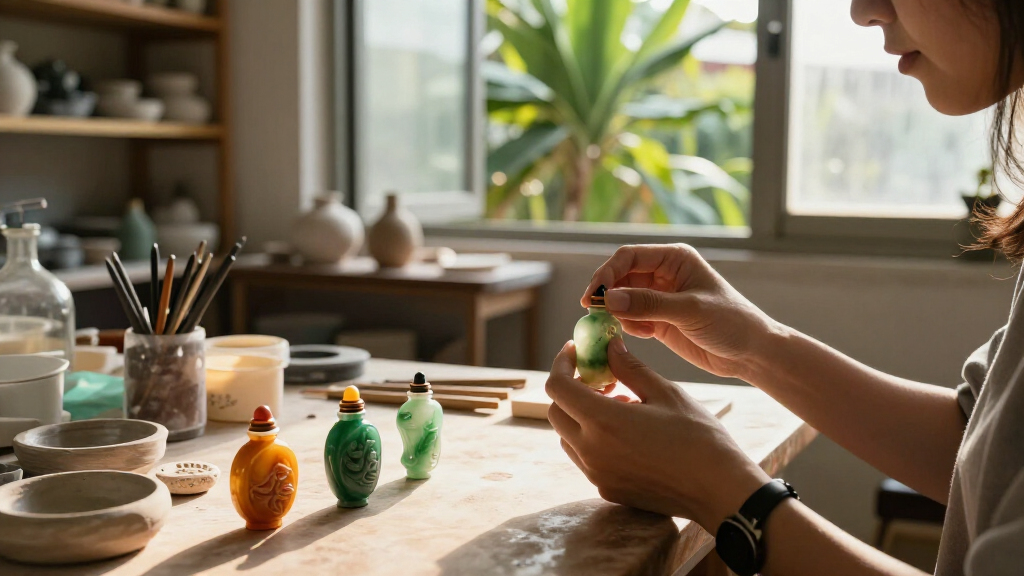
Lim’s bottles retain recognizable features of the historical objects but shift their scale and presentation. Traditional snuff bottles were generally only a few inches across, designed to be portable and easily put away. Lim’s versions are several inches tall and commonly require both hands to hold. They combine polymer clay and Jesmonite, a casting material made from mineral powder and liquid acrylic polymer. Chalk, acrylic paint and gloss provide the surfaces and finishes, which can include small painted or relief images of animals and imagined creatures.
Each sculpture also contains a hanging charm hidden inside its lid. Lim says the detail refers to the tiny spoon attached to the lid of a traditional snuff bottle, used to scoop the powdered tobacco. The works take motifs from her research as well as personal aspects of her heritage. Lim told Colossal that the series has shifted over time: “Initially, my own snuff bottle works were designed in a way to highlight certain personal aspects of my heritage. Over time, they’ve come to reflect different points in my research.”
The report connects Lim’s work to her study of Chinoiserie, a European design fashion of the 17th and 18th centuries that adapted Chinese and other Asian motifs for Western audiences. Lim says she is trying to revisit that history more conscientiously. Her other sources include The Classic of Mountains and Seas, an ancient Chinese text containing fantastical descriptions of landscapes and creatures. Colossal reports that Lim is translating its imagery into recent sculptures and paintings. She is also experimenting with metal, laser-cut elements and frames that extend the imagery of her paintings.
Reworking Chinoiserie Through Sculpture
Lim’s work places a historical exchange of visual styles at the center of a contemporary practice. Chinoiserie involved European makers borrowing and adapting Asian motifs for Western consumers; Lim’s stated aim is to reclaim and reimagine that practice with closer attention to cultural sources. The enlarged bottles make that inquiry visible through familiar decorative forms, while her use of Chinese literary references and personal heritage gives the pieces a distinct basis beyond imitation.
The current exhibition also offers visitors a chance to encounter the works in a museum dedicated to East Asian art. The report does not claim that the exhibition changes the wider debate around cultural appropriation, but Lim’s own description makes clear that this history informs her choices of form and reference. Her approach matters to readers interested in how artists work with inherited designs: it shows a specific practice grounded in research, material experimentation and the artist’s own background.
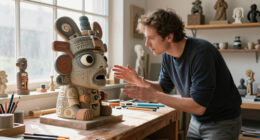
large Chinese snuff bottle sculpture
As an affiliate, we earn on qualifying purchases.
As an affiliate, we earn on qualifying purchases.
From Portable Objects to Large Forms
Snuff bottles developed in China in the 17th century alongside the popularity of snuff, a scented powdered tobacco that originated in the Americas. Users inhaled it through the nose, taking small amounts from a bottle with a spoon attached to its lid. As with snuff in Europe, the habit became especially popular among affluent people. The bottles’ compact size and varied ornament made them both useful containers and decorative objects.
According to Colossal, Lim became interested in their designs after seeing examples in museum collections around the United Kingdom. She began sculpting motifs inspired by them and later increased the scale. Her interest in Chinoiserie provides a wider historical frame: European producers adapted Asian visual styles for a Western market, while Lim says her work draws from specific cultural styles and processes in an effort to approach that legacy differently.
The report identifies several near-term developments beyond Reimaginings. Lim is due to show works with Cynthia Corbett Gallery in Paris later in October 2026 and plans to unveil a public artwork in Paddington, London, later in the year. It also notes that she is exploring metal and laser-cut elements, though it gives no technical or installation details for the upcoming public work.
As an affiliate, we earn on qualifying purchases.
Exhibition and Project Details
The source report does not provide a complete exhibition checklist, visitor numbers, sales information or details about how the Bath museum is presenting each sculpture. It also does not specify the date or design of Lim’s planned Paddington public artwork, or the exact works she will show with Cynthia Corbett Gallery in Paris. Those plans are reported, but further information on their scope and public access is not included.
The account describes Lim’s intentions and materials but does not include independent commentary from curators, historians or other artists. The broader effect of her approach to Chinoiserie therefore cannot be established from this report alone. Lim’s stated aim to engage more conscientiously with the practice should be understood as her account of her own work, not as an external assessment.
As an affiliate, we earn on qualifying purchases.
Bath Show and Upcoming Work
Reimaginings remains on view at the Museum of East Asian Art in Bath through November 14, 2026, according to Colossal. The report says Lim’s work will also appear with Cynthia Corbett Gallery in Paris later in October and that a new public artwork is planned for Paddington later this year. It does not provide specific dates for either presentation.
Lim is continuing to test new materials, including metal, and to develop laser-cut sculptural elements and frames that carry motifs from her paintings. Further information about those works, and any installation details for the Paddington artwork, will be needed to establish how the projects develop beyond the plans described in the report.
As an affiliate, we earn on qualifying purchases.
Key Questions
What is Hannah Lim showing in Bath?
Her solo exhibition, Reimaginings, is on view at the Museum of East Asian Art through November 14, 2026, according to Colossal.
How do Lim’s sculptures differ from traditional snuff bottles?
Traditional snuff bottles were typically only a few inches across. Lim’s versions are larger, several inches tall and usually held with both hands. They also contain a hidden hanging charm that refers to the small spoon attached to traditional bottle lids.
What materials does Lim use?
The report says she uses polymer clay and Jesmonite for structure, with chalk, acrylic paint and gloss for surface finishes. She is also experimenting with metal and laser-cut elements.
What are the sources behind the imagery?
Lim draws on historical ceramics, her British-Singaporean heritage, Chinoiserie and Chinese mythology. Colossal also reports that The Classic of Mountains and Seas has informed recent sculptures and paintings.
What projects are planned after the Bath exhibition?
Colossal reports that Lim will show works with Cynthia Corbett Gallery in Paris later in October 2026 and plans a new public artwork in Paddington, London, later in the year. Specific dates and project details were not provided.
Source: rss
Fall Picks
fall essentials
As an affiliate, we earn on qualifying purchases.