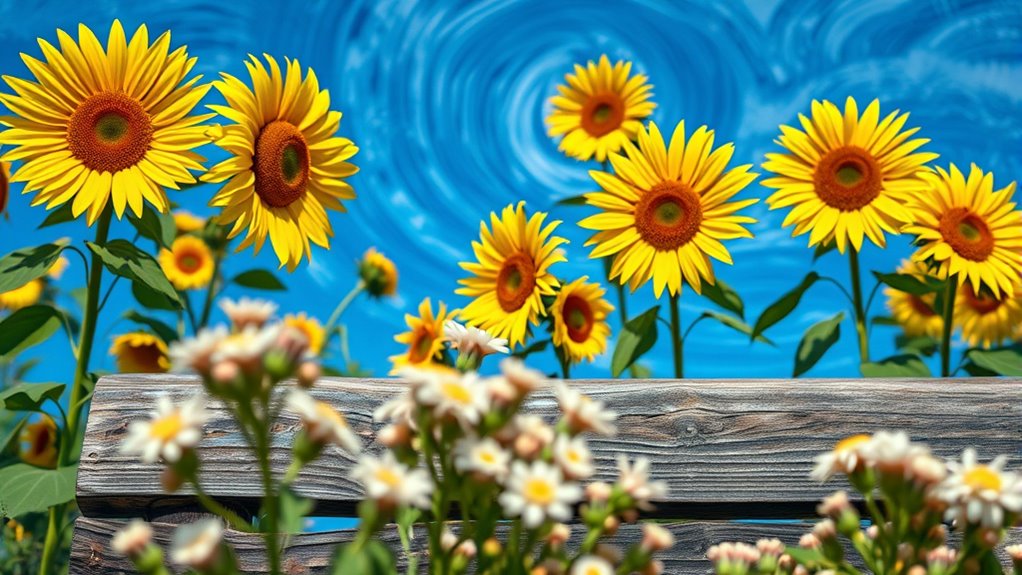

In van Gogh’s work, you’ll find flowers like sunflowers and irises bursting with vibrant life, symbolizing beauty and fleeting moments. Conversely, Kiefer’s flowers appear more decayed, often textured or combined with ash, representing loss and the passage of time. While van Gogh encourages you to appreciate life’s transient beauty, Kiefer invites you to reflect on mortality and remembrance. To understand how each artist uses flowers differently, there’s more worth exploring beyond this glimpse.

Get art and craft supplies delivered free with Prime
- Fast, free delivery on millions of items
- Prime Video, Amazon Music and more included
- Member-only deals all year
Key Takeaways
- Van Gogh depicts vibrant, lively flowers symbolizing fleeting beauty and the urgency to cherish life.
- Kiefer uses decayed or textured flowers to evoke themes of mortality, decay, and remembrance.
- Both artists employ flowers to explore life’s transience, but Van Gogh emphasizes vitality; Kiefer emphasizes loss.
- Van Gogh’s flowers celebrate natural beauty, while Kiefer’s highlight the passage of time and inevitable decay.
- Their contrasting styles deepen the symbolic meaning of flowers within broader themes of life, death, and memory.

Flowers have long served as powerful symbols and vibrant motifs in art, capturing both beauty and fleeting mortality. When you explore the works of Kiefer and Van Gogh, you quickly realize how deeply intertwined flower symbolism is with their artistic visions. In the art historical context, flowers often represent themes of life, death, renewal, and transience. Van Gogh’s paintings, like his iconic sunflowers and irises, exemplify this; they celebrate natural beauty while also hinting at mortality. His brushstrokes convey a sense of urgency, as if capturing the fleeting life of each bloom. Van Gogh’s intense emotional connection to flowers elevates their symbolism from mere decoration to profound expressions of human experience, making them a mirror for both personal and universal themes. Additionally, Van Gogh’s focus on ephemeral beauty underscores the transient nature of life and art itself, emphasizing the importance of appreciating beauty in the moment.
Kiefer, on the other hand, approaches flower imagery with a more somber, reflective tone. His use of flowers often evokes decay, remembrance, and the passage of time. In his artwork, flowers are not just symbols of life but also reminders of mortality and loss. You might notice how Kiefer employs materials like ash or earth in his pieces, emphasizing the transient nature of existence. The flowers in his work seem to be preserved in moments of transition, embodying the tension between life and death. This approach aligns with the broader art historical context where flowers have been used to symbolize mortality since the Renaissance, often appearing in vanitas paintings to remind viewers of the fleeting nature of worldly pleasures.
Both artists, in their unique ways, challenge you to reflect on the temporality of life. Van Gogh’s vibrant, almost frantic depictions invite you to savor beauty while it lasts, urging a recognition of life’s ephemeral quality. Kiefer’s somber, textured compositions push you to contemplate loss and remembrance, acknowledging that beauty and decay are inseparable parts of existence. Their contrasting styles deepen your understanding of flower symbolism within art historical context, showing how flowers can serve as poignant metaphors for the human condition. Whether in Van Gogh’s luminous blooms or Kiefer’s decayed blossoms, you see that flowers in art are more than decorative elements—they are powerful symbols that carry complex, layered meanings about mortality, hope, and the passage of time.
van Gogh sunflower wall art print
As an affiliate, we earn on qualifying purchases.
As an affiliate, we earn on qualifying purchases.
Frequently Asked Questions
How Do Kiefer and Van Gogh Differ in Their Use of Color?
You’ll notice that Kiefer and Van Gogh differ in their use of color, shaping the emotional impact of their work. Kiefer employs muted, earthy tones to evoke symbolism and depth, creating an introspective atmosphere. Van Gogh, on the other hand, uses vibrant, expressive colors in his artistic palettes to convey intense emotion and movement. Their contrasting approaches highlight how color symbolism influences each artist’s unique style and message.
What Symbolic Meanings Are Associated With Flowers in Their Artworks?
You see that flowers in their artworks symbolize more than just beauty; they often represent life, death, and renewal through flower symbolism. Kiefer uses botanical motifs to evoke memory and mortality, while Van Gogh emphasizes emotional expression with vibrant, dynamic flowers. Their works invite you to interpret the flowers’ deeper meanings, connecting nature’s transient beauty to human experiences of loss and hope.
Which Specific Flowers Are Most Commonly Depicted by Kiefer and Van Gogh?
You’ll notice that Kiefer often depicts poppies and roses, emphasizing flower symbolism like remembrance and love, while Van Gogh passionately captures sunflowers and irises, reflecting energy and hope. These flowers aren’t just botanical accuracy; they evoke deep emotions and cultural meanings. Juxtaposing their choices, you see how Kiefer’s darker tones contrast Van Gogh’s vibrant yellows, creating a powerful dialogue about life, death, and renewal through their favorite blooms.
How Did Personal Experiences Influence Their Flower-Themed Art?
Your personal memories and emotional symbolism deeply influence their flower-themed art. Kiefer channels his past struggles and history into his paintings, making flowers symbols of resilience or loss. Van Gogh, on the other hand, uses flowers to express his emotional highs and lows, transforming personal feelings into vibrant, expressive images. Their artworks serve as visual diaries, revealing how personal experiences shape their interpretation of flowers.
Are There Any Notable Collaborations or Influences Between Kiefer and Van Gogh?
You might notice a subtle influence between Kiefer and Van Gogh, as both explore flower symbolism deeply. While they didn’t collaborate directly, Kiefer’s use of layered textures and Van Gogh’s bold brushstrokes reflect shared artistic techniques that evoke emotion. Their works intertwine through a mutual fascination with nature’s transient beauty, inviting you to see flowers as symbols of life’s fleeting moments, connecting their powerful visions across time.
As an affiliate, we earn on qualifying purchases.
Conclusion
As you reflect on Kiefer’s and Van Gogh’s powerful floral imagery, you realize these flowers aren’t just pretty details—they symbolize life, death, and renewal. Their vibrant blooms invite you to see beyond surface beauty and explore deeper meanings. Isn’t it fascinating how flowers can tell such profound stories? Next time you encounter a flower in art, ask yourself: what hidden truths are waiting to bloom beneath its petals?
flower-themed art prints for home
As an affiliate, we earn on qualifying purchases.
As an affiliate, we earn on qualifying purchases.
As an affiliate, we earn on qualifying purchases.
Halloween Picks
halloween
As an affiliate, we earn on qualifying purchases.