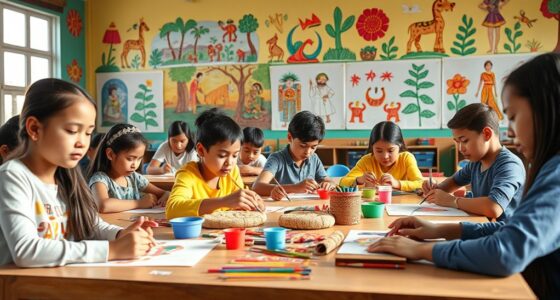
AI is revolutionizing art curriculum design by providing objective assessment tools, enabling real-time collaboration, and personalizing learning experiences to match each student’s skills and interests. It helps you create more engaging, inclusive environments that prepare students for new creative opportunities. By integrating AI, you can encourage experimentation and growth while fostering innovation. If you keep exploring, you’ll discover how these changes can truly transform your approach to art education.

Get art and craft supplies delivered free with Prime
- Fast, free delivery on millions of items
- Prime Video, Amazon Music and more included
- Member-only deals all year
Key Takeaways
- AI enables objective, efficient assessment and personalized feedback, enhancing skill development in art education.
- It fosters real-time collaboration and interdisciplinary projects, expanding creative possibilities for students.
- Adaptive learning algorithms tailor curricula to individual progress, maintaining engagement and addressing learning gaps.
- Integrating AI enriches traditional teaching methods, creating more inclusive and innovative art learning environments.
- AI-driven tools support dynamic curriculum design, emphasizing continuous growth, experimentation, and technological integration.

Artificial intelligence is transforming art education in ways that were unimaginable a decade ago. It’s reshaping how you evaluate student work and how students engage with each other creatively. With AI-driven assessment tools, you can now measure artistic skills more objectively and efficiently. Instead of relying solely on subjective judgments, AI algorithms analyze aspects like composition, color harmony, and technique, offering detailed feedback that helps students understand their strengths and areas for improvement. This not only speeds up the grading process but also provides personalized insights that guide learners toward growth. As a result, your curriculum becomes more dynamic, allowing students to focus more on honing their craft rather than waiting for traditional evaluations.
AI transforms art education by providing objective, detailed feedback, speeding grading, and enabling more dynamic, personalized learning experiences.
AI also fosters creative collaboration in ways that expand what’s possible within your classroom. You can integrate AI-powered platforms that facilitate real-time teamwork, enabling students to co-create digital artwork, music, or multimedia projects regardless of physical location. These tools encourage diverse perspectives and push students to think outside their usual creative boundaries. Moreover, AI can serve as a collaborative partner, offering suggestions, generating ideas, or even sparking new directions in a project. This kind of interaction not only enhances individual creativity but also teaches students how to work effectively in interdisciplinary teams, a crucial skill in today’s interconnected world. By weaving AI into your curriculum, you create a space where students learn to harness technology as a partner rather than just a tool, fostering a more innovative approach to art-making.
In addition, AI’s role in curriculum design allows you to tailor lessons more precisely to individual student needs. Adaptive learning platforms analyze each learner’s progress, adjusting tasks and challenges to keep them engaged and appropriately challenged. This personalized approach ensures that students aren’t left behind or bored, but instead continuously pushed to develop their skills. It also helps you identify learning gaps early, enabling you to modify your teaching strategies accordingly. As a result, your curriculum becomes more flexible and responsive, supporting a wider range of learning styles and artistic interests.
Ultimately, AI’s integration into art education isn’t about replacing traditional methods but enhancing them. It empowers you to create a more engaging, inclusive, and innovative curriculum that prepares students for the evolving landscape of art and technology. By leveraging AI-driven assessment, fostering creative collaboration, and personalizing learning experiences, you help cultivate an environment where students can experiment, grow, and succeed in new and exciting ways.
As an affiliate, we earn on qualifying purchases.
Frequently Asked Questions
How Does AI Influence Traditional Art Teaching Methods?
AI transforms traditional art teaching by fostering creative collaboration and artistic innovation. You can use AI tools to inspire students, offering new perspectives and techniques that enhance their skills. It encourages experimentation, allowing learners to push boundaries and explore new mediums. By integrating AI, you make lessons more interactive and dynamic, helping students develop their unique voices while staying connected to evolving artistic trends.
What Ethical Concerns Arise From Using AI in Art Education?
Using AI in art education is like steering a river with hidden rocks; you must stay alert to ethical concerns. You risk copyright infringement when AI generates work from protected sources. Bias and representation issues can skew learning, reinforcing stereotypes instead of fostering diversity. You need to guarantee transparency and fairness, so AI supports creativity without compromising ethical standards or unintentionally harming marginalized voices.
Can AI Replace Human Art Educators Entirely?
AI can’t replace human art educators entirely because automation concerns limit its ability to replicate emotional understanding and nuanced teaching. You benefit from human guidance, which fosters creativity, empathy, and personalized feedback. While AI can assist with technical skills and streamline tasks, it lacks the emotional intelligence needed to inspire and connect on a deeper level. So, human educators remain essential for an all-encompassing, emotionally rich art education experience.
How Accessible Is AI Technology for Diverse Educational Institutions?
AI technology’s accessibility varies across educational institutions due to cost barriers and technological disparities. You might find that well-funded schools easily adopt AI tools, while under-resourced institutions face challenges. To bridge this gap, look for affordable options and community-driven solutions. It is crucial to advocate for equitable access, ensuring all students benefit from AI innovations, regardless of their school’s financial or technological capabilities.
What Skills Should Students Develop Alongside AI Integration in Art?
You should focus on developing your creative collaboration skills and technical literacy. As AI integrates into art, working effectively with others and understanding how to use new tools become essential. Embrace teamwork, share ideas, and learn the technical skills needed to operate AI software. This combination boosts your ability to innovate, adapt, and stay competitive in evolving art landscapes, making your work more dynamic and impactful.
digital collaboration platforms for students
As an affiliate, we earn on qualifying purchases.
As an affiliate, we earn on qualifying purchases.
Conclusion
As you explore AI’s role in art curriculum design, it’s like witnessing a brushstroke of coincidence—technology and creativity seamlessly intertwine. Just as a chance encounter sparks new inspiration, AI opens unexpected doors for innovation and personalized learning. You’ll find yourself shaping a future where art and AI coexist, each enhancing the other in unpredictable, exciting ways. Embrace this convergence, and watch how your artistic journey becomes richer and more limitless than ever before.
adaptive learning software for art education
As an affiliate, we earn on qualifying purchases.
As an affiliate, we earn on qualifying purchases.
As an affiliate, we earn on qualifying purchases.
Fall Picks
fall essentials
As an affiliate, we earn on qualifying purchases.