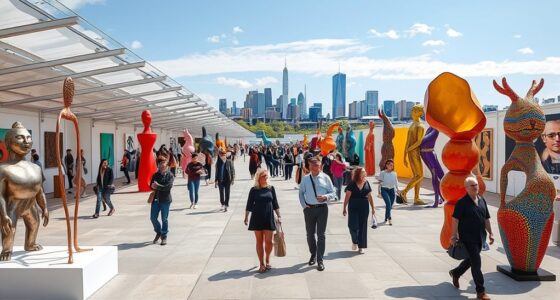
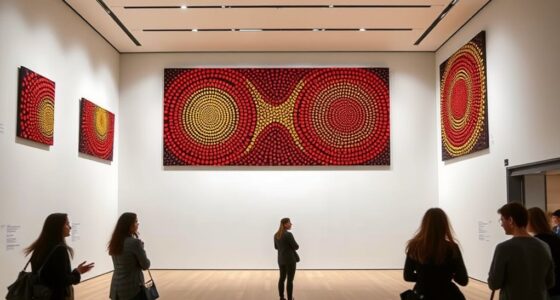
Documenting performance art is challenging because you’re trying to preserve moments that are inherently fleeting and often sensory or emotional in nature. You need to balance capturing the work responsibly while respecting the artist’s intent and audience experience, which can be disrupted by recording. Technological limitations also make it difficult to fully convey the essence and spontaneity of live performances. If you’re curious about overcoming these hurdles, you’ll discover more ways to approach this complex task.

Get art and craft supplies delivered free with Prime
- Fast, free delivery on millions of items
- Prime Video, Amazon Music and more included
- Member-only deals all year
Key Takeaways
- Capturing ephemeral moments risks losing subtle nuances and emotional depth inherent in live performances.
- Ethical concerns arise over permissions, privacy, and potential exploitation when recording and sharing performance art.
- Technological limitations hinder reproducing sensory elements like spatial dynamics, sound, and atmosphere.
- Recording may interfere with the artist’s intent or audience experience, risking disruption or alteration of the performance.
- Digital security and rights management pose challenges in safeguarding recordings from unauthorized access or misuse.

Performance art often exists in fleeting moments, making documentation essential for capturing its impact and preserving its legacy. When you attempt to record these ephemeral experiences, you face a range of challenges, particularly related to ethical considerations and technological limitations. Balancing the desire to document a performance without disrupting the artist’s intentions or the audience’s experience requires careful thought. You must ask yourself: How can you document authentically without intruding or altering the moment? Respecting the artist’s vision and the audience’s engagement is paramount, yet capturing the essence of a performance often involves making choices that could compromise its spontaneity or emotional resonance.
Ethical considerations come into play when you decide what to record and how to share it. For instance, should you photograph or film every aspect of a performance, potentially infringing on the artist’s privacy or intellectual property? Many performance artists intentionally incorporate audience participation or sensitive themes, which complicate decisions about documentation. You need to consider whether capturing these moments might exploit or diminish their meaning. Furthermore, you must be transparent with the artist about your intentions, obtaining permissions when possible, and respecting boundaries that might be set to preserve the integrity of the work. Failing to do so not only risks ethical violations but can also damage trust and artistic relationships. Additionally, understanding the limitations of technology helps set realistic expectations for what can be captured and preserved accurately. Recognizing these technological constraints allows you to make more informed choices about the methods you use to record and share performances. Being aware of the digital media landscape can help you navigate copyright concerns and distribution challenges more effectively. Moreover, ongoing cybersecurity threats mean that safeguarding digital recordings from unauthorized access or tampering is increasingly important.
Deciding what to record and share risks infringing on privacy and diminishing artistic meaning.
On the other hand, technological limitations often hinder your ability to faithfully record performance art. No matter how advanced your equipment, capturing the full sensory and emotional impact of a live performance remains a challenge. Video and audio recordings may miss subtle nuances—such as spatial dynamics, physical gestures, or the audience’s reactions—that are integral to the experience. Additionally, lighting conditions, sound quality, and camera angles can distort or omit critical elements. As you rely on technology, you might find yourself constrained by these limitations, which can result in representations that fall short of the original performance’s intensity or meaning. This ongoing technological evolution continually influences how well recordings can serve as authentic representations, emphasizing the importance of adapting your methods accordingly.
Ultimately, documenting performance art is a balancing act. You need to navigate ethical considerations carefully, ensuring that your recordings respect the artist’s intent and audience’s experience. Simultaneously, you must work within technological constraints, recognizing that no medium can fully replicate the live event. By approaching this task thoughtfully, you help preserve these fleeting moments for future audiences while honoring the complex, immersive nature of performance art.
high-quality portable audio recorder for performance art
As an affiliate, we earn on qualifying purchases.
As an affiliate, we earn on qualifying purchases.
Frequently Asked Questions
How Do Artists Decide What to Document in Performance Art?
When deciding what to document in performance art, you focus on capturing the essence and key moments that reflect your intent. You consider performance preservation by choosing elements most essential to conveying your message. Artistic selection guides you to document moments that best showcase your concept, emotions, and audience interaction. By prioritizing these aspects, you guarantee the most meaningful parts of your work are preserved, even if the full performance is fleeting.
What Ethical Considerations Arise in Documenting Ephemeral Performances?
When you document ephemeral performances, you face ethical concerns like consent challenges and representation ethics. You must guarantee performers agree to be recorded, respecting their wishes and privacy. Misrepresenting the artwork or capturing moments without full consent can harm artists’ intentions and audience perception. By prioritizing clear communication, respecting boundaries, and honestly representing the performance, you uphold ethical standards and honor the fleeting nature of the art.
Can Digital Archives Fully Capture the Essence of Live Performances?
You might think digital archives can fully capture live performances, but they often lack visual permanence and emotional resonance. While recordings preserve visuals, they miss the atmosphere, audience reactions, and energy that make live art special. Digital archives offer a snapshot, but true essence often remains elusive, leaving you craving the immediacy and visceral impact that only a live experience provides.
How Does Audience Participation Influence Documentation Strategies?
You realize that audience participation shapes how performances are documented. Participatory recordings become essential, capturing audience memory and engagement, which often can’t be fully conveyed through traditional media. You adapt your documentation strategies to include these recordings, understanding that they offer unique insights into the live experience. By doing so, you preserve the interactive essence, ensuring that the fleeting nature of performance art is remembered through collective participation.
What Role Does Technology Play in Preserving Performance Art?
Imagine technology as your superhero in preserving performance art—without it, your efforts might vanish like smoke. You leverage advanced archiving methods to capture every moment with stunning visual fidelity, ensuring the fleeting becomes timeless. From high-resolution video to immersive virtual reality, you make sure each performance endures, allowing future audiences to experience its essence. Technology transforms ephemeral art into an everlasting legacy, giving you the power to preserve beauty before it slips away.
4K video camera with spatial audio capture
As an affiliate, we earn on qualifying purchases.
As an affiliate, we earn on qualifying purchases.
Conclusion
As you try to capture performance art, you realize it’s like chasing shadows—beautiful but elusive. The fleeting nature of these moments slips through your fingers, reminding you that some things are meant to live only in memory. While photos and videos attempt to freeze time, they can never fully grasp the experience’s essence. Embrace the challenge, knowing that the true power of performance art lies beyond what you can document—it’s felt, not just seen.
privacy screen for recording performances
As an affiliate, we earn on qualifying purchases.
As an affiliate, we earn on qualifying purchases.
digital rights management software for video
As an affiliate, we earn on qualifying purchases.
As an affiliate, we earn on qualifying purchases.
Halloween Picks
halloween
As an affiliate, we earn on qualifying purchases.