
TL;DR

Get art and craft supplies delivered free with Prime
- Fast, free delivery on millions of items
- Prime Video, Amazon Music and more included
- Member-only deals all year
Raed Yassin’s Warhol of Arabia is included in In Minor Keys, the main exhibition of the 61st Venice Biennale. The photographic mixed-media series reimagines Andy Warhol’s documented 1977 visit to Kuwait, but its imagined scenes are artistic fiction rather than a historical record.
Artist Raed Yassin is presenting Warhol of Arabia, a series of photographic mixed-media works imagining Andy Warhol’s 1977 visit to Kuwait, in In Minor Keys, the main exhibition of the 61st Venice Biennale. Anchored in a documented trip, the works invent scenes around the pop artist’s time in the Gulf country and offer an artistic interpretation—not documentary evidence—of the social and cultural world surrounding it.
The series, made between 2016 and 2018, reconstructs the visit through staged-looking images that Yassin describes as an imaginative view of the period. In The Party XII, Warhol appears on the floor between a sheikh and a woman wearing a kaftan. Yassin colors Warhol’s hair pink and glasses yellow while leaving the other figures in a different visual register, marking the artist as an outsider within the scene.
In The Exhibition XIII, Yassin places images of four brightly colored headscarves over a photograph of Warhol with his Campbell’s soup can multiples. The gesture alters familiar Pop imagery associated with the artist by bringing Gulf clothing into the composition. The exhibition presents these interventions as part of Yassin’s reimagining, not as a literal account of what occurred during Warhol’s Kuwait stay.
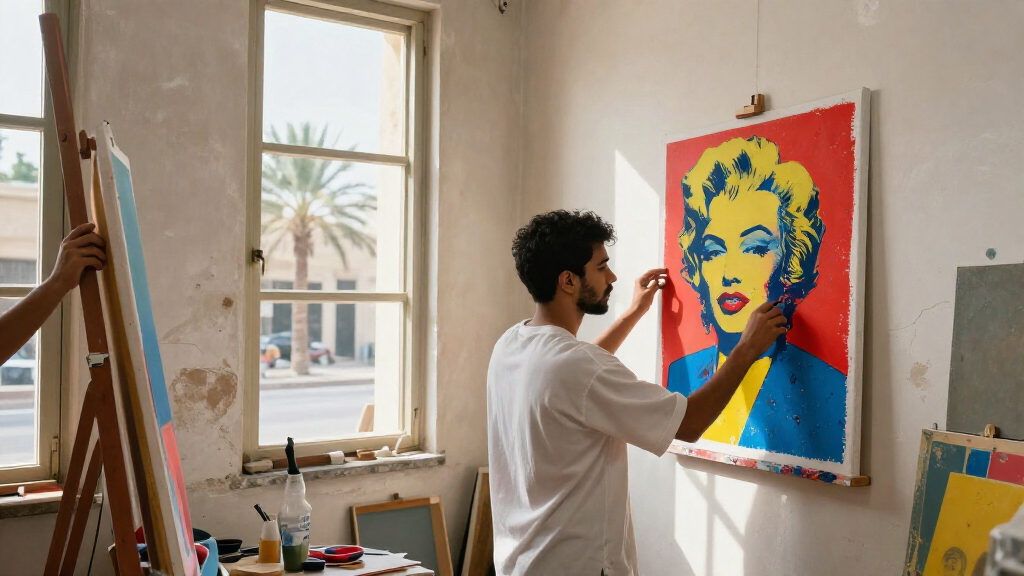
Warhol went to Kuwait in January 1977 after being invited by the country’s national arts council. He spent a week there, attended social gatherings and held a solo exhibition at Salat Al Funoon gallery, which included portraits of Mao Zedong and Marilyn Monroe and flower prints, according to the source report. Yassin’s works take that visit as their historical starting point while filling in scenes that the account does not document.
Reframing Warhol’s Gulf Visit
The exhibition places a little-discussed episode in Warhol’s career alongside contemporary art at a major international event. It also shifts attention from the artist alone to the setting that received him: a Kuwait experiencing an oil-fueled influx of money and growing connections with Western cultural exports, as described in the source report.
Yassin’s work matters as an interpretation of what is missing from the available record. Rather than claiming to recover private conversations or social life as fact, the series uses fiction to explore how the period might be imagined. That distinction lets viewers consider both Warhol’s international career and the limits of accounts that focus mainly on his visit and its market opportunities.
Popular right now

Breville Barista Express Espresso Machine with Built-In Grinder, Black Sesame

KitchenAid Artisan Mini 3.5-Qt Tilt-Head Stand Mixer, Candy Apple Red

Vitamix Touch & Go Advance 32-Ounce Bar Blender, White
As an affiliate, we earn on qualifying purchases.
The 1977 Kuwait Visit
Warhol’s Kuwait trip came as he faced pressure to find new buyers. The source report says his domestic star was fading and some patrons were reluctant to meet his high asking prices. Kuwait, newly enriched by oil and linked to Western cultural exports, offered a potential audience for his work. He skipped U.S. President Jimmy Carter’s inauguration to make the week-long trip.
Yassin, a contemporary artist, uses that established itinerary as a point of departure rather than a complete account of the visit. The report describes the region’s cultural history in the 1970s as poorly documented in wider public discussion. Yassin said he was interested in what was happening in society beyond the familiar emphasis on oil and industry; the scenes in his series are his own imagined response to that gap.
“This is my imagination of it, which creates a different world entirely.”
— Raed Yassin, speaking to Hyperallergic
Where the Record Ends
The source account establishes the trip, the invitation, the gallery exhibition and some of Warhol’s social activities, but it does not verify the specific encounters shown in Yassin’s pictures. The scenes in the series should not be read as eyewitness documentation. The material provided also does not give further details about the Venice presentation, such as the works’ exact placement within the exhibition or any accompanying historical records.
The Biennale Presentation
Warhol of Arabia is part of In Minor Keys at the 61st Venice Biennale. The immediate next step for audiences is to view the series in that exhibition and consider how its fictional scenes relate to the documented 1977 visit. The source material does not specify the exhibition’s closing date or announce further presentations of the works.
Key Questions
What is Warhol of Arabia?
Warhol of Arabia is Raed Yassin’s series of photographic mixed-media works, made from 2016 to 2018, that imagines scenes around Andy Warhol’s 1977 trip to Kuwait.
Where is the series being shown?
The series is included in In Minor Keys, the main exhibition of the 61st Venice Biennale.
Did Warhol really visit Kuwait?
Yes. The source report says Warhol visited Kuwait for a week in January 1977, at the invitation of the country’s national arts council, and held a solo exhibition at Salat Al Funoon gallery.
Are the scenes in Yassin’s works historical records?
No. The documented visit is the series’ anchor, but Yassin’s scenes are artistic inventions. The source does not establish that the pictured gatherings or interactions happened as shown.
What did Warhol show in Kuwait?
His solo exhibition at Salat Al Funoon included portraits of Mao Zedong and Marilyn Monroe, as well as flower prints, according to the source report.
Source: hyperallergic.com